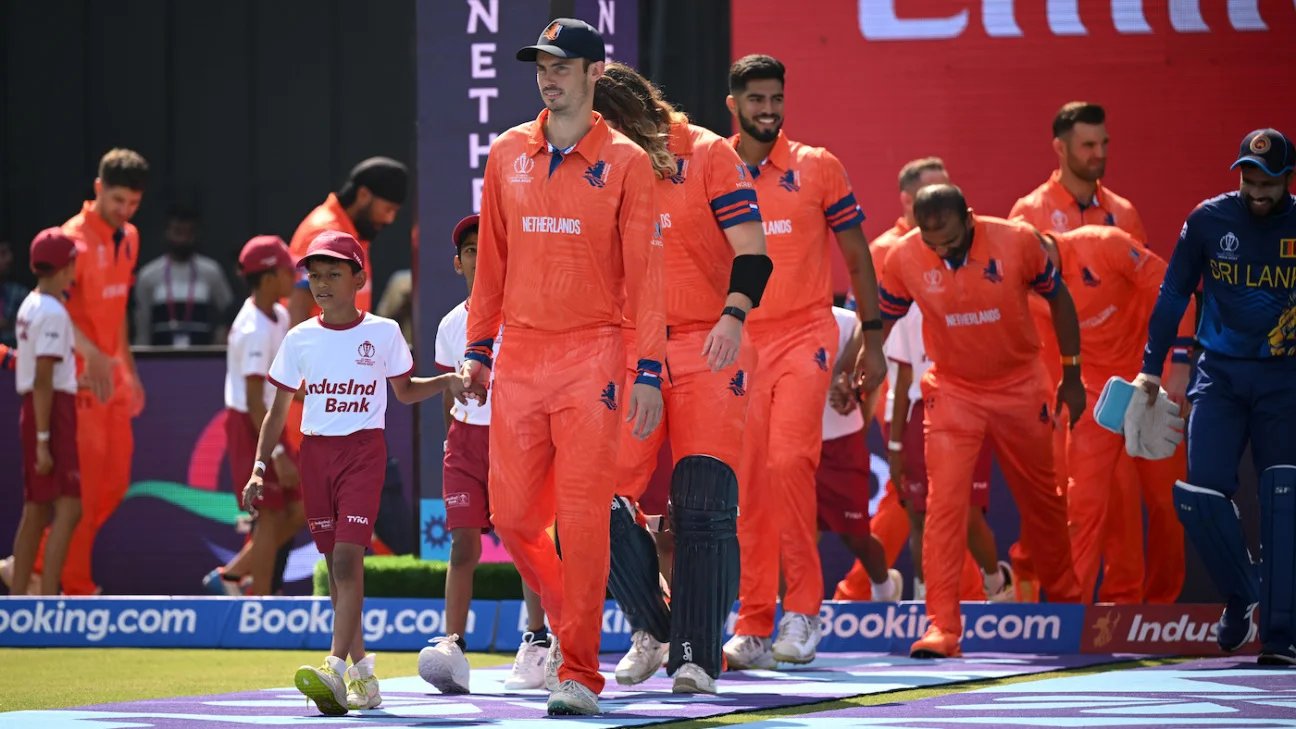
The ICC’s decision to revamp the format of next year’s 50-over World Cup has been met with anger and confusion by players from Associate nations. The captains of Namibia, Netherlands and Scotland have all publicly criticised the changes, which will see two teams eliminated from the World Cup after just two preliminary matches each.
Next year’s World Cup in South Africa, Zimbabwe and Namibia will still technically be played among 14 teams, an increase from the 2019 and 2023 editions. But two of those teams will be knocked out after playing just two matches each, following the introduction of a three-team, round-robin ‘Super Series’ to launch the tournament between the lowest-ranked qualifiers.
The move has incensed players from leading Associate nations, who are most likely to be affected by the changes. It has also left them questioning the relevance of the ongoing Cricket World Cup League 2, in which eight Associate teams play 36 matches each merely to secure a spot at next year’s global qualifier.
“Qualifying for an ODI World Cup is a huge achievement for any country, so when the reality of that opportunity changes after years of planning, it’s incredibly disappointing,” Netherlands captain Scott Edwards said, in a statement released by the World Cricketers’ Association (WCA), cricket’s global players’ union.
Netherlands qualified for the ten-team 2023 World Cup ahead of Test nations Ireland, Zimbabwe and West Indies, and pulled off two major upsets in beating South Africa and Bangladesh. Their success has not earned them any further opportunities: they have not played an ODI against ICC full-member opposition since.
“The ICC talks a lot about growing the game globally but decisions like this make it harder for Associate nations to play against the best teams in the world,” Edwards added.
“Those opportunities are what helps countries improve and inspires the next generation of players. If we’re serious about making cricket a global sport, we should be creating more opportunities on the global stage, not less.”
Namibia captain Gerhard Erasmus said: “For players in many countries, an ODI World Cup isn’t just another tournament. It’s our long form and something careers are built around and generations of players aspire to.
“We all accept that you have to earn the right to be there, but we also want qualification to provide a real opportunity to compete on the biggest stage. This follows a long history of limited opportunity at Associate level.”
The WCA itself criticised the ICC’s decision-making process, citing a lack of transparency, communication and consultation. Its chief executive Tom Moffat said it was “difficult to reconcile” the ICC’s decision to fundamentally alter the tournament’s format with the governing body’s “stated ambition of growing cricket globally”.
When the ICC announced the increase to a 14-team World Cup five years ago, the proposed format involved two groups of seven teams followed by a ‘Super Six’ second group stage. Teams have planned accordingly throughout this cycle, only to learn 15 months before the tournament that the format will be significantly altered.
“The ICC is entitled to determine the structure of its global events,” Moffat said. “However, when commitments are made to the game, qualification pathways are established, and countries and players invest years pursuing those opportunities, significant changes deserve genuine consultation, transparency and a clear explanation.”
Scotland captain Richie Berrington added: “Players don’t expect to make every decision, but we should be meaningfully consulted on decisions that have significant impacts on the game and on players’ careers. Better decisions are made when different perspectives are brought to the table, and we’re urging the game to start doing that properly.”
Other Associate players to criticise the new format include Scotland’s George Munsey, who told Cricinfo that it was “absolutely no surprise that the ICC hasn’t looked after anyone outside the top three [Australia, England and India]” in a wider interview. Netherlands players Max O’Dowd and Logan van Beek have also spoken out on social media.
Paul Stirling, the ODI captain of 12th-ranked Ireland, said that the success of the ongoing 48-team FIFA World Cup showed the “value and interest” that less established sporting nations can bring to world events. “It would be great to see cricket take a similar approach to maximise opportunities for the game,” he said.
The ICC said in a press release on Wednesday that the “evolved” format would produce “a more compelling tournament” and “enhance the overall experience for fans while continuing to provide emerging teams with the opportunity to compete on cricket’s biggest stage”.
Cricket’s governing body has long argued that T20 – rather than 50-over cricket – is the sport’s growth format, hence the recent expansion to a 20-team men’s T20 World Cup.
Source link


 dailynewsnblog