dailynewsnblog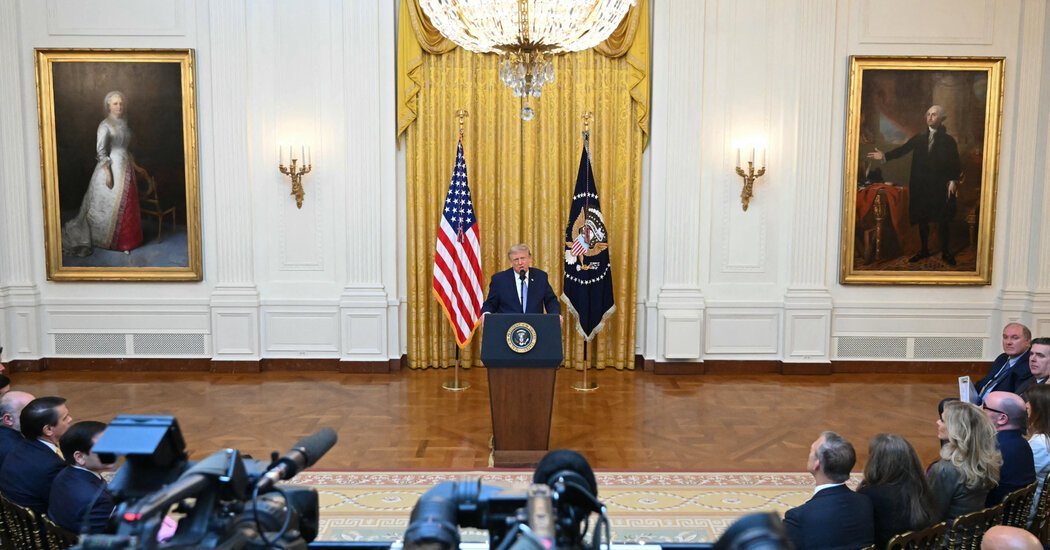
President Trump said his address on Thursday night was about building public confidence in American elections, but he spent much of his speech undermining them.
A broken election system is one of Mr. Trump’s most common refrains, dating to early 2016.
“Great damage has been done to our country,” the president said. “Our elections were left vulnerable to being rigged and stolen, and the trust of the American people was lost. This cannot be allowed to continue.”
But documents Mr. Trump released to support his claims — and previous assessments from the intelligence community — do not back up his most aggressive statements about election security. In fact, some of the documents reach the opposite conclusion.
They also do not contain significant new revelations about vulnerabilities in election systems. One of the documents posted on the White House website was blunt: “We assess that vote tabulation systems would be difficult to manipulate on a wide enough scale to compromise election results.”
Below are takeaways from Mr. Trump’s prime-time speech.
Trump called for bolstering protections he has dismantled.
Mr. Trump called for fixing vulnerabilities in electronic voting system so that “we can never watch a stolen election again.”
“If you look at voting today, it’s in such bad shape in so many states,” Mr. Trump said. “And we are committing to fix it, and we are also committing to be working with those states and local jurisdictions to help them fix and patch known technical vulnerabilities before the midterm elections.”
But Mr. Trump has spent the first part of his second term dismantling the election protections built up over previous years. The F.B.I.’s task force on foreign influence was shut down, the Office of the Director of National Intelligence sharply cut back a task force that warned against foreign meddling and the Cybersecurity and Infrastructure Security Agency has been gutted.
And Mr. Trump has appointed an heir to a housing fortune with no relevant experience as the interim director of national intelligence.
Grains of truth were blown out of proportion.
Mr. Trump described a series of allegations about voter interference in the 2020 vote. He said that China had bought, stolen or hacked tens of millions of voter data files across 18 states. And he attacked a “deep state” conspiracy that he said was aimed at suppressing the information.
“Yet those responsible for sounding the alarm instead kept the information secret and hidden,” Mr. Trump said. “They did not disclose to me as president or to anyone else and to the best of our knowledge they did not inform Congress.”
It is true that the documents show an intense debate among intelligence officials about alerting their superiors.
But U.S. intelligence and congressional officials have long known that China obtained voter data — publicly available information often purchased by political campaigns. What’s more, former intelligence officials have said, China gathered the data not to manipulate voting results, but instead to better craft influence campaigns to shape voters’ perceptions.
While the documents outline some nascent interest by Chinese officials in influence operations, they concede Beijing never endorsed any broad-based effort to undercut Mr. Trump.
Mr. Trump also referred to a report about Venezuela showing it could successfully tamper with voting machines.
John Solomon, who is leading Mr. Trump’s task force on declassifying documents on a range of issues, told reporters outside the White House that the intelligence community documents show no evidence that votes in election machines were changed in the past three elections.
What about Russia?
Railing against the F.B.I. and intelligence agencies’ investigations into to Russian meddling in 2016 is one of Mr. Trump’s favorite themes. And in 2020, a majority of intelligence officials assessed that the Russian campaign to denigrate Joseph R. Biden Jr. was the most robust. (At the time, John Ratcliffe, then the director of national intelligence, disagreed with that view and argued that career intelligence officials had downplayed China’s efforts.)
But Mr. Trump barely mentioned Russia in his speech on Thursday, using most of it to lament Chinese efforts to denigrate him.
Mr. Trump’s approach to Russia has long been to treat its president, Vladimir V. Putin, as a peer, and his Justice Department is currently pressing ahead with an investigation into a possible “grand conspiracy” by Democrats to tie the president to Russia.
Mr. Trump appeared to allude to such a conspiracy with a non sequitur about burn bags, which are used to get rid of government documents that no longer need to be saved, and former President Barack Obama.
He repeated a demand for voting restrictions before the midterms.
For weeks, Mr. Trump has been pressuring Congress to pass a broad election bill to curb mail-in voting, provide documentary proof of citizenship and show photo identification to vote.
Mr. Trump ended his speech with a call to Congress to pass it, despite Republican resistance.
“Addressing this crisis of election security demands that Congress must pass the SAVE America act,” Mr. Trump said. “The only reason you would not do it is you want to cheat. Because your policies are so bad. And your candidates are so pathetic.”
But the problems Mr. Trump focused on his speech — allegations that foreign governments are mounting influence campaigns or could potentially hack local election authorities — have almost nothing to do with the measures that are part of the bill.
And the lack of focus on anything else forward-looking underscores how little Mr. Trump’s interest in elections is about the ones still to come, compared to the ones he has already faced.