dailynewsnblog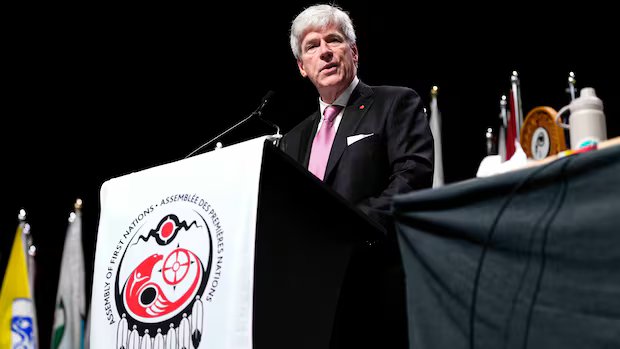

Listen to this article
Estimated 5 minutes
The audio version of this article is generated by AI-based technology. Mispronunciations can occur. We are working with our partners to continually review and improve the results.
Federal cabinet ministers faced pointed concerns from frustrated chiefs Thursday at an Assembly of First Nations (AFN) meeting in Ottawa, as the Liberal government tried to, once again, ease tensions over its efforts to streamline major project development.
“I come here with a simple message,” Energy and Natural Resources Minister Tim Hodgson told delegates at the AFN’s annual general assembly at the Rogers Convention Centre.
“There is no good way to build major projects without First Nations partnership and leadership. Full stop.”
That point is becoming a bit of a refrain for the Liberal cabinet.
The chiefs outlined their position on Wednesday by unanimously resolving to oppose the Carney government’s proposed legislative reforms to get projects like pipelines approved within a year, if those reforms weaken environmental protections or sidestep Indigenous rights.
Chief Kelsey Jacko of Cold Lake First Nations in Alberta was the first person at the microphone after Hodgson spoke.

“Reconciliation is not a buzzword to be used while fast-tracking pipelines behind our backs,” Jacko said.
“If you want to build through our territory, you face us directly as a sovereign government, not through organizations, not through toothless regulatory rubber stamps.”
Shana Thomas, hereditary chief of Lyackson First Nation, part of the Cowichan Nation in B.C., told the ministers First Nations “cannot be expected to continually, quietly absorb colonial violence … while we act as though it’s all for the good of the economy.”
“It is 2026 and the days of the Crown running roughshod over our rights and title are over,” Thomas said.

Dominic LeBlanc, the minister responsible for one Canadian economy, told the Assembly of First Nations general meeting on Thursday that the prime minister’s approach to major projects will be in ‘full partnership’ with Indigenous leaders, ‘from the beginning of conversations.’ Canada will ‘uphold and respect your rights,’ he said.
Prime Minister Mark Carney has worked to allay these concerns, starting last year when he called a series of summer summits with Indigenous leaders to discuss the Building Canada Act. Then in December, after signing a pipeline agreement with Alberta, Carney promised to hold a first ministers’ meeting with First Nations leaders where the latter would set the agenda.
Hodgson suggested the government has heard the concerns and acted since that first summit. He pointed out the Alberta pipeline plan would follow a southern route and maintain the ban on oil tankers on B.C.’s north coast, as local First Nations demanded.
“First Nations voices have been key to many of the decisions we’ve made over the last year and a half,” Hodgson said.
Dominic LeBlanc, minister for internal trade and one Canadian economy, similarly told the assembly that any accord between provinces and Ottawa to streamline does not “diminish the responsibility of the Government of Canada to uphold the constitutional rights of Indigenous Peoples.”
Debates on child welfare, separatism
The concerns continued to arise, however, as another ministers’ panel arrived to discuss reconciliation more generally.
Indigenous Services Minister Mandy Gull-Masty told the group, “first and foremost, that children and families are at the forefront of my decision making,” but faced instant pushback on that very issue.
Chief Pauline Frost of Vuntut Gwitchin First Nation in Yukon accused the government of trying to divide First Nations leaders on the issue of long-term reform of child and family services. The issue lingers unresolved after chiefs rejected a $47.8-billion agreement in 2024.
Chiefs heard Wednesday that Canada is now shopping around its own reform plan region by region while ignoring the plan First Nations came up with.
“We’re looking to Canada to honour that, and not to go across the country to try to divide us nation by nation, building a plan that we didn’t agree to,” Frost said.
Gull-Masty replied by citing the Ontario chiefs’ decision to break ranks with the broader assembly and sign an $8.5-billion regional child welfare reform agreement.
“This, to me, is an indication that more needs to be done in that space,” Gull-Masty said.
The assembly turned to several other pressing issues Thursday afternoon, beginning by urging federal and provincial governments to support Namaygoosisagagun First Nation in northern Ontario, where most of the community was destroyed by a wildfire.
Later, former AFN national chief Matthew Coon Come addressed the delegates as they unanimously carried an emergency resolution rejecting separatism in Alberta and Quebec.
“Any attempt to alter our status as nations or to undermine our inherent rights without our free, prior and informed consent will be firmly opposed,” warned Coon Come, who led the Grand Council of the Crees during Quebec’s 1995 separation referendum.
“The Quebec chiefs support Treaty 6, 7 and 8 as they continue to assert and defend their inherent right to self-determination and to uphold their treaties.”
The meeting concluded Thursday afternoon with the chiefs passing resolutions on housing, infrastructure, child and family services, and more.