‘A moving target’: Two Canadian ships anxious to leave Gulf after almost five months


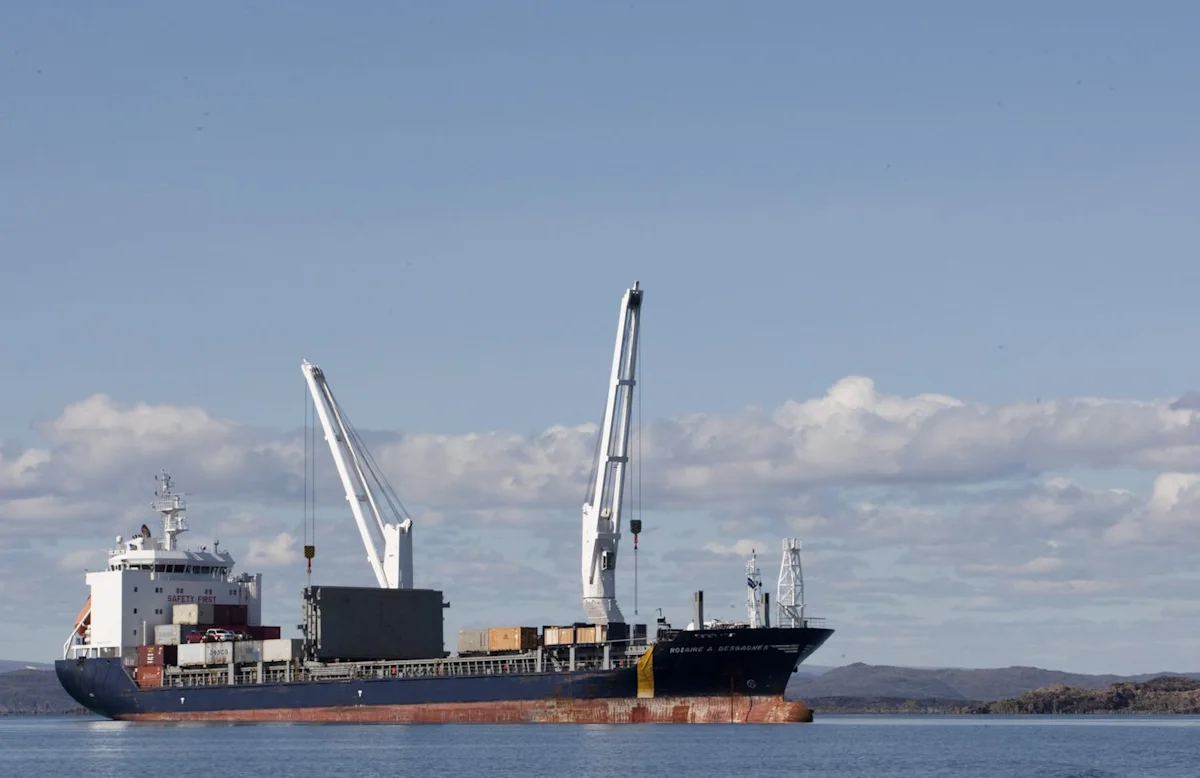
The cargo ship Rosaire A. Desgagnés unloads freight to be hauled into Iqualuit, Nunavut, on Aug. 18, 2009. Adrian Wyld/TCPI/The Canadian Press – The Canadian Press

MONTREAL — A Canadian shipping firm has repeatedly had to postpone plans to exit the Strait of Hormuz after nearly five months trapped in the Persian Gulf amid the Middle East war.

Quebec-based Desgagnés’s two freighter ships are the only known Canadian commercial vessels that were stuck in the Gulf when the U.S. and Israel launched attacks on Iran in late February.

Desgagnés vice-president Pascal Larose says U.S. Navy officials in Bahrain have provided him with a route to steer clear of mines and pledged a measure of protection come departure day, but the “danger zone” will take 12 hours to sail through. And the timing is now anyone’s guess.

“It’s a moving target,” Larose said in a phone interview, stating that the exit hinges on American military authorities. “We’re going through their recommendation.”

Early last week, the company had aimed to have at least one of its freighters leave the region within seven days. That never came to pass. Even as the Middle East conflict ramped up, Desgagnés held out hope for an imminent voyage. None has been scheduled so far.

“It’s kind of changing every day,” Larose said.

A fresh round of fighting between America and Iran has put any plans for departure on hold.

Over the past week, U.S. forces said they hit more than 300 targets in Iran, including military speedboats near the Strait. In response, Iran’s military said early Monday it launched another barrage of strikes aimed at U.S. military facilities in Bahrain and Kuwait as well as sites in Oman and Jordan.

On Monday, U.S. President Donald Trump announced he was reimposing a naval blockade of Iranian ports and demanding a 20 per cent tariff for all cargo shipped through the critical waterway, which typically carries a fifth of the world’s oil and liquefied natural gas.

The would-be toll echoed previous threats that have failed to materialize and contradicted the administration’s earlier line that no state should charge fees for passage through open seas, a pillar of international maritime law.

Tankers and cargo vessels are seen in the Gulf of Oman, along shipping routes linking the Strait of Hormuz and the Arabian Sea, Tuesday, June 16, 2026. (AP Photo)

For Desgagnés, prolonged shutdown of the passage has been “very costly,” Larose said.

The company had to lease a pair of freighters to replace the sidelined vessels and plug the hole in its 24-boat fleet. “When you charter a ship like that, your margin is very minimal, if not negative.”

The two stranded ships — the Miena Desgagnés and the Rosaire A. Desgagnés — had been transporting general cargo to ports in Iraq, Saudi Arabia and the United Arab Emirates when they passed through the Strait in the week leading up to the outbreak of war in late February, Larose said.

From March through May, they sat “frozen,” bobbing side by side in the Persian Gulf northeast of the Saudi Arabian port city of Jubail.

Larose described the ordeal as “stressful” for the 34 crew members — 17 per ship, plus three trainees from Quebec’s maritime institute who were pulled out in March. None of the remaining sailors were Canadian.

“We didn’t experience any immediate threat. There was no drone attack or missiles or towards us,” he said. “We were really careful in choosing where to anchor.”

In May, the mariners briefly docked at Dubai to take on more food, water and fuel, leaving them self-sufficient for two more months.

They had expected from the outset to be on board until mid-June. Nonetheless, by early last month “they were tired,” Larose said.

Most of the original crew members went home to the Philippines and Ukraine several weeks ago, with fresh crews now anxious to leave the area.

In June, after idling for more than three months, the freighters found work within the Gulf hauling a metallic powder used in steel production.

When they finally depart the region, they may not return.

“There’s a good chance we’ll say no. We’ll go elsewhere,” Larose said.

“The hurt is big enough.”

This report by The Canadian Press was first published July 14, 2026.

Christopher Reynolds, The Canadian Press


Source link

  • Related Posts

    Spanish Mountain Gold Expands Orca Fault Mineralization Intersecting 80.15 Metres of 0.83 g/t Gold Including 27.2 Metres of 1.92 g/t Gold as Part of Its Feasibility Study Drill Program

    Article content The Company is seeking new ways to achieve optimal financial outcomes that are safer, minimize environmental impact and create meaningful sustainability for communities, which the Company terms “The…

    Occupational Licensing Around the World

    Hartley and Kleiner have a new Fed Minneapolis working paper surveying workers around the world to measure occupational licensing by country. In the United States, occupational licensing has increased substantially…

    Leave a Reply

    Your email address will not be published. Required fields are marked *

    You Missed

    Yemen’s Houthis launch missiles at Saudi Arabia after strikes on Sanaa airport

    Yemen’s Houthis launch missiles at Saudi Arabia after strikes on Sanaa airport

    He saw a pit on Google Maps. It turned out to be a 390-million-year-old meteor crater

    He saw a pit on Google Maps. It turned out to be a 390-million-year-old meteor crater

    Best RGB TVs (2026): My Picks After Testing the Hottest TVs

    Best RGB TVs (2026): My Picks After Testing the Hottest TVs

    How To Prestige in Phasmophobia: Levels, Reset, and Rewards Explained

    How To Prestige in Phasmophobia: Levels, Reset, and Rewards Explained

    Spanish Mountain Gold Expands Orca Fault Mineralization Intersecting 80.15 Metres of 0.83 g/t Gold Including 27.2 Metres of 1.92 g/t Gold as Part of Its Feasibility Study Drill Program

    Bank of Canada expected to hold key interest rate steady

    Bank of Canada expected to hold key interest rate steady