dailynewsnblog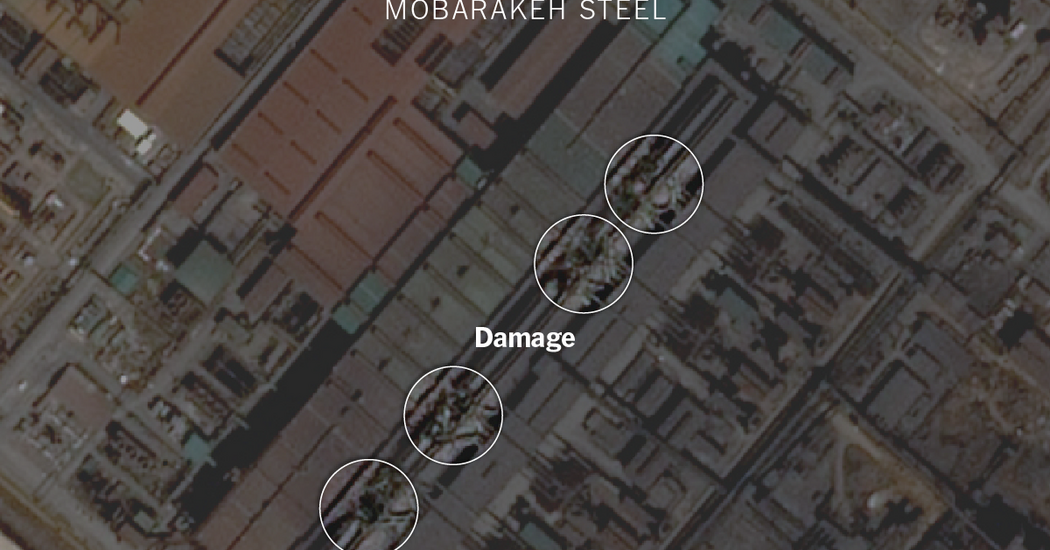
Over the course of the Iran war, U.S. and Israeli warplanes hit missile depots and launchers, security forces’ headquarters and air defense systems.
Yet not all of the targets during the six-week campaign were traditional military sites. On March 27, and again a few days later, Israeli airstrikes pounded a vast steel complex just outside Isfahan called Mobarakeh Steel, and another one in the southwest of the country.
Prime Minister Benjamin Netanyahu of Israel asserted that his country’s strikes had slashed Iran’s steel production capacity and eliminated revenue for the powerful Revolutionary Guards, whose repression underpins the Iranian government.
Companies like Mobarakeh illustrate the complexities inherent to Iran’s economy. While Iran’s clerical leadership and security forces are deeply enmeshed in the country’s most profitable and important businesses, those same companies are vital to the livelihoods of millions of ordinary Iranians, regardless of whether they have deep ideological allegiance to the government.
The attacks shut down major parts of the Isfahan plant for weeks, idling over 20,000 workers and choking off the supply of steel to domestic manufacturers. “I felt like my own home had been destroyed,” said Mostafa, a former employee, who asked to speak on condition of anonymity to avoid retribution by the government.
The United States and Iran have lurched between peace talks and exchanges of fire in recent weeks. Their negotiations were expected to cover the economic benefits Iran might receive in return for long-term limits on its nuclear program.
The interim cease-fire agreement, signed last month, could result in as much as $300 billion for Iran’s reconstruction and economic development. But that now seems a distant prospect, after President Trump said this week that he believed the temporary truce was “over.”
If any investment does flow to Iran, companies like Mobarakeh will undoubtedly come into focus because of their importance to Iran’s economy, as well as their affiliation with Iran’s most powerful security forces.
Mr. Trump has frequently threatened to attack Iranian infrastructure, and if war restarts, there will be scrutiny over any such strikes.
On Thursday, Iran’s Islamic Revolutionary Guards Corps accused the United States of striking a railway bridge that connected the country with Turkmenistan. A spokesman for U.S. Central Command confirmed that the United States struck the railway bridge, describing it as military logistics infrastructure that enabled a flow of weapons and other military supplies to key areas.
Mobarakeh has provided revenue to an investment fund belonging to a state-run militia, the Basij, which answers to the Guards, according to the U.S. Treasury. A 2021 report by Iran’s Parliament identified the investment fund as a major shareholder of Mobarakeh.
Recent financial statements from Mobarakeh show that its shareholders include an investment fund ultimately controlled by Iran’s supreme leader. Although the statements do not show a link to the Guards, they often obscure their ownership through proxy investors.
In justifying the strikes on steel facilities, Mr. Netanyahu said they would deprive the regime “of both financial resources and the ability to produce many weapons.”
Mobarakeh executives did not respond to a request for comment, and it is unclear if the steel produced at Mobarakeh was used in making Iran’s weapon systems.
“Mobarakeh Steel products might not be directly used in missile production, but the company is most probably engaged in research and development of modern high-strength steel alloys for future large-scale production,” said Farzin Nadimi, a senior fellow with the Washington Institute and an expert on Iranian military affairs. He added, “Mobarakeh Steel products, though, are more likely used in producing missile transporter-launcher vehicles.”
International law prohibits strikes on industrial sites that serve civilians, unless the facility makes an effective contribution to military action and striking it confers a definite military advantage, international law experts said.
The dominant international view rejects the idea that generating revenue for military operations is enough to qualify a civilian site as a military target, said Susana SáCouto, director of the War Crimes Research Office at American University’s Washington College of Law.
Miad Maleki, a former U.S. Treasury official, said that while he believed the complex was a legitimate target for sanctions, he doubted that it should have been hit in military strikes. “These are the Iranian people’s assets, and it’s going to hurt the economy even way beyond the Islamic republic,” he said.
“It does employ many people and pay salaries for many people,” Mr. Maleki added. “But at the same time, it’s really just a major source of revenue for a lot of corrupt actors.”
Opaque ownership
Built by an Italian business group, Mobarakeh became operational in 1992 and was a symbol of Iran’s industrial development and rebuilding after the Iran-Iraq War of the 1980s.
People with ties to the Revolutionary Guards moved into leadership positions at the plant starting in the late 1990s, two former employees said, declining to be named to avoid repercussions from Iran’s government. For instance, Mehdi Taj, a former senior Guards commander, served on the complex’s board of directors and held an executive position there in the early 2000s.
Mr. Taj is now the director of Iran’s soccer federation, which did not respond to a request for comment.
And a privatization drive carried out in the mid-2000s transferred portions of state-owned companies, like Mobarakeh, to powerful and opaque players such as the Guards and conglomerates that answer to Iran’s clerical leadership.
In 2008, a consortium led by Mehr Eghtesad Iranian Investment Company, an outfit belonging to the Basij, purchased 45 percent of Mobarakeh’s shares. As of 2021, Mehr Eghtesad was one of Mobarakeh’s largest shareholders, with a nearly 14 percent stake, according to a parliamentary report written that year.
The Basij is one of the primary forces that the regime deploys to suppress protests, including the recent nationwide demonstrations in December and January. Those protests arose over discontent with Iran’s currency crisis and perceived economic mismanagement by the government.
Mehr Eghtesad’s owner, a bank, in 2020 merged with another Iranian bank, Bank Sepah, which did not respond to a request for comment.
Mobarakeh earned roughly $1.6 billion in net profit in 2024-2025. The U.S. Treasury said in 2018 that the company “has provided millions of dollars” annually to Mehr Eghtesad.
“Some part of the economy is run through the government, but some larger part of the economy is run through the shadow government or Revolutionary Guards,” said Mahdi Ghodsi, an economist at the Vienna Institute for International Economic Studies.
One relatively new shareholder of Mobarakeh, according to documents filed with the Tehran Stock Exchange, is a company belonging to Astan-e Quds-e Razavi, an Iranian foundation that the United States put sanctions on in 2021 for being controlled by Iran’s former supreme leader, Ayatollah Ali Khamenei. The company owned 1.79 percent of Mobarakeh as of last year.
Other major owners include several state-owned pension funds. Iran’s pension funds have been struggling for years to make payments to retirees, and the destruction of key sectors of the economy is likely to worsen that problem.
Iranian legislators investigated possible corruption by managers at Mobarakeh in 2021 and blamed many of its issues on the flawed process of privatization, saying it was “now governed by completely opaque ownership alongside entirely state-controlled management.”
A ‘beloved’ company
Interviews with some of the people who used to work at Mobarakeh present another image of the company.
For aspiring engineers growing up in Isfahan, working at Mobarakeh was a “dream job,” said Maryam, who now lives outside Iran. She and some other former employees whom The New York Times spoke to requested that they not be fully identified, for fear of repercussions for speaking publicly.
Some said they felt they were at a prestigious, state-of-the-art company that was contributing to the country and cared about their well-being.
“Even before I was born, my father was working in steel,” said Maziyar Shokrani, who, like his father, worked at Mobarakeh.
Mr. Shokrani began working there as a lawyer in the mid-2000s, taking a bus each day to the sprawling plant 40 miles outside Isfahan. “I know my entire life and existence to be from steel,” he said.
Mobarakeh also donated funds to build stadiums and educational institutions and supported poor families in the area surrounding the complex, said Mostafa, the former employee, who now lives outside Iran.
“It was beloved in that region,” Mostafa said. “Any industry that hit a snag, or any group that had a problem, they had some hope that Mobarakeh Steel would arrange for some kind of support.”
The Iranian news outlet Rouydad24 reported in early May that of 27,000 workers, just 2,000 were still working at the plant. Iranian officials have said that Mobarakeh is being rebuilt more quickly than expected, and in early June the company relaunched a furnace that had been damaged in the strikes.
In interviews, former employees had differing views about who was to blame for the strikes on Mobarakeh.
“More of the blame should be cast with the Guards, because it deliberately and consciously took the country’s economy down this path,” said Mr. Shokrani, who now lives outside Iran.
In the minds of Iranians, the United States and Israel were closely linked in their conduct of the war, said Abbas Kamranian-Marnani, a mechanical engineer who worked at Mobarakeh or its contractors for a decade and now lives in Europe. “They worked mostly toward the destruction of infrastructure and the destruction of Iran,” he said.
Mr. Kamranian-Marnani said strikes like the one on the steel plant had caused Iranians to lose hope in the idea of better relations with the United States.
A senior U.S. military official, speaking on condition of anonymity to discuss operational matters, said they did not know of any U.S. role in the steel strikes.
Josh Holder, Sanam Mahoozi and Eric Schmitt contributed reporting.