dailynewsnblog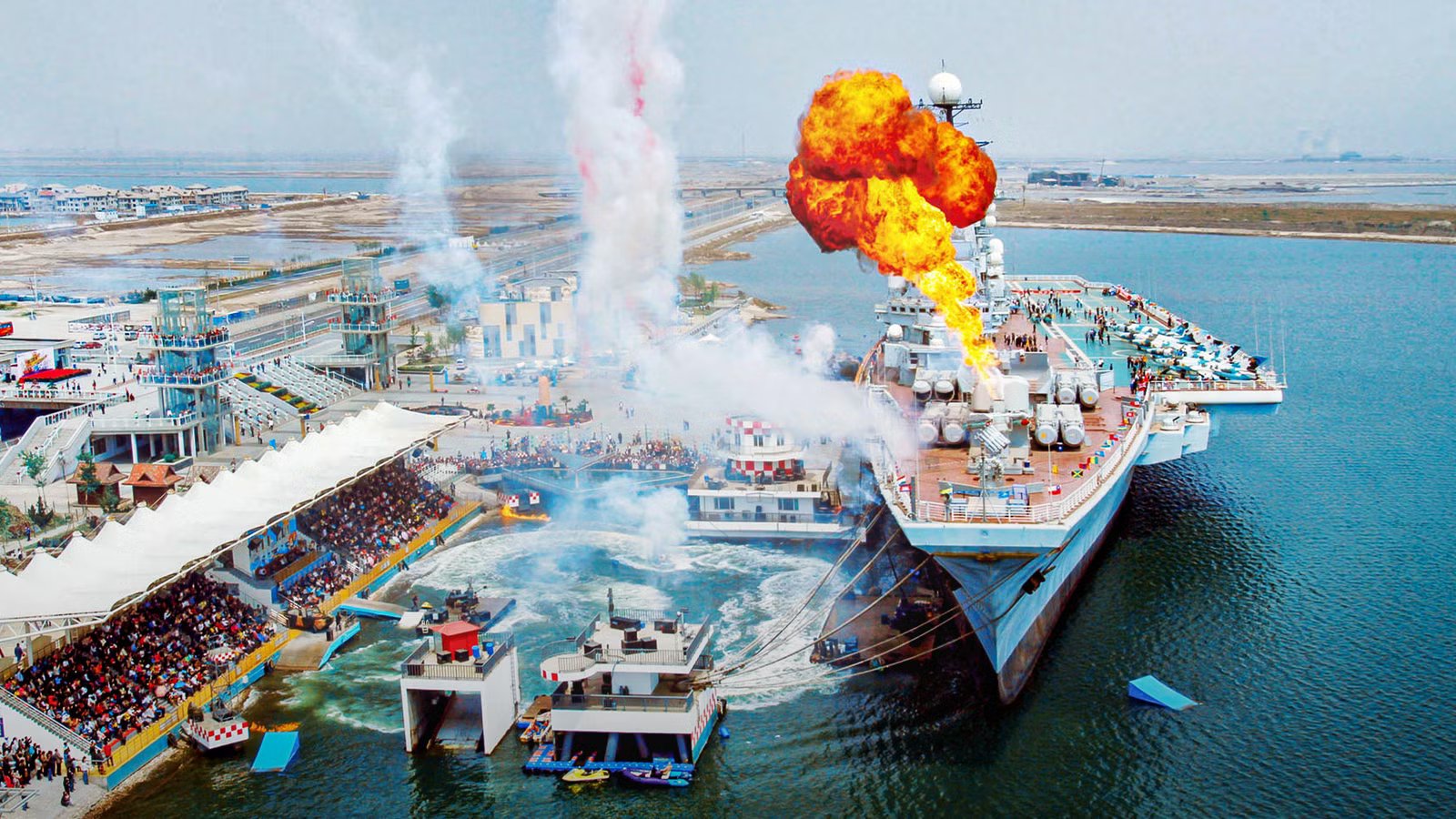
Quietly nestled away in a bay on the outskirts of Beijing is a relic of the furious Cold War arms race now repurposed as a tourist destination. Serving as a kind of seaside resort and naval aviation museum wrapped in the same package, the former Soviet aircraft carrier Kiev offers guest rooms where visitors can stay overnight and even has jet ski shows with a theme akin to the post-apocalyptic ‘Waterworld’ movie.
Some may be surprised to learn the Soviet Union’s former capital ship now serves as a novelty in the People’s Republic of China, yet it is a fitting symbol of the shift in dominant naval power in the 21st century. There are only six aircraft carriers in the world currently preserved as floating museums; the Kiev is the only one located outside the United States.
Originally commissioned in 1975 as the flagship of the Soviet pacific fleet, it was sold to Chinese investors in the mid-1990s, which is how it became a foundational stepping stone to the rapidly expanding Chinese Navy.The People’s Liberation Army Navy is on track to build nuclear-powered supercarriers with magnetic catapults and stealth fighter jets that rival those of the US Navy, but the Kiev is enjoying a quiet post-service career entertaining tourists.
Passing The Torch Of Naval Aviation

When the Kiev was launched from Chernomorsky Shipyard in Ukraine, it stoked fears in the United States that the Soviet Union was building a blue water fleet with advanced naval aviation capability to rival that of the American armada. In true Soviet fashion, it was a heavy aircraft-carrying cruiser bristling with a lethal mix of anti-ship missiles, anti-submarine rockets, and Yakovlev Yak-38 jump jets. This hybrid design was its undoing, as neither the ship nor its aircraft ever achieved combat capability that could rival that of their American adversary.
The successor to the Kiev, Admiral Kuznetsov, and its unfinished sister ship, the Varyag, also failed to live up to expectations. But Kuznetsov has never truly been combat-capable and in 2026 is barely sea-worthy. Meanwhile, the PRC also purchased the Varyag to be a casino but repurposed it after it arrived in China to be its first active aircraft carrier. Today, the domestically constructed Fujian has taken up the mantle of capital ship for the PLAN. Although it is not nuclear-powered like America’s 11 Nimitz and Ford-class supercarriers, it does have a flat deck and magnetic catapult.
It is expected that the next aircraft carrier constructed for the PLAN will be nuclear-powered, giving the Chinese Navy the same blue-water capability as America’s carrier strike groups. The Kiev offers a fun and novel way to experience the birth of naval aviation in China. Although the ship was never a part of the PLAN’s active fleet, it is a rare, albeit somewhat unusual, opportunity for aviation enthusiasts.
In fact, the Kiev is even more unique since its sister ship, the Minsk, which was also a theme park for several years, has been mothballed due to fire damage and is not open to the public. Only four ships of the Kiev class were ever constructed, with one being broken up in South Korea for scrap metal. Notably, however, the fourth ship, Admiral Gorshkov, was purchased by the Indian Navy and converted into a ski jump carrier that still serves today.
Fun In The Sun: A Resort Dedicated To Air Power From The Sea

The angled deck of the Kiev, once coated in specialized heat-resistant tiles to withstand the scorching exhausts of vertical-takeoff jets, is now a viewing platform. Tourists can lean over the railings holding cotton candy and cameras, looking down into the water where the stunt show takes place. According to Baidu Wiki, the park is famous for its Hollywood-style stunt shows featuring dirt bikes, jet skis, acrobats, explosions, pyrotechnics, and more, depending on the day.
On the land side of the resort, as well as on the Kiev’s deck and inside its hangar bays, is a showcase of both Russian and Chinese military hardware. Right outside the dock sits a Russian-themed street featuring servers in traditional dress, restaurants serving Russian food, and gift shops packed with souvenirs.
According to Vintage Aviation News, planes on display include a Yak-38 alongside Nanchang Q-5s and other models of Chinese fighter jets like the Shenyang J-6 and Chengdu J-10. The site has expanded into a broader naval museum, now exhibiting the decommissioned Chinese destroyer Chongqing, a Ming-class submarine, and multiple patrol boats.
Part of the carrier’s vast interior was retrofitted into the unique Binhai Aircraft Hotel, featuring luxury suites built right inside the hull. Entering the forward missile magazines is like stepping through a portal to the Soviet Navy. These sections of the ship have been restored and pay faithful homage to the military origin of the Kiev. Even the mess areas, once home to hundreds of sailors, have been rebuilt, and wax mannequins dressed as Soviet troops are scattered throughout to enhance the immersion.
Why The Kiev Wasn’t A Flat Top

One of the reasons that the Soviet Navy built the Kiev as an ‘aircraft cruiser’ when it launched was to avoid limitations instituted by the Montreux Convention. This security agreement limited aircraft carriers from transiting the Turkish Straits at Istanbul that connect the Mediterranean and Black Seas. The Soviet shipyards in Ukraine were located on the Black Sea, and any vessel constructed there would need to pass through Istanbul in order to navigate to the Atlantic Ocean.
The production of Kiev-class aircraft carriers ended in 1987 with the Admiral Gorshkov, now INS Vikramaditya. Designed to challenge NATO submarines and project power, their operational lifetimes were cut short by the 1991 collapse of the Soviet Union. The Kiev was the pioneer of the class. It was the only one of its class to log proper deployment cruises across the Atlantic and Mediterranean, even tailing US carrier strike groups. When the Soviet Union collapsed, Ukraine broke away to regain its independence, and Russia no longer needed prohibitively expensive capital ships.
Now that the Russian Federation no longer had access to the shipyards in Ukraine, maintaining this fleet was far from attractive. Not only was the general chaos of the dissolution of the Soviet defense network a major obstacle to maintaining a massive vessel, but they were rapidly becoming obsolete as well. The Kiev, Minsk, and Novorossiysk were all sold off in short order, but the Admiral Gorshkov remained until the historic deal was made with India. It wasn’t long before trying to set its sights on an even bigger prize: the Varyag.
The Birth Of China’s Carrier Aviation

Now known as the Liaoning, the Varyag was purchased from Ukraine on the condition that it would be converted into a casino for entertainment rather than a warship, unlike the other two Russian carriers. In 1998, Ukraine auctioned off the empty hull for a meager $20 million to a party-connected businessman from Macau. The massive 67,000-ton hull was 68% complete when the USSR collapsed, and Ukraine stopped all work on it.
The Chinese military was keen on acquiring the Varyag in the chaos of the Soviet Union’s dissolution, but faced a new number of seemingly insurmountable obstacles. To bypass arms embargoes and pressure from Western geopolitical juggernauts like the United States, the Chinese military recruited Xu Zengping, a Hong Kong-based businessman and former PLA basketball player. After setting up a company in Macau, the National Interest writes that Xu brought suitcases of US dollar bills and gallons of Chinese liquor to drinking sessions to win over Ukrainian shipyard officials.
The ploy paid off when Xu officially won the auction, buying the massive warship for a meager $20 million. Crucially, while Western intelligence assumed the ship had been stripped of its propulsion, Ukrainian officials left the heavy, militarily sensitive ship engines completely intact inside the hull. Thus, the PLA Navy found the foundational archetype on which to build its blue water fleet of aircraft carriers that now cruise the high seas.
The Long Road To Take Off

Xu officially won the auction for the Varyag, but it wouldn’t be that easy to get it back to China. The colossal aircraft carrier spent 16 months trapped in the Black Sea as diplomatic machinations unfolded to grant passage through the Bosphorus Strait controlled by Turkey. The PRC ultimately had to make concessions that included a $1 billion package, state-sponsored tourism deals, and military technology transfers to the Turkish Army.
In late 2001, the strait was closed to all other maritime traffic as a fleet of tugboats and pilot ships guided the colossal rudderless aircraft carrier through the strait. Because of its crippled condition, the Varyag was also denied passage through the Suez Canal and instead had to make a painful 15,200-nautical-mile journey around Africa, passing the Cape of Good Hope. It would not arrive at the Dalian Naval Shipyard and moor at a dock in Chinese waters until 2002.
The ship was never delivered to Macau and instead spent a decade in the care of the Dalian Shipbuilding Company, which performed a top-to-bottom overhaul of the entire vessel. The Kiev, Minsk, and especially the Varyag granted China the insight it needed to leapfrog from zero carrier experience to the flat-top Type 003 Fujian with its magnetic catapults and arrested landing wires. Today, Dalian Shipyard is building the Type 004.
Naval analysts and satellite imagery strongly indicate that the fourth carrier is nuclear-powered. The ship is projected to be a true 100,000-ton supercarrier, matching the footprint of the American Nimitz and Ford classes. With four active carriers, China will transition from a defensive flotilla to an offensive power-projection armada. Tourists to Binhai who visit the Kiev can enjoy a fun, perhaps quirky, experience that opens a window into the origin of this incredible transformation in Naval power.
Catch what other trackers miss
Emergency squawks, holds, NOTAMs — live signals, no signup.
Open tracker
Catch what other trackers miss
Emergency squawks, holds, NOTAMs — live signals, no signup.
Open tracker