dailynewsnblog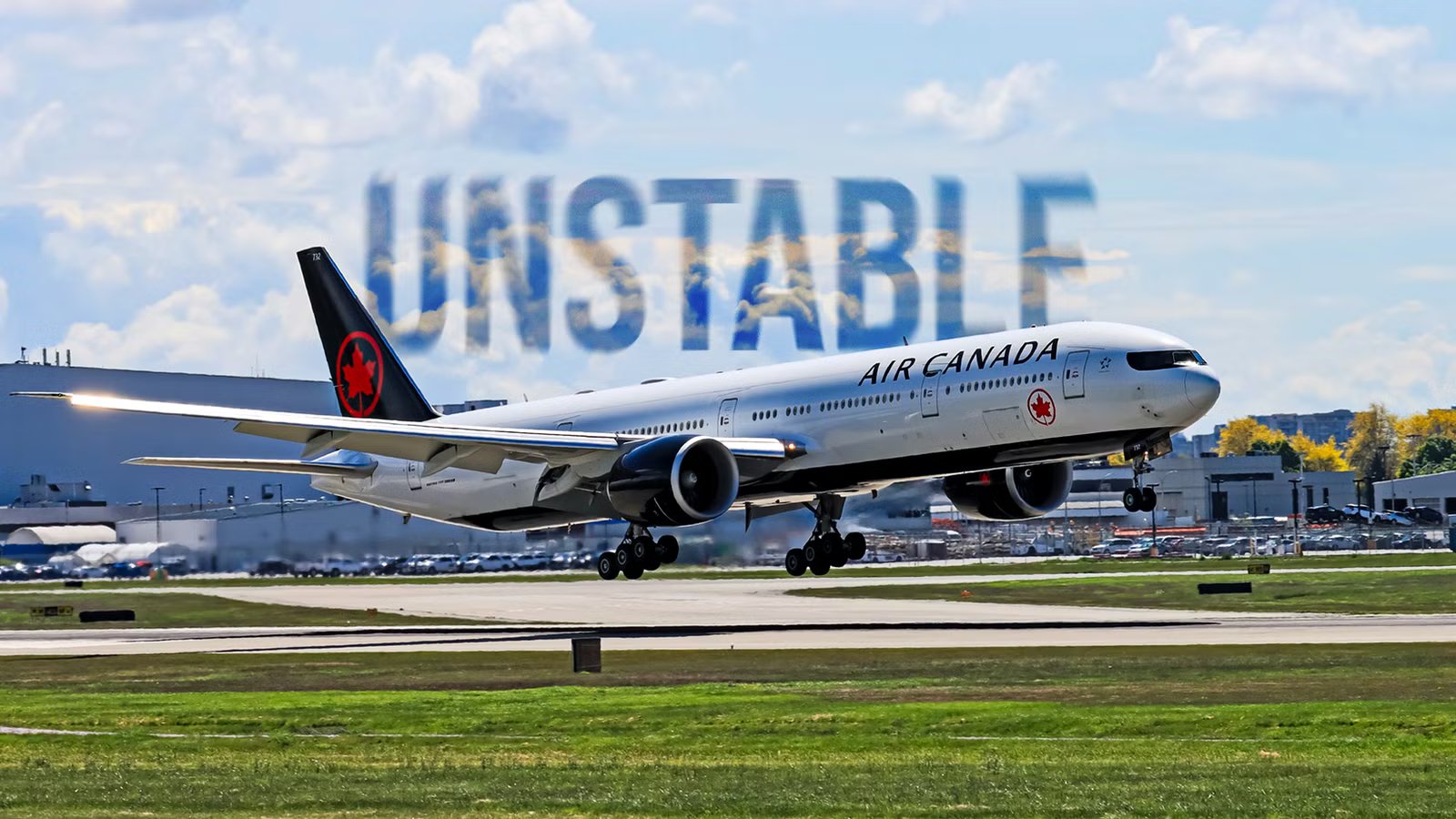
Boeing 777 pilots, like their counterparts on the vast majority of aircraft at most airlines, have set-in-stone parameters they should work within prior to carrying out landings. These ensure what is known as a stable approach and give pilots a clear set of rules to stick to when committing to a landing. If they are not met, the decision should be easy: go around and try again.
But most of the time, flight crews push on with a landing even if the criteria for a stable approach are not met. Thankfully, this does not mean the majority of landings are made in such conditions. However, it leaves a huge disparity between what should be done and what is actually done when it comes to almost all unstable approaches. Why? Well, psychology and the human factor play a huge part in what is really a very short space of time relative to an overall flight.
What Makes An Unstable Approach?

Whether an approach is stable or not is essentially based on the carriers’ own standard operating procedures (SOPs) being met before a minimum height is reached during descent. That is according to the Flight Safety Foundation (FSF), which coined the term “stabilized approach” in its Approach and Landing Accident Reduction (ALAR) toolkit back in 1998. In this, the organization recommended a minimum height of either 1,000 feet (305 meters) or 500 feet (152 meters) above airport elevation in instrument or visual meteorological conditions (IMC or VMC), respectively.
The FSF’s recommendations stretched to specific criteria behind a stable approach. Simply put, these suggested the correct flight path, speed, landing configuration, and rate of descent by 500 feet (152 meters) in good weather, leaving only small control tweaks needed. Some leeway was granted, namely around speed and sink rate. Overall, though, there was a clear-as-day checklist there for airlines and flight crew alike.
FSF stabilized approach criteria in VMC, from Sky Library:
The aircraft is on the correct flight path |
The airspeed is not more than reference landing speed (VREF) plus 20 knots (23 mph / 37 kmh) indicated speed and not less than VREF |
The aircraft is in the correct landing configuration |
Sink rate is no greater than 1,000 feet (305 meters) per minute |
Power setting is appropriate for the aircraft configuration and is not below the minimum power for the approach as defined by the operating manual |
All briefings and checklists have been conducted |
All of this aimed to further ensure safety at what is realistically the most dangerous part of a flight. Indeed, the FSF’s toolkit came after its own research found that unstabilized approaches were a causal factor in 66% of 76 accidents and serious incidents during the final stages of those flights between 1984 and 1997. Through the guidance, the organization sought to aid airlines and pilots in preventing aircraft from arriving at runway thresholds too high, too fast, out of alignment, incorrectly configured, or otherwise unprepared for landing.
Almost All Unstable Approaches Result In Landing Anyway

The issue is that the recommendations appeared not to give the industry the overwhelming push the FSF would have desired. Almost two decades after the organization published the toolkit, it cited evidence that showed almost all unstable approaches were still resulting in aircraft touching down in another report.
Some 95% to 97% of flight crews whose aircraft were in an unstable state continued to touch down, its 2017 report into go-around decision-making stated. This problem of go-around policy non-compliance, the FSF went on to conclude, was “real” and “arguably the largest threat to flight safety” currently. Improving compliance would be “significant,” it added.
Among a string of findings that the report laid out, it noted the industry had “predominantly” turned to reducing unstable approaches, rather than incorporating go-arounds as standard practice, to avoid accidents in the final stages of flights. But clearly, entirely eradicating unstable approaches was always going to be impossible. When it came to why pilots still pressed on despite finding themselves in such situations, the reasons were plentiful.
Boeing 777 And Decision-Making Time

It is easy to pass judgment from the outside. Pilots are tasked with safely delivering passengers, and so what seems an overwhelming disregard of parameters put in place to minimize the risk of incidents raises some pretty serious questions. It is important to consider the realities in cockpits, though, in order to paint a picture of why unstable approaches may be ignored. Among the most blatant factors is timing.
Take the 777 from  Boeing, which is among the bestselling widebody series ever produced. If traveling long-haul frequently, there is a good chance you will have stepped foot aboard a 777 variant at some point. Pilots behind the controls of a 777 have well under a minute of decision-making time after reaching the vital 500 feet (305 meter) threshold at which an approach should be stable. At an appropriate landing speed of 132 knots (152 mph or 244 km/h), a typical 777 will touch down 35 to 42 seconds after hitting this point.
Catch what other flight trackers miss
Emergency squawks, holds, NOTAMs — live signals, no signup.
Open tracker
Catch what other flight trackers miss
Emergency squawks, holds, NOTAMs — live signals, no signup.
Open tracker
Boeing itself recommends approach speeds for different 777 variants of between 139 knots (160 mph or 257 km/h) and 150 knots (172 mph or 278 km/h), so this could vary. Either way, the point stands: A pilot might have little over half a minute, while in the thick of bringing an aircraft down safely, to process whether a go-around is required, make that call, and then carry it out. That is not to try and justify landings made following unstable approaches, but the timing factor does offer some useful context.
Human Factors Play A Large Part In Unstable Landings

It is really in the context of timing that the human factors behind landings made after unstable approaches start to make sense. The FSF said in 2017: non-compliance with go-around policies was the “industry norm”; awareness of risks among pilots and management was “low”; policy itself was viewed as “unrealistic”; and the practice of going around came with its own complexities and caveats. All of this meant pilots could well have had such thoughts racing through their minds when deciding what to do with an unstable approach.
Pilot James Albright provided an insight into the decision-making process in such circumstances previously. “If 95% to 97% of flight crews are failing to go around when their SOPs tell them to, we have a problem with the crews, the SOPs, or both,” he wrote. “Too many of us find ourselves in unstable approaches and believe, ‘I can save this.’ The fact that we almost always do reinforces our decision to deviate from our stable approach rules.”
But there could be other factors at play, Albright noted in the particular account of a landing made despite questions surrounding the stability of the approach. Among them was the fear that other crew members may not be supportive of a decision to go around, passengers might complain, or questions might be asked by employers. Naturally, that lingering thought of what a delay might entail is worth bearing in mind.
Why Not Just Go Around?

Arguably, the key reason most unstable approaches result in landings is down to how go-arounds are viewed. Whether it be fears that the maneuver is riskier than a landing, lack of training, or the belief that go-arounds are only for exceptional cases, potential misconceptions frequently pop up as reasons why they might be avoided.
Guidance from the International Air Transport Association (IATA) stated in 2026: “It is the responsibility of operators to develop and promulgate a clear policy on go-arounds.” Such policy, the trade body said, should state that a go-around was “a normal flight maneuver” and something “to be initiated whenever a continued approach would not be safe” or, notably, “when the approach does not meet the stabilized approach criteria”.
But the body went a step further, noting operators should clarify that there would be “no punitive response from management to a go-around” and any failure to do so “when appropriate” would be followed up. All of that goes to say, questions looked to still be there among pilots over when to go around, and how that decision may be received.
Few Approaches Are Unstable

While perhaps somewhat alarming to those unfamiliar with being behind the controls of an aircraft, the important thing to remember is that most landings do indeed follow stable approaches. As the Flight Safety Foundation reported previously, 95% to 97% of all unstable approaches were continued to landing. However, just 3.5% to 4% of all approaches were unstable. So, before vowing never to set foot on a plane again, rest assured that the majority of landings are carried out following approaches that meet SOPs.
What these figures do mean is that there is room for improvement across the industry. Whatever the psychological factors preventing pilots from going around in most cases, the practice is yet to be normalized. With that, fears around the likes of causing delays, judgment from colleagues, or carrying out a go-around need to be addressed. As the FSF wrote in 2017: “No other single decision can have such an impact in the reduction of aviation accidents as the decision to go around.”