dailynewsnblog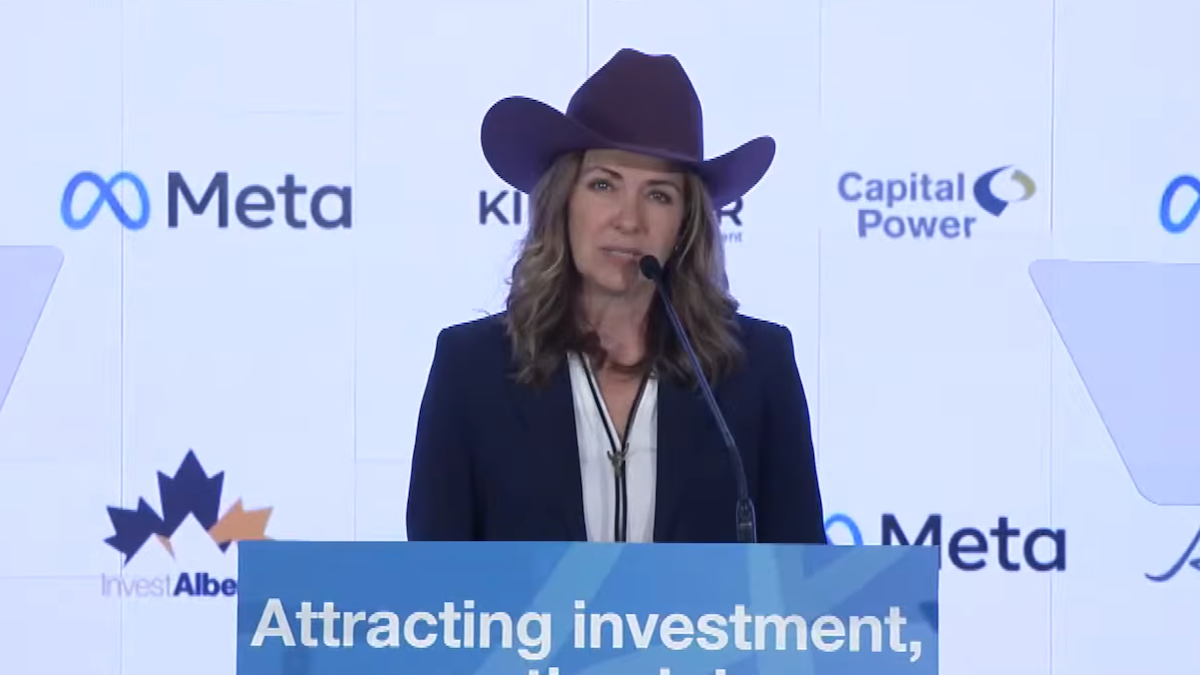
Other than a few jobs and modest annual government revenues, it’s not completely clear what benefits these massive plants will bring to Alberta
With yesterday’s announcement of plans by Meta Platforms Inc. of Menlo Park, Calif., to build a massive Artificial Intelligence data centre northeast of Edmonton it has become clearer than ever that the Alberta Government is determined to welcome an industry that is distrusted and unwanted in many North American jurisdictions.

In that regard, though, the government of Premier Danielle Smith is hardly unique on a continent overwhelmingly governed by sub-national governments espousing enthusiastic commitment to surveillance capitalism.
And to give the government its due, it was evident during yesterday’s news conference in Calgary that the UCP is willingly owning it, come what may. Indeed, the Smith Government has been promoting the province for months as an international hub for AI data centres and dismissing concerns about their enormous draw of energy and other potentially negative environmental and economic impacts.
Yesterday’s announcement of Meta’s claimed $13-billion project, which if completed will be the biggest AI data centre in Canada and one of the largest in the world, was the other shoe dropping after the July 4 announcement that three corporations plan to build a huge natural-gas-powered electricity plant called the Greenlight Electricity Centre in the Sturgeon County “industrial heartland.” Greenlight will provide the power for Meta.
The price tag for the 932-megawatt first phase of the Greenlight project was said to be $4.6 billion, with the possibility to expand it to 1,800 megawatts – enough to power about a million and a half homes – with the additional price tag not mentioned.
So we’re talking about a cost closing in on $20 billion for the first phase alone of the combined projects, and according to its past statements the Alberta government has hopes of seeing 14 AI data centres built throughout the province over the next 20 years.

According to a recent report cited by journalist Andrew Nikiforuk in The Tyee, that level of development would occupy about 5,000 hectares provincewide and consume about 150 million megawatt hours of electricity, emit 68 million tonnes of carbon dioxide, and consume more than seven billion litres of water every year.
Clearly public anxiety about the environmental impact of AI data centres, and particularly their water use, was on the minds of the government and corporate officials at yesterday’s news conference in Calgary.
The newser included a rooting section ready to cheer pronouncements by Premier Smith, Meta Data Centre Strategy Vice-President Gary Demasi, Technology Minister Nate Glubish, Utilities Minister RJ Sigurdson and Sturgeon County Mayor Alanna Hnatiw. And at least the video recorded part of the newser did not include reporters’ questions, presumably for fear they might ask inconvenient ones.
The government news release and virtually every statement by the officials at the newser included the talking point, in Mr. Demasi’s words, that “we plan to use a water efficient, closed loop cooling system which uses dry cooling for the rest of the centre. As a result the cooling system requires no operational water.”
Perhaps there is a hydraulic engineer out there who can explain the difference between “operational water” and plain old H₂O. Rest assured, though, that closed-loop systems still require considerable amounts of water, not to mention “a cocktail of additives such as corrosion inhibitors, biocides, and antifreeze blends to keep water doing its job.” And then there’s the matter of fill-and-flush discharges.

Mr. Demasi noted that “our annual water use is actually less than a typical Alberta golf course.” As Saskatchewan-based researcher Simon Enoch of the Canadian Centre for Policy Alternatives noted at a recent presentation on data centres in Regina, this has always been true if compared by surface area.
At more than 700 hectares, though, the planned Meta data centre is considerably bigger that the typical 18-hole golf course, occupying 50 to 75 hectares. So it would be fair to note that more clarity is needed on exactly what the Meta executive had in mind here.
Mr. Demasi also said that “Meta has a goal to be water positive in 2030. This means we’ll restore more water than we actually consume in our local watersheds.” It might be very interesting to learn how that actually works. One factor, of course, will be that “these systems dump heat into the air using fans and radiators,”* a process that no doubt has impacts of its own.

Ms. Smith also repeated a claim in the government’s news release that thanks to the government’s “bring your own power” policy, “this will benefit electricity customers across the province by reducing transmission costs by up to six per cent on Albertans’ utility bills.” At present, Alberta has the highest consumer electricity costs of any Canadian province.
This also requires further explanation, since the iron law of supply and demand indicates that the price of accessible natural gas will increase as the supply diminishes.
The project will create more than 3,000 construction jobs and, when the dust has settled, only about 300 “operational jobs,” the government news release said, adding that the plant will “generate approximately $250 million annually in benefits for Albertans, including through royalties, taxes, levies and fees.”
It would be interesting to know how much Meta expects to take out of the province in return for its investment and its modest contribution in jobs and government revenue.
*Answer supplied by Google AI, which was otherwise not very illuminating. Mea culpa.