dailynewsnblog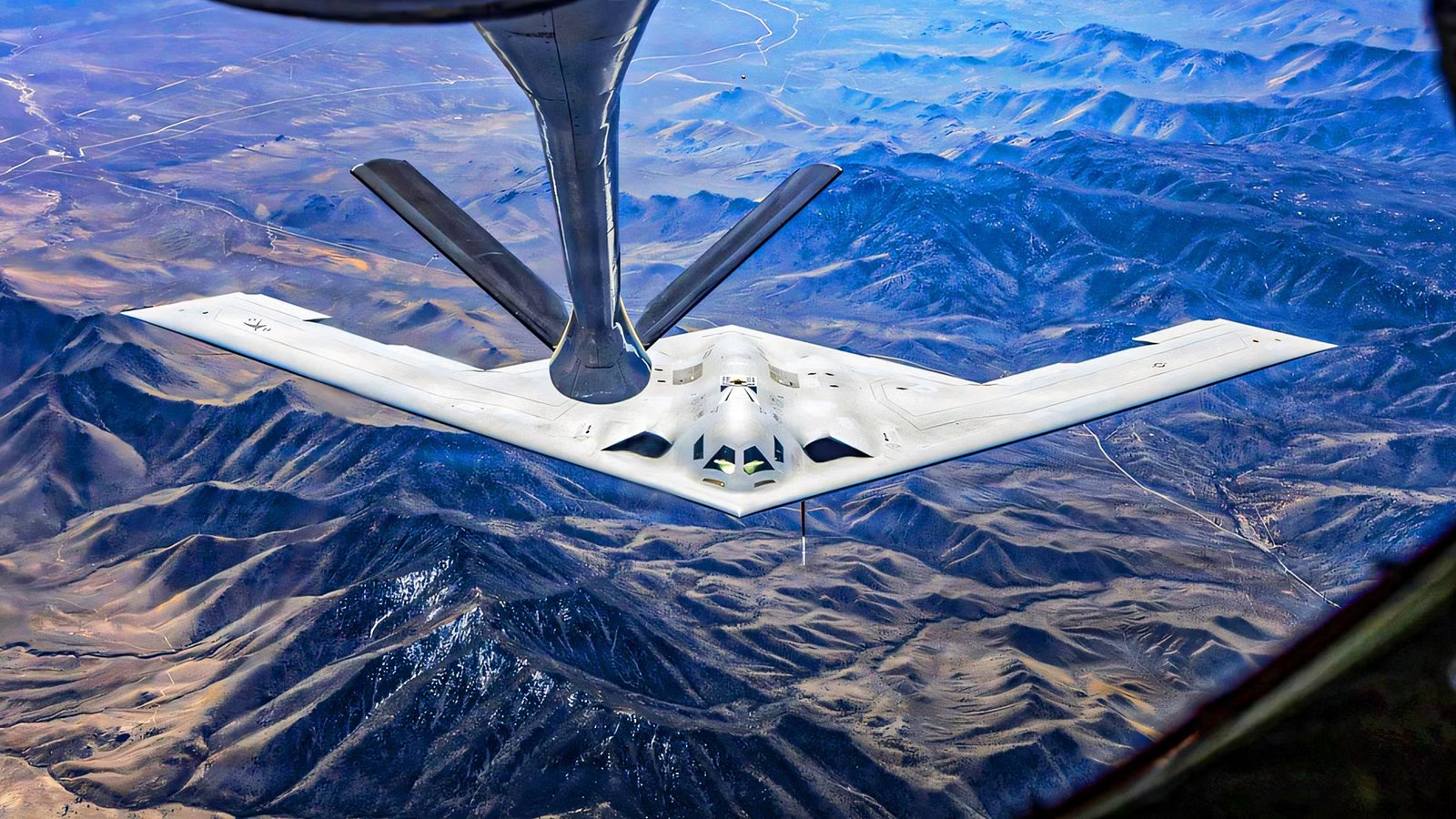
Northrop Grumman has officially reached the low-rate production stage of its $5 billion B-21 Raider program. Today, two have been delivered to the US Air Force for operational testing and validation before they are officially introduced to active service at Ellsworth Air Force Base (RCA) next year. The USAF is slated to receive at least 100 of the sixth-generation stealth bombers to fulfill the dual role of nuclear deterrence and conventional strategic strike, but is already considering expanding to 145 or more.
The B-21 is more than just a successor to the B-2 Spirit, but rather a radical breakthrough in defense aerospace technology that will introduce several firsts to the USAF as the world’s first true sixth-generation platform. While the first fully operational examples are expected to be delivered to frontline combat units next year, the USAF does not anticipate the first test flight of a sixth-generation fighter jet until 2028.
Defense analysis of air warfare capability around the world is heavily focused on fighter jets as a primary indicator of combat capability, yet the USAF, the world’s most powerful air force, chose to invest in strategic strike first. The reasoning behind this approach to modernization is a multi-layered and interwoven web of funding, strategy, and competing industrial priorities.
The Fighter Mafia: Stuck On The F-35

The Lockheed Martin F-35 Lightning II, also known as the Joint Strike, is a colossal investment made by the US Air Force, Navy, Marines, and 19 partner nations around the world. The lifetime of the program is expected to cost roughly $2 trillion over a nearly 90-year period. The central assembly line is located at Fort Worth, Texas, from the famous bomber plant operated by the USAF, but the colossal global supply chain includes factories in Italy and Japan as well.
The F-35 is in many ways a step backwards in defense aerospace technology as it compromises in a number of performance areas where the preceding F-22 Raptor is actually superior. However, the plane is a vessel for extremely advanced computing and software that augments the combat capability of its stealth airframe to achieve superior lethality that surpasses virtually any other fighter jet. Unfortunately, the program has been chronically plagued by technical setback after setback since it debuted in 2006.
Although Boeing was awarded the contract by the Department of Defense in 2025 to begin development of the F-47 NGAD, funding for fighter jet programs has been largely tied up in ever-increasing costs for the F-35. Just this year, the US Navy awarded nearly 1 billion dollars in additional funding for Lockheed Martin to enhance the F-35C and F-35B variants operated by its Carrier air wings as well as US Marine fighter squadrons.
The Technology Refresh Three Block Four program has been a disaster for the entire global fleet, with the DOD declaring it virtually unusable for all of 2025. As a result, it has reduced the combat effectiveness of all F-35s down to about a 44% combat capability rate, with that number dropping down to 25% for aircraft capable of fulfilling every single mission in the portfolio of the JSF. This abysmal situation is largely responsible for the slow progression that allowed the Chinese military to fly to sixth-generation fighter prototypes in 2024, before any Western nation even got off the drawing board.
Recapitalizing The Bomber Fleet

The B-21 Raider program has been one of the most flawlessly executed defense procurement programs in modern military history. From conception to production, the entire operation has run on schedule and on budget with Northrop Grumman claiming savings of roughly 50% compared to the legacy B-2 Spirit program, thanks to digital twinning and other advanced computer-based modeling and engineering aids. It couldn’t come a moment sooner with the state of the Air Force Global Strike Command’s bomber fleet.
Although the B-2 Spirit remains the only fifth-generation stealth bomber to ever take flight around the world, which makes it one of the most valuable military aircraft ever created, the entire fleet is showing its age. The incredibly limited production run that was dropped from over 100 down to just 21 has suffered from ‘vanishing vendor syndrome’ for decades, which has only served to drive down the prohibitive operating cost and maintenance expenses. Even with the most delicate ‘white glove’ touch possible, these planes will need to be replaced in the near future.
Simultaneously, the Rock will be one Lancer fleet operated by the US Air Force, which has been pushed to its limit as the airframes are being phased out due to structural fatigue from the stress of years of supersonic flying. The B-52 fleet is surprisingly expected to serve for decades to come, thanks to its incredibly over-engineered airframe that is being radically retrofitted with modern engines and avionics to complement the B-21 Raider on the battlefield tomorrow.
Transitioning the AFGSC to a two-type fleet with the B-21 as its primary platform will do more than just succeed the B-2 Spirit as a premier stealth platform, but rather modernize and significantly improve the entire fleet. Simultaneously, it will drive down the long-term cost and greatly expand the operating flexibility of all bomber squadrons. The B-21 isn’t made to just be stealthier and more sophisticated than its predecessor; it’s also made to be much more efficient and rugged.
Agile Combat Employment And The Raider
The transition to a two-bomber fleet coincides with the pivot to the Pacific that demands the US Air Force have planes capable of flying to much simpler and smaller air bases around the world and operating with minimal ground support in between combat sorties. The B-52J will introduce a host of advanced technologies, such as modern data links, better radar, hypersonic weapons, and interfaces for advanced loyal wingman drones. This will be complemented by superior engines that will improve its range and durability, while its rugged airframe already makes it an excellent platform for ACE.
The B-21 Raider will diverge from the B-2 because it will be able to operate alongside the B-52 at austere air bases made for Cold War fighter jets. The B-21 is going to be significantly smaller than the B-2 while packing nearly as much punch, thanks to its advanced technology that will do everything the new B-52J will do and more, wrapped in a stealth airframe. It is expected to have the same or longer range while being able to fly to smaller airfields that do not have any of the complex climate-controlled hangars required for the Spirit in the past.
This is crucial for deployments to the Pacific Theater simply because of infrastructure limitations at many of the air bases in the first and second island chains. At the same time, this has a broader strategic advantage in allowing the US Air Force to be more unpredictable with the staging and locations of where the B-21 deploys for deterrence and flies to for stopovers during missions.
Although the B-2 Spirit is virtually invulnerable to the enemy in flight, there are about half a dozen bases where it could land, making it extremely vulnerable on the ground. The Raider solves this problem and goes even further, thanks to its small footprint, which makes it easy to accommodate and simpler to support.
B-21: The Ultimate Bomber

There are only three air forces in the entire world that maintain strategic bomber fleets: the US, Russia, and China. Of these three great air powers, the United States does not have the most bombers, but it does have the only stealth bombers in existence. Neither one of its adversaries has produced a fifth-generation strategic strike aircraft, and neither has even drafted a sixth-generation stealth bomber. Meanwhile, of all these sixth-generation fighter programs around the world, none are even close to achieving full-rate production like the B-21 Raider.
Although China successfully test flew two prototypes, the Chengdu J-36 and the Shenyang J-50, neither one has shown significant progress since those 2024 video leaks. The Future Combat Air System, in development with France, Spain, and Germany, has officially collapsed over industrial work sharing as of just weeks ago. The Global Combat Air Program, or BAE Tempest, is making progress under a trilateral partnership between the United Kingdom, Italy, and Japan, but it’s still years from a prototype taking flight.
After the dissolution of FCAS, Spain and Germany have shown interest in joining the GCAP sixth-generation development program. And as a result of the many problems with the F-35, Canada, Poland, and even India are also considering investing in the GCAP at various levels to take their first steps on the road to a next-gen stealth fighter. Momentum is gathering for European air forces and other international allies, but the F-47 is likely to take flight first.
The NGAD will feature several extremely advanced technologies, like variable cycle engines and directed energy weapons (lasers) that are also being paralleled by the European program. Each is meant to be a part of a ‘system of systems’ with the collaborative combat aircraft uncrewed platforms to support them, as well as integration through data links into a next-gen ‘kill web’ with advanced 4.5 gen fighters and bombers, as well as fifth-generation planes. The B-21 Raider will also be a part of this network, but by the time all of these other platforms are fully online, it will be a tried and tested warbird already.

![19-Hour Flights: The USA’s 11 Ultra-Long Nonstop Routes Revealed [List & Map]](https://dailynewsnblog.com/wp-content/uploads/2026/08/qantas-boeing-787-9-landing.jpg)