dailynewsnblog
To most passengers, an aircraft is identified by the flight number printed on a boarding pass. However, the identity used by pilots and air traffic control can be slightly different. The same aircraft may operate one flight under a standard airline call sign, another under a modified alphanumeric call sign, and later move empty under a completely different operational identity. This can make flight tracking confusing, especially when the aircraft registration, commercial flight number, and radio call sign do not all appear to match.
The reason is that a call sign is not permanently attached to an aircraft in the same way that its registration is. Instead, it identifies the specific flight or operation underway at that moment. Airlines, air traffic control, and air navigation providers use call signs to keep radio communication clear and reduce the risk of confusion between similar-sounding flights. As a result, the same physical aircraft can appear under different identities throughout the day without anything unusual happening.
Here’s Everything You Need To Know About Call Signs

A call sign is one of those aviation terms that sounds simple until you look at how it is actually used. In simple terms, it is the identifier used by pilots and air traffic controllers to refer to a specific aircraft or flight over the radio and on controller screens. For scheduled commercial flights, this normally combines the airline’s radio name, known as its telephony designator, with a flight identification.
For example, a  British Airways ticket may show BA238, with BA being the airline’s two-letter IATA code used commercially, while air traffic control may see an operational call sign such as BAW238 or an adjusted alphanumeric version, with BAW being British Airways’ three-letter ICAO code and “Speedbird” its spoken radio name.
There is also a regional difference in how these call signs are spoken. For example, in the United States, numbers may be read more naturally, meaning a flight could be heard as “Seventy-Five” rather than “Seven Five.” In many other countries, digits are generally spoken separately to reduce ambiguity. This might sound like a small difference, but on a busy radio frequency, the way numbers are pronounced can make a call sign easier or harder to distinguish from another aircraft, runway instruction, or altitude clearance.
In many cases, the call sign still looks very similar to the flight number printed on a boarding pass. However, the two do not always have to match, and where a passenger might book a flight under an IATA flight number used for tickets, airport screens, and airline apps, air traffic control sees a separate ICAO-based call sign. This is especially relevant because airlines use different systems for commercial and operational purposes. The commercial flight number is built around the airline’s two-letter IATA code, while the full operational call sign uses the airline’s three-letter ICAO identifier and its spoken telephony designator.
This is why the same aircraft can operate under different call signs throughout the day. The aircraft itself keeps its registration, but each scheduled flight or special movement has its own designated call sign. In other words, the registration tells you which aircraft it is, while the call sign tells controllers what flight or mission it is performing at that moment.
Why Airlines Are Starting To Use Alphanumeric Call Signs

One of the most important reasons a flight number and call sign may not match exactly is the growing use of alphanumeric call signs. Historically, many airline call signs were simply the airline’s radio name followed by the flight number. However, as the number of flights increased, this created a safety problem. Two aircraft operating in the same area could have call signs that sounded almost identical, especially when spoken quickly over a busy radio frequency. This is known as call sign similarity, and it can increase the risk of a crew responding to an instruction intended for another aircraft.
To reduce that risk, airlines and air navigation service providers increasingly use alphanumeric call signs. Instead of relying only on numbers, these call signs add or replace part of the number with a letter. For example, an airline may take a commercial flight number and adjust it into a slightly different operational identity that is easier to distinguish on the radio. This does not change the flight number passengers typically see, the aircraft registration, or the actual service being operated. It simply provides pilots and controllers a safer, more distinct way to identify the flight during radio communication.
Catch what other flight trackers miss
Emergency squawks, holds, NOTAMs — live signals, no signup.
Open tracker
Catch what other flight trackers miss
Emergency squawks, holds, NOTAMs — live signals, no signup.
Open tracker
This is also why not every flight operated by an airline will necessarily use an alphanumeric call sign. The goal is not to make every call sign more complicated, but to reduce conflicts where similarity could become an issue. Some airlines may only modify certain flights, while others use alphanumeric call signs more widely across their networks. Europe has been one of the main regions where this practice has become common, aided by deconfliction tools used to compare and reduce similar call signs. You can see the alphanumeric call signs in action using the new Simple Flying Flight Tracker.
Call signs can also change when an aircraft is not operating a regular commercial service. Airlines often add a letter to distinguish positioning, ferry, or training flights from scheduled passenger operations. A positioning or ferry flight may receive a call sign ending in P, spoken as “Papa,” while a training flight may use T, spoken as “Tango.”
What Squawk Code 7700 Actually Means
How often is it used by commercial airline pilots?
Airlines With Unique Radio Call Signs

While most call signs used by airlines are straightforward, some others might require an explanation. A clear example of how clear a call sign can be is the Dutch flag-carrier KLM. Since the Amsterdam-based airline has a conveniently abbreviated name of only three letters, its ICAO code and radio call sign are the exact same. However, when talking about special call signs, the first airline that might come to mind among aviation enthusiasts is the aforementioned British Airways and its iconic call sign “Speedbird”, which originates from an old logo featuring a bird and the speed associated with air travel.
Several thousand miles away in South Africa, South African Airways uses the call sign “Springbok”. A call sign that has already been in existence since the 1930s, and before the airline even adopted its current name. Over in Taiwan, state-owned China Airlines uses the call sign “Dynasty”, while Taiwanese competitor Starlux Airlines uses “Starwalker,” building on the carrier’s cosmic and space-inspired brand. The Irish flag-carrier  Aer Lingus very appropriately uses “Shamrock.”
Notable Airline Call Signs | |||
|---|---|---|---|
Airline | IATA Code | ICAO Call Sign | Radio Call Sign |
British Airways | BA | BAW | Speedbird |
South African Airways | SA | SAA | Springbok |
China Airlines | CI | CAL | Dynasty |
Aer Lingus | EI | EIN | Shamrock |
Pegasus Airlines | PC | PGT | Sun Turk |
Scoot | TR | TGW | Scooter |
Air Asia | AK | AXM | Red Cap |
Virgin Australia | VA | VOZ | Velocity |
Starlux Airlines | JX | SJX | Starwalker |
Sunclass Airlines | DK | VKG | Viking |
However, not only large flag-carriers with a decades-long history feature unique call signs. Some newer airlines also feature call signs that are worth mentioning. Turkish low-cost airline Pegasus, for example, uses the call sign “Sun Turk.” This is likely attributable to the airline’s presence at many airports along the Turkish coast, which is a popular holiday destination for sun-seeking Europeans. Similarly, Danish holiday airline Sunclass uses the call sign “Viking”, referring to the Viking history of its Scandinavian home markets.
To see these and other interesting call signs from airlines around the world, such as AirAsia’s Red Cap or Scoot’s Scooter, you can use Simple Flying’s new Flight Tracker.
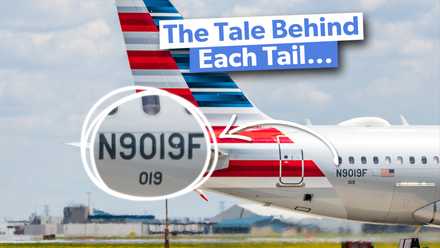
Why Do US Aircraft Registration Numbers Begin With “N”?
The United States Navy used the letter “N” for its operations in 1909.
Why Some Aircraft Add “Heavy” To Their Call Sign

Those who have listened to air traffic control (ATC) might also have heard pilots and controllers use the suffix “Heavy” behind the call sign. This addition is used to warn air traffic controllers and other pilots in the area about wake turbulence, which may pose a danger for other nearby aircraft. The “Heavy” addition is used for operating at a maximum takeoff weight (MTOW) exceeding 300,000 lb (136,077 kg). Within this category fall aircraft such as the  Boeing 747, 767, 777, 787, Airbus A330, A340, A350, and several other widebodies.
Catch what other flight trackers miss
Emergency squawks, holds, NOTAMs — live signals, no signup.
Open tracker
Catch what other flight trackers miss
Emergency squawks, holds, NOTAMs — live signals, no signup.
Open tracker
This suffix is used regardless of whether the aircraft is actually operating at its MTOW on a specific flight. For example, a Boeing 777 or Airbus A350 departing on a relatively light short-haul sector would still use “Heavy” since classification is based on the aircraft type’s certificate. The importance of the suffix to identify large aircraft has to do with the powerful wake vortices they can leave behind, especially during takeoff, landing, and low-speed flight. These invisible rotating air masses can be dangerous for smaller aircraft that follow too closely behind in the same flight path. By adding “Heavy” to the radio call sign, everyone on the frequency immediately understands that the aircraft requires appropriate separation.
Furthermore, there are also a number of special cases, such as the Boeing 757 which has a MTOW below the usual 300,000 lb (136,077 kg) threshold, but it is still treated as a heavy aircraft because of the strength of the wake turbulence it can generate. Above “Heavy,” the suffix “Super” is used for the Airbus A380, and was also used for the Antonov An-225.