dailynewsnblog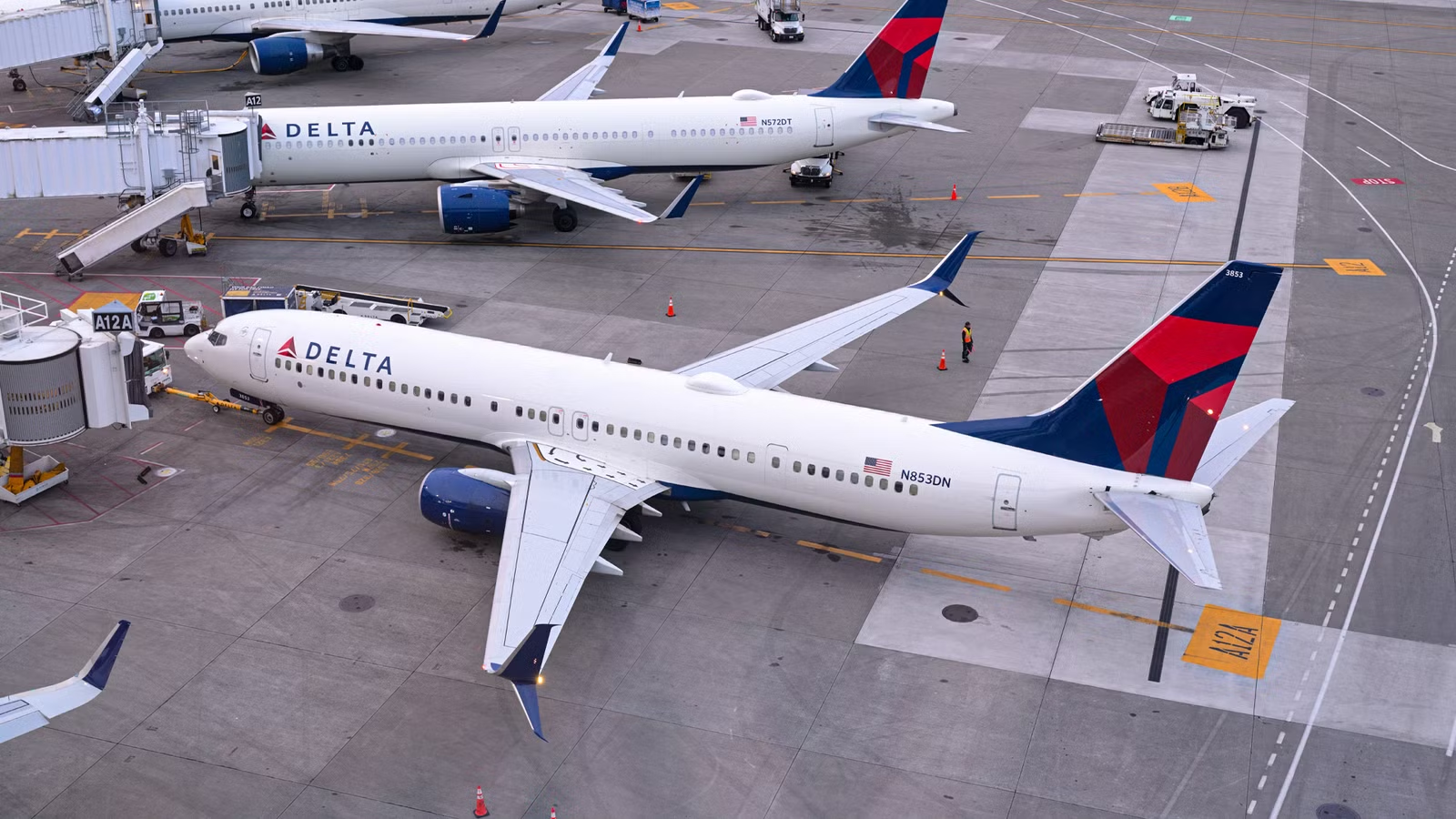
Airlines are always looking for ways to optimize their aircraft and cut fuel burn. After all, fuel is one of the biggest expenses faced by any airline, and shedding even one percentage of a plane’s fuel burn can yield huge savings across an aircraft’s lifespan, especially when upgrades are rolled out across a fleet. This is exactly what  Delta Air Lines is doing with its Boeing 737 fleet, as it will begin installing new fins on the plane’s rear fuselage to improve aerodynamics and efficiency.
The carrier has already retrofitted its entire 737 fleet with split scimitar winglets, first installed on the carrier’s 737-900ER fleet, followed by the 737-800s. This project was completed in 2025, and the airline is also looking to boost fuel efficiency on its Boeing 767s, while its 757s have long flown with blended winglets. In addition, Delta is taking delivery of new Airbus A321neos, A330neos, and A350s with greater fuel efficiency, while planning to take 737 MAXs and 787s in the more distant future.
The New VCT Finlets On Delta’s 737

You’ll never see it from the window, but Delta has installed new ‘finlets’ on 22 of its Boeing 737s as part of an in-service validation. These are located on the aft fuselage behind the rear set of exits, and there are four of these blade-shaped finlets in total. Developed by Vortex Control Technologies, they’re installed asymmetrically, with three on the left side and one on the right side, as the right side of the 737’s aft fuselage already features a vortex generator from the APU inlet.
The purpose of the finlets is to reshape airflow, reduce flow separation, and improve pressure recovery on the aft fuselage. Aircraft generate significant vortices on the aft fuselage, and the installation of the finlets helps reduce drag, lowering fuel burn. Delta and VCT verified a fuel burn reduction of 1.2%, although VCT advertises that airlines could see as much as 1.4% lower fuel burn on the 737. In addition, the finlets allow for the removal of vortex generators located between the vertical and horizontal stabilizers.
The aluminum finlets are 25 inches (63.5 centimeters) long and 2.5 inches (6.35 centimeters) high, while weighing 1.8 pounds (0.82 kilograms). They’re bolted directly to the aircraft’s skin using eight standard fasteners and are located in an unpressurized part of the fuselage. The team behind the finlets has already developed drag-reducing microvanes for the Lockheed C130 Hercules and the Boeing C-17 Globemaster III, which have proven successful.
Delta’s New Order For Finlets On The 737

After a successful in-service trial, Delta Air Lines announced on June 17, 2026, that it would order the VCT finlets for its entire Boeing 737 fleet. In total, Delta has 240 737s, split between 77 737-800s and 163 737-900ERs, and it intends to complete the fleetwide retrofit of finlets in just 18 months, about half the time that it took the carrier to install split scimitar winglets on the same planes. They should prove to be quick to install, while the cost should be fairly minimal.
The carrier plans to install the finlets during maintenance visits, as well as at outstations during overnight hours. The process of installing the finlets will be straightforward, and the trial also validated the low installation/maintenance costs of the finlets. VCT and Delta worked closely on this project, and the Delta order represents the largest sale of finlets yet. The finlets were first certified on the 737-700 in 2018, with certification for the 737-800 and 737-900ER following in 2023.
Boeing 737 Generation | Variants | Boeing 737 Generation | Variants |
|---|---|---|---|
737 Original (1967) | 737-100 737-200 | 737NG (1997) | 737-600 737-700 737-800 737-900/900ER |
737 Classic (1984) | 737-300 737-400 737-500 | 737 MAX (2017) | 737 MAX 7 737 MAX 8 737 MAX 9 737 MAX 10 |
Delta Air Lines is the sixth customer for the VCT finlets, following Avelo Airlines, Copa Airlines, Norwegian, Southwest Airlines, and SunExpress. Avelo was the first airline to install finlets on the 737-800 and has equipped its entire 737-800 fleet, while Norwegian and SunExpress will also install them across their entire 737-800 fleets. Considering current oil prices, these finlets will prove especially beneficial for large 737 operators like Delta, which will see significant savings.
Why Delta Air Lines Doesn’t Want Blended Winglets On Most Aircraft Anymore
The carrier appears to be following a similar practice to that of Southwest Airlines and others
The Delta Air Lines 737 Fleet

Delta isn’t the largest operator of the Boeing 737: in the United States, American Airlines operates over 400 examples, United Airlines has over 600 737s, and Southwest Airlines flies nearly 800 737s, while Delta has just 240 examples. It also does not yet operate the 737 MAX. Instead, the airline has focused more heavily on the Airbus A320 family, while also operating large numbers of Airbus A220s, Boeing 717s, and 757s.
Still, the 737 is its second-largest fleet and will grow once the airline starts taking delivery of its 100 737 MAX 10s. Delta is the world’s largest operator of the 737-900ER, with 163 examples in service. These planes are relatively young and cost-effective, as all of them were built in the 2010s. 33 of these are second-hand examples acquired after the COVID-19 pandemic, while the rest were delivered new to Delta, and they seat a high number of passengers while operating relatively long flights.
Delta’s 737-800 Delivery Batches | Number | Delta’s 737-900ER Delivery Batches | Number |
|---|---|---|---|
1998-2002 | 71 | 2013-2019 | 130 |
2010 | Two | 2022-2023 | 33 (used) |
2017 | Four (used) |
What’s more notable is that the carrier will also install the finlets on the 737-800s. This fleet is smaller, and the planes are much older, with most of them between 24 and 28 years old. Delta, however, is looking to grow its fleet and is only retiring planes that are at the end of their economic lives. In practice, the 737-800s still have another six to ten years of life left in them, and the carrier has already installed split scimitar winglets. Furthermore, the airline is refurbishing some of these planes with its latest seats.
The Importance Of Cutting Fuel Burn

Oil prices have been relatively low over the past few years, but then spiked after the start of the war in Iran. Although prices are sitting at $69.54 per barrel as of the time of writing, the situation in Iran is volatile, and it’s far from guaranteed that they won’t rise again in the near future. In the current situation, aircraft efficiency is as important as ever, and the new finlets will help lower fuel costs for Delta.
The 22 planes are already providing meaningful savings, and the fuel cost reduction will be even more dramatic when the entire fleet is retrofitted. VCT advertises that the finlets can cut fuel burn on a 737 by as much as 1.4%, saving airlines approximately $125,000 a year per aircraft in fuel costs. With Delta’s reported figure of 1.2%, this means that it could save close to $107,000 annually per aircraft. Once all 240 737s are retrofitted, this could amount to over $25 million per year.
Of course, Delta’s annual fuel burn is close to $10 billion, but it’s still a significant figure when considering that airlines are traditionally extremely cost-sensitive. In addition to the new finlets, Delta’s split scimitar installation yielded a fuel burn reduction of 1.6% to 2.2%.
With both upgrades completed, Delta’s 737s could burn over 3% less fuel compared to a 737 with neither upgrade, such as those flown by American Airlines. These two upgrades significantly improve the operating economics of the 737NG, and just as the split scimitars are becoming increasingly popular, expect that the VCT finlets will also be ordered by more airlines operating large 737NG fleets.

No Regrets: Why Delta Air Lines Easily Got Rid Of The Boeing 777
Delta retired its Boeing 777s in 2020 without regret, favoring more cost-efficient Airbus jets.
Additional Projects For The Delta Fleet

Delta has been testing the effect of MicroTau’s riblet film on its Boeing 767 fleet. The film takes inspiration from sharks by featuring microscopic grooves to help reduce drag. These panels can be applied to the aircraft’s fuselage, wings, and tail, and it’s believed that the riblets could deliver as much as a 4% reduction in fuel burn. Given that the 767 typically operates long-haul routes, this can deliver significant savings since these planes are in the air for longer than a narrowbody.
Delta is also partnering with Airbus to develop new technology to cut fuel burn, and is testing the viability of Airbus’s fello’fly technique, which features aircraft flying closely together in formation. By cruising in a V-shaped formation that mimics how geese fly, aircraft can ride on the wake of a lead plane, requiring significantly less thrust at cruising altitude and possibly resulting in a 5% to 10% reduction in fuel burn, while also lowering carbon emissions.
In addition to improving fuel efficiency, Delta has also been working on reducing the environmental impact of its flights. The airline has been increasing its use of Sustainable Aviation Fuel, while its fuel efficiency initiatives also reduce carbon emissions. In addition, Delta holds large orders for multiple new aircraft types, which will burn less fuel and consequently emit less carbon. At the same time, the airline is retiring older planes, including Airbus A320-200s, Boeing 757-200s, and 767-300ERs.
Catch what other trackers miss
Emergency squawks, holds, NOTAMs — live signals, no signup.
Open tracker
Catch what other trackers miss
Emergency squawks, holds, NOTAMs — live signals, no signup.
Open tracker