dailynewsnblog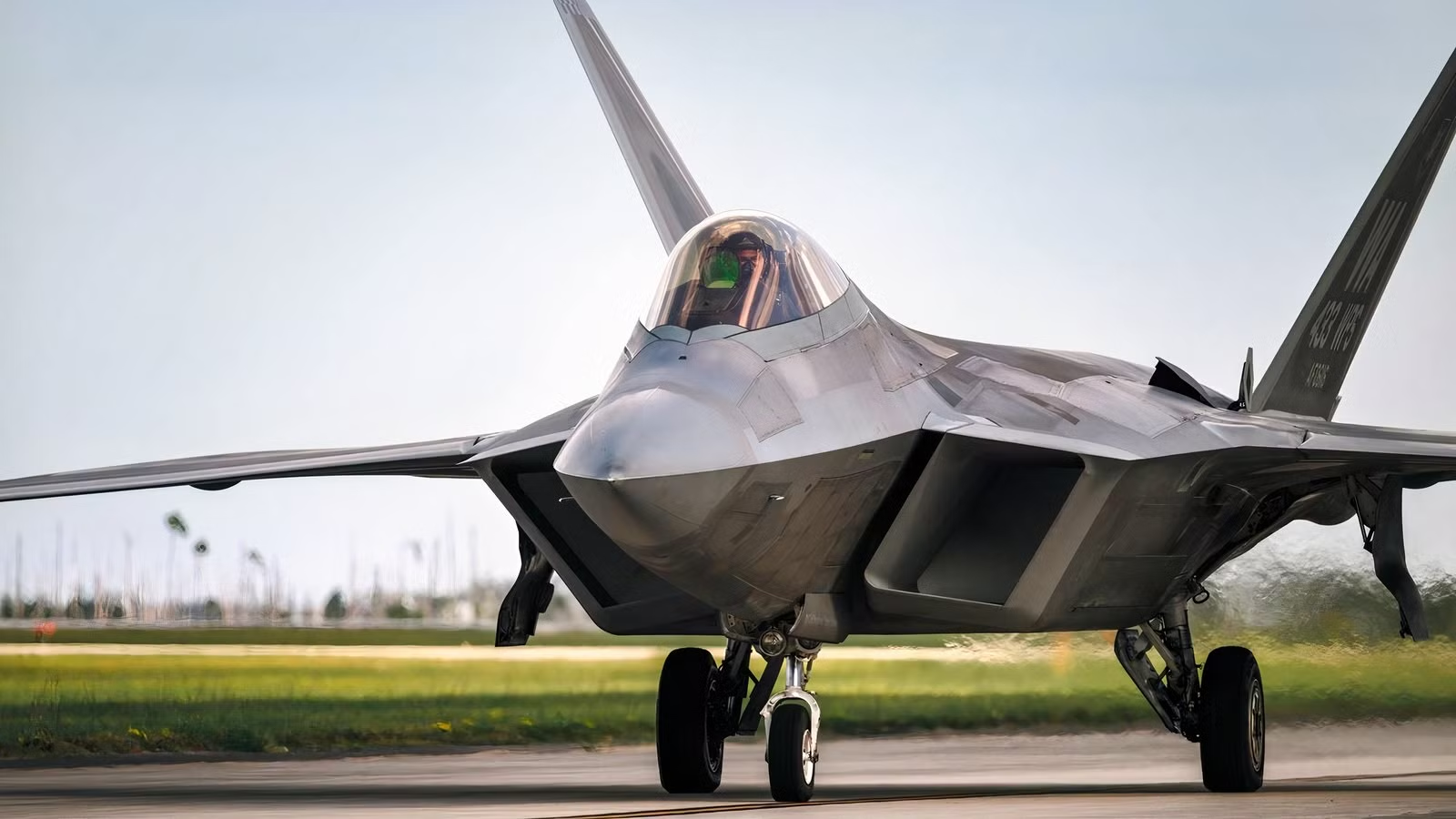
A Lockheed MartinF-22 Raptor in supercruise gets roughly 0.30 to 0.37 miles per gallon (0.127 to 0.157 kilometers per liter). That number sounds terrible until you ask what any other operational fighter burns to achieve the same speed: approximately 0.11 to 0.13 miles per gallon (0.047 to 0.055 kilometers per liter), using an afterburner. That figure comes from its confirmed internal fuel load of 18,000 lb (8,165 kg), or about 2,687 US gallons, and an estimated burn rate of 0.045 to 0.055 miles per lb of fuel at around Mach 1.5. But the Raptor is covering those miles at nearly 990 miles per hour (1,593 km per hour) and, crucially, it is doing so without afterburner. That distinction is what makes the number strategically meaningful, and it is the core of what this article explains.
Supercruise is defined as sustained supersonic flight without the use of afterburner, a capability the USAF’s official F-22 fact sheet confirms as a defining characteristic of the Raptor, made possible by its two Pratt & Whitney F119-PW-100 turbofan engines. The F-22 is the only operational fighter in the United States Air Force that can sustain it, and among the few in the world. Fuel consumption figures for military aircraft are typically classified, so the values used here are derived from confirmed specifications and independently corroborated estimates, the same methodology used throughout this article.
The Short Answer: How Is 0.30–0.37 MPG Calculated?

The calculation starts with the confirmed internal fuel load. At 18,000 lb (8,200 kg) and a JP-8 fuel density of approximately 6.7 lb per US gallon, the F-22 carries roughly 2,687 gallons internally. At Mach 1.5 and 35,000 feet (10,668 meters), the aircraft is traveling at approximately 990 miles per hour (1,593 km per hour).
Low-bypass-ratio turbofans in the F119’s thrust class exhibit dry-specific fuel consumption values of approximately 0.70 to 0.82 pounds per pound-force of thrust per hour during sustained supersonic flight, a figure consistent with published NASA material on thrust specific fuel consumption and with unclassified literature covering military turbofan performance.
At supercruise, the F119 does not run at maximum dry thrust; sustaining level Mach 1.5 in a clean configuration requires roughly 60 to 75% of maximum dry output per engine. That yields a total fuel burn of approximately 18,000 to 22,000 lb per hour (8,165 to 9,979 kg per hour), which, divided into 990 miles, produces a 0.30 to 0.37 MPG range.
The cross-check against the ferry range supports the estimate. The Air Force lists a ferry range above 1,850 miles (2,977 km) with two external wing tanks, adding approximately 8,000 lb (3,629 kg) of usable fuel to the 18,000-lb (8,165-kg) internal load. That profile is flown at subsonic cruise speeds — roughly Mach 0.85, or approximately 560 miles per hour (901 km per hour) at altitude. Working backward from those numbers gives a subsonic efficiency in the vicinity of 0.40 to 0.47 miles per gallon. The supercruise figure of 0.30 to 0.37 MPG sits approximately 15–20% below that subsonic ceiling — a consistent result, since traveling faster requires overcoming more drag and consumes proportionally more fuel per mile.
When in supercruise mode, the F-22’s 2,687 gallons of internal fuel last approximately 45 to 60 minutes before exhaustion. That translates to a maximum range on internal fuel of roughly 750 to 990 miles (1,207 to 1,593 kilometers) before the pilot must either throttle back to subsonic or tap external tanks. Simple Flying’s comprehensive analysis of the Raptor’s fuel efficiency across all flight regimes arrives at consistent estimates, noting that supercruise endurance on internal fuel supports meaningful supersonic transit legs rather than brief sprints — a distinction that separates the F-22’s operating model from any fourth-generation design attempting sustained supersonic flight with afterburner.
What Pushes That Number Up Or Down In Practice?

Five variables meaningfully shift the supercruise efficiency figure away from the 0.30–0.37 MPG baseline. Altitude is the strongest single lever: above 40,000 feet (12,192 meters), air density drops sharply, reducing aerodynamic drag. The F-22 can operate well above 50,000 feet (15,240 meters), and at those heights the engines work against substantially less resistance, improving efficiency per mile — though the speed corresponding to any given Mach number also falls with altitude, slightly moderating the absolute gain. This high-altitude performance envelope and its role in extending range are consistent with independent technical summaries of the aircraft’s design and performance, such as Aerospaceweb’s F-22 performance breakdown.
Configuration is the second variable, and the most operationally significant. Carrying two 600-gallon (2,271-liter) external fuel tanks increases aerodynamic drag enough that supercruise is typically initiated in a clean configuration after the tanks are jettisoned, not while carrying them.
Gross weight interacts directly with the lift and drag required to maintain level flight: a freshly fueled aircraft at maximum internal load is heavier and demands more thrust than the same aircraft midway through a mission.
Temperature affects combustion efficiency subtly: colder air at altitude is denser, improving specific thrust output for a given fuel flow. Finally, and most consequentially for real missions, any deviation from clean steady-state cruise moves the efficiency profile. A single brief afterburner burst to accelerate through a Mach transition collapses fuel efficiency to the 0.11–0.13 MPG afterburner range for its duration, and high-G maneuvering during an engagement spikes instantaneous fuel burn well above any cruise-phase estimate.
In practical mission profiles, combat air patrol legs, which involve slow subsonic orbits at lower fuel burn and not sustained supercruise, significantly change how far the internal fuel load actually takes the aircraft. A combat radius of approximately 300 to 375 miles (483 to 603 kilometers) on internal fuel in a realistic mixed mission profile reflects all those phases combined. The pure-supercruise figure describes only the most fuel-intensive leg of an operation, not the full sortie economics. Understanding the difference matters for anyone trying to translate the 0.30–0.37 MPG number into operational planning terms.
How Many Miles Per Gallon Does An F-35 Get?
Jet fighters are not necessarily known for their fuel efficiency, but is the F-35 Lightning II any different?
What Do The Official Sources And Engine Data Actually Confirm?

The F-22’s fuel efficiency in supercruise cannot be directly verified from publicly released government documents: specific fuel consumption figures for the F119-PW-100 engine are classified, as is the Raptor’s detailed fuel burn profile by flight regime. What can be established from open sources is the framework within which the derived estimates must fall. The USAF confirms internal fuel capacity at 18,000 lb (8,165 kg), and the F-22 Demo Team’s public specifications confirm supercruise at Mach 1.5+ as a verified capability.
As stated by the National Museum of the United States Air Force, the F119-PW-100 engine produces approximately 35,000 lbf (155.7 kN) of thrust per engine with afterburner and approximately 26,000 lbf (115.6 kN) dry, confirmed by the USAF.
That dry thrust output is higher than the afterburner thrust of many fourth-generation fighter jets, which is the fundamental reason supercruise is possible at all: the F-22 carries enough dry thrust in reserve to overcome supersonic wave drag without needing the afterburner’s supplemental fuel injection. The Air & Space Forces Magazine analysis of the Raptor’s operational performance notes that sustained Mach 1.5+ supercruise had been confirmed in operational service, with no public disclosure of the specific fuel burn rate, consistent with the classification of detailed engine performance data across flight regimes.
As previously detailed on Simple Flying’s analysis of the F-22’s cost per flight hour, the fuel consumption component of the F-22’s approximately $80,000-per-hour operating cost is real but is significantly exceeded by the maintenance, stealth-coating upkeep, and other costs that make the Raptor so expensive to operate.
How Does Supercruise MPG Stack Up Against The Alternatives?

To put the supercruise efficiency figure into its operational context, we have to consider various aircraft and their afterburner regime: as stated by Skybrary, the afterburner use dramatically increases fuel consumption and significantly reduces range efficiency compared to dry thrust operation, making it unsuitable for sustained flight except in short-duration high-performance situations.
As noted on Simple Flying analysis of the pilot experience differences between the F-22 and Lockheed Martin F-35, the Raptor sustains supercruise at around Mach 1.5, while the F-35 can exceed Mach 1 in short bursts or in specific flight profiles, but it lacks the combination of engine performance and airframe efficiency that lets the Raptor hold Mach 1.5 as a cruise mode.
A McDonnell DouglasF-15C or a  Boeing F-15EX attempting to sustain Mach 1.5 must use partial afterburner, placing them in approximately the same 0.12–0.15 MPG efficiency band as the F-22’s own afterburner regime. The F-15’s internal fuel load of approximately 13,455 lb (6,103 kg) at that burn rate supports roughly 15 to 20 minutes of sustained Mach 1.5 flight, as examined in Simple Flying. The F-22 sustains it for 45 to 60 minutes.
As documented by Migflug, the Eurofighter Typhoonand Dassault Rafale can achieve limited supercruise, approximately Mach 1.2 to 1.4 in clean configuration under optimal conditions — making them the closest Western analogues to the F-22’s supercruise capability. Their MPG figures for that partial supercruise regime are not publicly available, but the lower sustained speed limits their operational utility of the capability relative to the F-22’s higher and more robustly sustained Mach 1.5+. Russia’s Sukhoi Su-57 is claimed to have supercruise capability, but independent verification of that claim and any associated fuel efficiency data is not available in open sources. The F-22 remains, among confirmed and verified supercruisers, the performance benchmark by a meaningful margin.
How Lockheed Martin Fighters Stack Up Against Each Other In 2026
Lockheed Martin’s fighters continue to define the shape of Western airpower, but how do the F-22, F-35, and F-16 compare in evolving scenarios?
What Are The Exceptions, Limits, And Honest Caveats?

Every figure in this analysis is a derived and a rough estimate, not a declassified measurement. The USAF has not published the F-22’s fuel burn profile by flight regime, and any number in the public domain is calculated from open-source confirmed inputs. The specific fuel consumption value assumed for the F119 in dry supersonic operation is drawn from the published engineering literature on broadly comparable low-bypass-ratio turbofans; the actual F119 figure could fall outside that range if Pratt & Whitney achieved substantially better or worse performance than analogous designs. The F-22’s MPG range is deliberately wide to accommodate that uncertainty.
A second caveat is operational: real F-22 missions almost never consist of clean, sustained supercruise from start to finish. Combat air patrol missions involve slow orbits at subsonic speeds, spending fuel for situational awareness rather than transit. Training sorties involve repeated maneuvering that spikes fuel burn far above cruise-level efficiency. Escort missions may require the F-22 to match the speed and altitude of the aircraft it is escorting rather than optimizing for its own efficient regime. The 45-to-60-minute supercruise endurance figure is a ceiling, not a floor. The combat radius of approximately 300 to 375 miles (483 to 603 km) on internal fuel in a realistic mixed mission profile reflects this gap between theoretical efficiency and practical operation.
There is also a stealth dimension to the supercruise efficiency question that is rarely discussed in fuel-focused analyses. Flying at Mach 1.5 generates aerodynamic heating on the airframe’s leading edges and radar-absorbing material coatings — heat stress that accelerates degradation of the materials that give the F-22 its low radar cross-section. The USAF has not publicly quantified this effect on maintenance intervals or coating replacement costs, but as we have previously documented in our F-22 operating cost analysis, stealth coating maintenance is already one of the aircraft’s dominant cost drivers. Extended supercruise operations may impose a maintenance overhead beyond the direct fuel cost that the MPG figure alone does not capture.
What 0.30–0.37 MPG Actually Tells You About The F-22

At 0.30–0.37 MPG, the Raptor burns more fuel per hour than most readers will consume in a year. Against any aircraft covering the same distance at the same speed, it burns one-third as much. But to fully understand that derived supercruise figure, it has to be put alongside the 0.11–0.13 MPG of any afterburner-dependent aircraft trying to sustain the same Mach 1.5, and it quantifies something the USAF fact sheet states in operational terms: not fuel efficiency in an abstract way, but strategic reach at speeds that compress the timeline of combat.
But efficiency per mile is only meaningful when time is not a constraint. According to the RAND Corporation’s operational assessment of the F-22, the aircraft’s supercruise capability was identified as one of its two most tactically significant performance attributes, alongside stealth, precisely because compressing transit time changes the geometry of air combat: it shrinks the window adversaries have to respond, and it extends the F-22’s ability to choose when and where to engage. Subsonic cruise is more fuel-efficient per mile, but supercruise changes the operational situation in ways a fuel economy table cannot capture.
When the F-22 is close to its eventual retirement, and the Boeing F-47 next-generation platform will take its place, supercruise capability will almost certainly remain a core design requirement for the successor. The F119 demonstrated that sustained Mach 1.5 in dry military power was achievable in a production fighter, permanently redefining the baseline for what a US air superiority platform is expected to do. Whatever the F-47’s eventual supercruise efficiency turns out to be — and it will almost certainly be classified too — the engineering logic the F-22 established will be the foundation it builds on.
Catch what other trackers miss
Emergency squawks, holds, NOTAMs — live signals, no signup.
Open tracker
Catch what other trackers miss
Emergency squawks, holds, NOTAMs — live signals, no signup.
Open tracker