dailynewsnblog
Riyadh’s new King Salman International Airport (KSIA) is being built to handle 185 million passengers a year, a figure that would make it the busiest airport on the planet by a wide margin. For comparison, the all‑time record for annual passenger throughput is 110.5 million, set by  Hartsfield-Jackson Atlanta International Airport(ATL) in 2019. KSIA’s long-term target is roughly 73% higher than that benchmark, despite the site handling just 42 million passengers today. By 2030, the airport’s first phase is designed to process 120 million passengers annually, enough to surpass Atlanta’s record on day one, and construction is already underway, with the third runway breaking ground in January 2026.
This article looks at how Saudi Arabia plans to reach those numbers, what makes King Salman International different from earlier mega hub projects like Dubai’s Al Maktoum International (DWC), and whether the country’s airline and tourism strategy can realistically fill an airport built for 185 million passengers a year.
The Numbers: What 185 Million Passengers Actually Means

To put the KSIA capacity figures in context: five of the busiest airports on Earth in 2025 processed a combined total of approximately 460 million passengers:  Dubai International Airport(DXB) (~95 million), Hartsfield-Jackson Atlanta (~106 million),
  Dallas/Fort Worth International Airport (DFW) (~85 million),
  Tokyo Haneda Airport (HND) (~91 million), and
  Istanbul Airport (IST) (~85 million). At full build-out, KSIA alone will process more than a third of that total. It will handle more than Dubai and Frankfurt combined. It will process nearly three times the current passenger volume of London
  London Heathrow Airport(LHR) .
These are the design specifications around which the physical infrastructure is being sized and built today, with Bechtel, Parsons, and Mace already contracted and excavators on site.
The airport covers an area of 22 square miles (57 square km), which places it among the world’s largest by land area. According to the Public Investment Fund’s official project page, the development includes six parallel runways, a minimum of seven terminals (six commercial plus one iconic terminal designed as the airport’s architectural centerpiece), and approximately 4.6 square miles (12 square km) of supporting facilities including residential, recreational, retail, and logistics real estate — an aerotropolis designed to function as a complete urban district, not merely a processing facility for arriving and departing passengers. The cargo operation will handle 3.5 million tons annually by 2050, a figure that would rank it among the world’s top five cargo airports at today’s volumes. Total reported investment has grown from the initial 2022 estimate to approximately $30 billion (SAR 112.5 billion), as scoping has expanded alongside the project’s ambitions.
The economic rationale is explicit and quantified. According to Airport Technology’s project profile, KSIA is expected to add SAR 27 billion ($7.2 billion) per year to Saudi Arabia’s non-oil GDP when fully operational, creating approximately 103,000 direct and indirect jobs. Construction will generate a further 150,000 jobs. For a government whose entire Vision 2030 strategy is built on diversifying away from hydrocarbons, an airport generating $7.2 billion annually in non-oil economic activity is a core strategic asset, which is precisely why the Public Investment Fund, Saudi Arabia’s sovereign wealth vehicle, owns the development company outright.
Foster + Partners’ Masterplan: What The Airport Actually Looks Like

The architectural firm commissioned to design King Salman International Airport is Foster + Partners — the British studio responsible for, among other things,  Beijing Capital Airport (PEK) Terminal 3,
  Hong Kong International Airport(HKG) , and
  London Stansted Airport (STN) ‘s single-terminal concept. KSIA is, by a considerable margin, the largest project in the firm’s history. The masterplan is organized around six parallel runways, a central spine of terminal buildings connected by a single concourse loop, and an approach to passenger circulation explicitly designed to eliminate the connection failures that plague hub airports at scale.
As Simple Flying has previously examined, the Foster + Partners statement on the project describes KSIA as “a game-changing infrastructure program” whose “scale of ambition for the program’s physical build, as well as its commitment to sustainability, innovation and economic development, is unmatched.” The Iconic Terminal is a single building intended to set a visual identity comparable to the role the Sydney Opera House plays for that city: instantly recognizable, globally distinctive, and designed to communicate something specific about the culture and ambition of the nation it serves.
The broader terminal campus is designed around a planning philosophy that prioritizes transfer connection times, self-service processing, and wayfinding clarity at the scale of a 120-million-passenger annual operation. Mark Van Doorne, Vice President of Master Planning at KSIADC, told the Arab Aviation Summit that “a city of this size should have an airport that can handle at least 50 million passengers” — and that the ambition is to use KSIA to benchmark what a truly 21st-century mega-hub can achieve in operational efficiency.
The sustainability targets embedded in the masterplan are among the most ambitious in the airport industry. KSIA is targeting LEED Platinum certification, the highest designation in the US Green Building Council’s rating system. Renewable energy will provide a substantial portion of the airport’s power. In July 2025, KSIADC signed a memorandum of understanding with Biofuel Company to deploy B100 biodiesel as a substitute for fossil diesel throughout the construction phase itself, an unusually early commitment to decarbonizing the build as well as the eventual operation.
As Simple Flying has reported in its photo overview of KSIA’s terminal vision, the renderings show a facility bathed in natural light through vast glass facades, with indoor greenery integrated throughout passenger dwell areas — a design philosophy that reflects both the branding aspirations of the project and the practical reality that an airport expecting to attract high-yield leisure travelers to Saudi Arabia needs to function as a destination in its own right.

Historic: Riyadh Air’s 1st Official Flight To Take Off In July
Riyadh Air will launch its first-ever commercial flight on July 1st, connecting Riyadh and London with Boeing 787-9 Dreamliners.
What Is Actually On The Ground: The September 2025 Construction Start

The gap between a rendered masterplan and an airport that processes 185 million passengers is typically measured in concrete poured, contracts awarded, and runways graded, and on all three metrics, KSIA has accelerated sharply since 2024. Construction officially commenced in September 2025, when KSIADC and the Riyadh Infrastructure Projects Center signed a collaboration agreement that triggered the transition from planning to execution.
In January 2026, ground was formally broken on the airport’s third runway, the first piece of new airside infrastructure to enter active construction under the expanded masterplan. The third runway will measure 13,780 feet (4,200 meters) in length, is being delivered by FCC Construcción SA of Spain and Al-Mabani General Contractors Company of Saudi Arabia, and is aligned with Riyadh’s prevailing wind patterns for maximum operational efficiency. When operational, it will increase the airport’s hourly aircraft movement capacity from 65 to 85 (a 31% increase!), supporting the gradual expansion of international services ahead of the major terminal openings planned for the late 2020s.
In May 2025, Bechtel, one of the largest engineering and construction firms in the world, signed an executive partnership agreement with KSIADC to develop three of KSIA’s passenger terminals: the commercial airline terminal, Terminal 6, and the private aviation terminal with aircraft maintenance facilities. In the same month, Parsons Corporation was awarded two four-year Delivery Partner contracts covering all airside infrastructure, such as runways, taxiways, and air traffic control towers, plus landside infrastructure, including roads, tunnels, bridges, and railway networks. Mace, the UK-based construction consultancy, holds the overall delivery partner monitoring role, overseeing the program as a whole. Jacobs was engaged in August 2024 for masterplan validation and runway design consultancy.
According to Passenger Terminal Today, KSIA Acting CEO Marco Mejia described the third runway milestone in terms that reflect the entire program’s trajectory:
“
Launching construction of the third runway marks a pivotal step in delivering the KSIA masterplan and reflects our commitment to developing world-class infrastructure capable of supporting future growth, enhancing operational efficiency and expanding long-haul connectivity without constraints.”
The pace of procurement also matters. KSIA’s capacity is currently at 42 million passengers annually — growing to a projected 56 million by the end of 2026 as interim expansion works at the existing Riyadh Airport (RUH) site are completed. As Simple Flying’s roundup of 2026’s most significant runway projects confirmed, KSIA is already among the most consequential airport developments globally in the current calendar year, with its third runway joining Heathrow’s delayed expansion, Hong Kong’s new third runway, and Istanbul’s continued growth as the headline infrastructure stories of the global aviation industry. The transition from planning to construction is complete. What remains is the execution.
The Airlines That Will Fill The Terminals: SAUDIA, Riyadh Air, And The Saudi Seven

Saudia, the Kingdom’s long-established national carrier, is already operating from Riyadh and expanding aggressively.  Riyadh Air, the new full-service carrier established by PIF specifically to serve KSIA, has 132 aircraft on order, and is targeting 100+ international destinations by 2030. Beyond these two, Saudi Arabia’s General Authority for Civil Aviation announced in November 2025 that the Kingdom is planning to launch three additional carriers, which would bring the total to seven Saudi airlines by the early 2030s.
According to Simple Flying’s reporting on the “Saudi Seven” strategy, Saudi passenger traffic across all airports exceeded 140 million in 2025, and the national target of 150 million international visitors per year by 2030 provides the underlying demand rationale for every seat the expanding Saudi airline network can fill. According to Aerospace Global News, Saudi Airlines Group alone expects to receive 191 new aircraft by 2032, bringing its total fleet to over 380 commercial aircraft.
The FIFA 2034 World Cup tournament will require stadiums, infrastructure, and aviation capacity to receive hundreds of thousands of international visitors simultaneously in a country where Riyadh is the most obvious entry point for the majority of flying travelers. Hosting the World Cup without a functional 100-million-passenger airport in the capital is operationally impossible; having it operational and battle-tested before 2034 is a hard requirement, not an aspiration. The FIFA deadline alone functions as the kind of forcing function that has historically turned mega-airport plans from indefinitely deferred promises into actual construction projects on actual timelines.
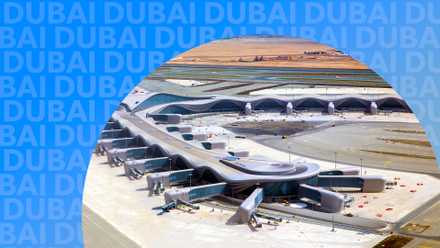
The Game-Changing New $35 Billion Mega Airport Project Coming To Dubai
Dubai’s new mega airport is scheduled to take over from the current airport in 2034 and eventually become the world’s largest airport.
Why Riyadh Sits At The Center Of The Earth For Aviation Purposes

One question the scale of KSIA’s ambitions naturally invites is whether Riyadh can realistically attract the volume of origin-and-destination traffic needed to fill a 185-million-passenger airport, or whether the projections depend on transit connectivity that may or may not materialize. The answer lies in geography. Riyadh sits almost exactly at the midpoint between Europe and Southeast Asia, roughly equidistant between London and Singapore. Within an 8-hour flying radius, accessible to a modern twin-aisle aircraft without technical stops, KSIA can reach approximately 4.6 billion people across three continents.
Saudi Arabia’s stated ambition is to use this geographic position to make Riyadh a global hub. According to the Public Investment Fund, KSIA is intended to capture a share of the 7–10 billion passengers per year that industry forecasts project for global air travel by the mid-2030s, specifically by offering competitive connection times on routes between Asia and Europe that currently route through Dubai, Doha, or Istanbul. For KSIA to succeed in this role, it needs exactly what the masterplan is being designed around: transfer times measured in minutes rather than hours, sufficient runway capacity to handle simultaneous arrivals and departures at scale, and airline partners willing to schedule connecting itineraries through Riyadh. All three of those conditions are being built into the program from the ground up, rather than retrofitted into an existing airport’s limitations.
As mentioned by Simple Flying,  Delta Air Lines announced nonstop service from Atlanta to Riyadh’s current airport for Winter 2026. That single route announcement, modest as it is relative to the eventual scale of KSIA, illustrates the trajectory. Airlines are beginning to treat Riyadh as a hub-worthy destination rather than a niche market, and they are making those routing decisions before KSIA’s new terminals open.
The Credibility Test: What Makes KSIA Different From Every Other Mega-Airport That Promised The World

The Centre for Aviation advisory and research platform, in a December 2024 analysis of KSIA, framed the critical risk plainly: it is a giant project, costing close to USD 30 billion, but there are warning signs about overdevelopment, both at home and abroad, and drew the comparison explicitly to Al Maktoum International Airport as a cautionary precedent. The CAPA skepticism is legitimate and worth taking seriously. Aviation infrastructure projects with targets in excess of 100 million passengers have a consistent track record of overestimating demand, underestimating construction timelines, and failing to attract the airline partners needed to fill their facilities.  Beijing Daxing Airport, which opened in 2019 as the world’s largest single airport terminal, was designed for 72 million passengers and processed less than 40 million in 2023. Al Maktoum International Airport‘s 200-million-passenger aspiration remains entirely theoretical 15 years after the first sod was turned.
KSIA’s case for credibility rests on specifics rather than aspiration. Bechtel and Parsons do not sign major delivery contracts on projects they assess as phantom infrastructure. The PIF’s SAR 112.5 billion commitment is sovereign wealth spending on a project at the center of a national economic strategy, not commercial speculation. Riyadh Air’s 132-aircraft order book is not a press release; it is a financial commitment that requires an operating hub to justify the investment. And the FIFA 2034 World Cup, unlike Vision 2030’s broader tourism targets, is a contractual obligation with a specific date attached. Every element of the KSIA program converges on a single irreversible conclusion: the airport is being built, the airlines will be flying, and the question is not whether KSIA opens but how close to its ambitious Phase 1 targets it will actually perform when it does.
A target of 185 million annual passengers by 2050 is extraordinary. No airport in history has come close to that figure, and the infrastructure required to support it will take years and tens of billions of dollars to build. What sets King Salman International Airport apart is that previous mega hub attempts lacked the combination of a strategic location, committed airline investment, a sovereign wealth fund willing to absorb decades of cost, and a national tourism strategy with immovable international deadlines.
Whether those four ingredients are enough to deliver 185 million passengers in 2050 remains uncertain. What is far less uncertain is that KSIA is on track to become the world’s busiest airport well before the decade is out.