dailynewsnblog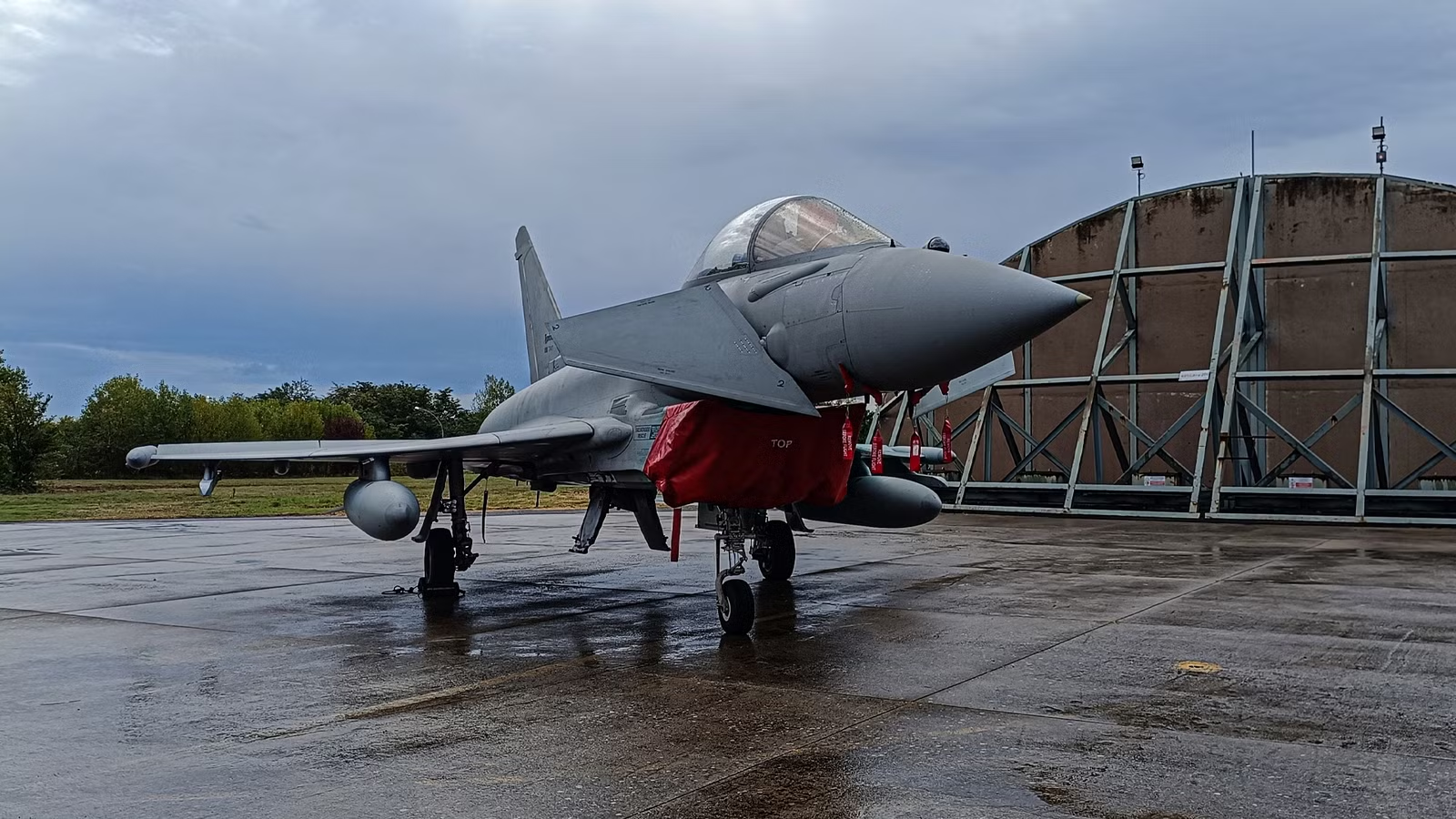
As America’s allies across the pond begin to look more inward for air defense solutions and reconsider their reliance on the US for defense industrial security, a crucial ally in Eastern Europe may be losing interest. The  Boeing F-15EX Eagle 2 is a cutting-edge 4.5-gen strike fighter capable of impressive air-to-air loadouts and air-to-ground payloads, coupled with performance that remains unrivaled by even fifth-generation stealth jets. Yet the Polish Air Force may be strongly considering the latest Eurofighter as a homegrown competitor.
What makes the Eurofighter particularly appealing are the characteristics that lend it well to the quick reaction alert mission set, a key requirement for Poland. The Typhoon was purpose-built to scramble from a runway at high altitude as rapidly as possible, and then execute a wide patrol radius with supercruise capability. The F-15 can achieve Mach 2.5; the Typhoon beats it out in climb speed thanks to its lighter airframe, and the Eagles simply cannot achieve comparable supersonic cruising speed without afterburner.
Two Opposing Houses Of Air Dominance

Because the Typhoon was purpose-built as a high-altitude interceptor from day one, it not only can reach higher altitudes faster than the Eagle II but also has a higher maximum operational ceiling. Given Poland’s strategic location on the Eastern front of the North Atlantic Treaty Organization, one of the most important roles that its Air Force plays is combat air patrol to intercept and identify unknown aircraft. The Russian Air Force is a concern for Poland and NATO, especially given the ongoing conflict between Russia and Ukraine, which began with the invasion in 2022.
The two airplanes are close rivals in terms of airspeed and performance characteristics, but where the Eagle reigns supreme is its 10,000-pound greater payload capacity, maxing out at 29,500 pounds. The Typhoon, however, offers just under 20,000 pounds of capacity and can carry some of the best standoff weapons made in Europe, such as the Meteor and Storm Shadow missiles. In fact, the American jet even wins out on price, with flyaway costs ranging from $90 million to $100 million compared to the Typhoon at $115 million to $120 million.
The F-15EX is optimized to be a ‘missile truck’ 4.5-gen jet for the US Air Force that supports fifth-generation stealth fighters like the Lockheed Martin F-35 Lightning II. Poland is procuring the F-35 Joint Strike Fighter alongside 150-200 4.5-Gen fighters, according to the Aviationist. However, the support role could also be fulfilled by the Eurofighter Typhoon while also diversifying the fleet. Given the unstable geopolitical trends under the administration of US President Donald Trump, numerous European nations have begun to withdraw interest in US defense programs and instead look to European sovereignty for security.
The Eurocanard Versus America’s Muscle Jet

The comparison between the Eurofighter Typhoon and the F-15EX Eagle 2 is a classic juxtaposition of two polar-opposite design philosophies. The European-made Typhoon is a mashup of complementary engineering ideas from all of Europe’s best aerospace houses, including Airbus, BAE, and Leonardo. Meanwhile, the F-15EX is a digitally refined, 21st-century evolution of the classic Cold War superfighter. While the Typhoon was made to be a super-agile dogfighter, the Eagle emphasizes sheer power and relies on trademark American ‘boom and zoom’ tactics.
The Typhoon is made with an aerodynamically unstable delta-canard design that relies on fly-by-wire avionics to keep the plane from falling out of the sky. The plane is virtually impossible to fly with analog stick and rudder skills, and that is exactly what makes it so agile in aerial combat. On the other end of the aerodynamic spectrum, the F-15EX uses a stable swept-wing design with dual vertical tails that give the plane massive lifting body surfaces and a solid handling feel at high speed or with a heavy payload.
The way these planes engage in combat highlights their differing design philosophies. The Typhoon is optimized for the entire spectrum of air combat, but it truly shines when it enters a visual range dogfight. It has a phenomenal instantaneous turn rate, meaning it can point its nose at an enemy aircraft faster than almost anything in the sky. Meanwhile, the Eagle II uses its massive twin General Electric F110 engines to rapidly climb to high altitudes, accelerate to Mach 2.5, unleash a salvo of long-range missiles from a distance, and immediately exit the combat zone before the enemy can react.
These Are The Countries The US Has Banned From Buying The F-35
The US has rebuffed the requests of at least eight countries to purchase the F-35 stealth fighter.
A Knife Fighter Versus A Juggernaut

For Poland, these differing flight dynamics change how either aircraft would pair with its incoming fleet of stealthy fifth-generation F-35s. In a conflict, the F-35s would operate invisibly, mapping out enemy targets. The Typhoon, using its high-altitude capability and incredible agility, could dart into contested airspace alongside the F-35 to clean up enemy fighters. The F-15EX would act as a rear-line arsenal ship. It would fly safely behind the stealthy F-35s, acting as a massive ‘missile magazine’ carrying up to 29 air-to-air missiles.
The Typhoon has an empty weight of roughly 24,000 lb. With its twin EJ200 engines, it achieves a thrust-to-weight ratio of roughly 1.15 in a standard combat configuration. Combined with low wing loading, the Typhoon can maintain tight turns without bleeding away its airspeed, allowing it to recover energy incredibly fast. The F-15EX has an empty weight of about 32,000 pounds, one-third heavier than the Typhoon. While the Eagle II’s engines produce a staggering 58,000 lbs of combined thrust, its massive maximum takeoff weight, fully loaded with weapons, highly encumbers its maneuverability.
In Poland’s theater, every second counts. The combination of recent Eurofighter Typhoon upgrades and its kinematic performance directly addresses Poland’s unique needs. Being a frontline NATO state sharing a highly militarized border with Russia and Belarus, Poland operates in a high-threat, compressed-timeline airspace. Thanks to its incredibly high thrust-to-weight ratio (TWR) and instantaneous engine spool-up, a Typhoon can start its engines, taxi, take off, and supersonic-climb faster than the heavier F-15EX. Recent upgrades to the Typhoon’s maximum missile capacity of 14 air-to-air munitions make it a strong competitor for the F-15EX, considering that it can carry multiple Meteor beyond-visual-range missiles on one hardpoint.
While the F-15EX still holds a raw numbers advantage, the Typhoon’s 14-missile capacity is more than sufficient for high-intensity air dominance missions. Crucially, the Typhoon achieves this payload capacity while maintaining vastly superior aerodynamic handling. A combat air patrol also requires a fighter to loiter over a designated sector for hours, ready to intercept a threat. The Typhoon can supercruise at Mach 1.5, covering a vastly larger geographic area during a long-range CAP. It travels at supersonic speeds between defensive sectors while burning a fraction of the fuel of an F-15EX, allowing Polish pilots to maintain high-speed coverage over Poland’s vast eastern border for a longer combat radius.

6 Aircraft That Represent The Future Of Air Combat
Discover six aircraft redefining modern air warfare, from stealth fighters to missile trucks, shaping the balance of air power in 2026 and beyond.
GCAP And The American Killswitch

Poland has shown active interest in joining the Global Combat Air Program, a multinational sixth-generation stealth fighter development initiative underway between the United Kingdom, Italy, and Japan. Spearheaded by BAE Systems, and also known as The Tempest, the three nations have formalized their trilateral industrial relationship through a formal working group, Edgewing. Leonardo Aerospace of Italy and Mitsubishi Heavy Industries of Japan form the other two pillars of the triad.
Poland, like other European militaries, sees investing in the Eurofighter as a solution to two problems. Procuring a European-made fighter jet keeps the supply chain close to home and ensures more control over the product and process. It also eliminates much of the uncertainty over the lifetime of the plane’s service, as the American-made counterparts carry much proprietary equipment ‘black boxed’ and unavailable to technicians in Europe. These systems require shipping to the US for processing when maintenance needs arise, potentially crippling fighter jets over minor issues.
The uncharacteristically hostile behavior of the US government towards its long-standing allies in Europe under the Trump administration has also created a major rift. Specifically, the F-35 program has raised concerns among many allies that American defense contractors could possess a kind of ‘killswitch’ ability that would allow America to effectively ground exported aircraft remotely. Controversy over these questions has led some nations like Canada, Switzerland, Portugal, and Spain to reconsider their interest in the F-35. The same doubt could easily be cast over the F-15EX in Poland.
How the Eurofighter Typhoon Stacks Up Against the US F-35
Dogfight agility meets stealth supremacy. The Eurofighter and F-35 redefine air combat in a clash of speed, power, and cutting-edge tech.
The Stepping Stone To Sixth-Generation Air Warfare

If Poland were to become a partner under the GCAP agreement, the Eurofighter Typhoon is a much better transitional platform for its Air Force and domestic defense contractors. The same companies that currently make the Eurofighter Typhoon, BAE, and Leonardo, are the core founding partners of the GCAP. Selecting the F-15EX isolates Poland within a legacy US supply chain, whereas choosing the Eurofighter serves as a bridge. The Typhoon integrates Poland directly into the European defense ecosystem that is actively designing GCAP.
The Eurofighter consortium has offered Poland localized manufacturing, parts assembly, and maintenance, repair, and overhaul facilities. Polish Deputy State Assets Minister Konrad Gołota explicitly noted that Poland has not produced domestic aircraft in decades. If Poland purchases the Typhoon, it establishes immediate, high-level industrial contracts and working relationships. Transitioning from a Typhoon manufacturing partner to a GCAP industrial contributor is a natural evolution rather than starting from scratch. Poland cannot logically contribute complex components to a 2035 sixth-generation stealth jet without first mastering the assembly and maintenance of a fourth-generation fighter.
On top of this foundational industrial base, Poland would need to accelerate industrial development in several other aerospace sectors to contribute to the GCAP program as a partner. The Tempest is intended to be a system of systems, like other next-gen fighter jets. It will integrate closely with loyal wingman drones, also called collaborative combat aircraft, and European tactical philosophy places a strong emphasis on active electronic warfare technology to complement passive stealth. These are highly advanced areas of weapons technology that would require a significant ramp-up for Poland to produce at scale.