dailynewsnblog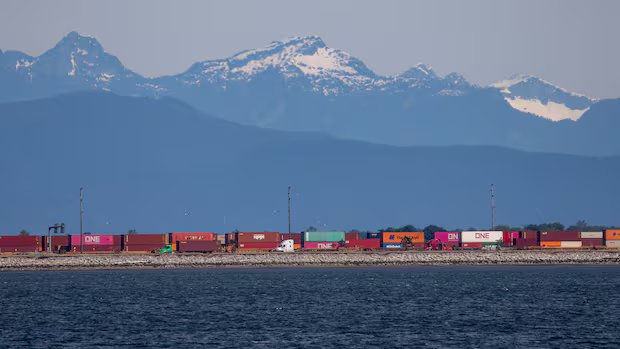

Listen to this article
Estimated 4 minutes
The audio version of this article is generated by AI-based technology. Mispronunciations can occur. We are working with our partners to continually review and improve the results.
The lack of a northern route for Alberta’s proposed new pipeline to the B.C. coast may have grabbed the headlines during Thursday’s announcement of an Ottawa-B.C. memorandum of understanding with more than $200 billion in investments.
But analysts say the federal government’s $10-billion commitment to a container port expansion in Delta, B.C., as part of the MOU means that Roberts Bank Terminal 2 (RBT2) is critical to the project, too.
Prime Minister Mark Carney said the federal investment into the expansion would unlock $100 billion in new trade capacity, while adding about $3 billion to Canada’s economy each year.
And as officials announced later Thursday that any new pipeline would flow through southern B.C. and end at Roberts Bank, analysts say the route and accompanying upgrade to the port expansion means the pipeline is now much more of a sure thing.
“Going south follows a corridor where there’s already a great deal of knowledge and a lot of infrastructure to work from,” Richard Masson, an energy consultant and former CEO for the Alberta Petroleum Marketing Commission, said.
Masson pointed to the decades-old Trans Mountain Pipeline, and its associated agreements with local communities and First Nations reached over years, as a “very good base” for any pipeline proponent taking the southern route to work off.

As the Liberal government agreed to uphold the oil tanker ban on B.C.’s North Coast, Conservative Leader Pierre Poilievre called the moratorium ‘ridiculous,’ saying that ‘the best way to diversity is by permitting a pipeline’ to Prince Rupert or Kitimat, B.C.
Indeed, the federally-owned Trans Mountain Corporation is set to plan and construct the new pipeline, working closely with the Pembina Pipeline Corporation.
But the lack of a northern route continues to have critics — with Conservative Leader Pierre Poilievre saying a northern route would allow Canada to access Asian markets far easier.
Poilievre told a news conference that it “takes about 36 hours less time to get to Asia from northern B.C. as it does from southern B.C.” due to geography and the curvature of the earth — reasons he believes “the best place to put a pipeline is to Prince Rupert or Kitimat.”
But Masson said he had yet to see capital cost estimates for either a northern route or southern route.

Prime Minister Mark Carney says his government is committed to ‘maintaining’ the federal tanker ban on B.C.’s North Coast. At a press conference with B.C. Premier David Eby, Carney said the moratorium will stay in place ‘in accordance’ with any proposed route for a new oil pipeline from Alberta.
He said arguments that a northern route would be more efficient were “pure speculation” at this point.
“Once oil is on a tanker, the difference between Vancouver or Prince Rupert going to Asia is probably a few cents because it’s very inexpensive to move oil on a tanker,” he said.
“The key is how big is the tanker. So if we could see Roberts Bank as the port — and it allows for VLCC (very large crude carriers) — then that’s the the best way to be efficient and and that would be great for Canada.”
Challenge to project
The RBT2 expansion is not without its critics, even as the Vancouver Fraser Port Authority argues it is vital to strengthen Canada’s trade infrastructure.
Last year, a Federal Court judge dismissed a lawsuit by environmental groups that said the expansion project would destroy vital chinook salmon habitat, threatening the survival of southern resident killer whales that rely on salmon for food.

In a statement on Thursday, the Wilderness Committee — one of the groups that filed the lawsuit — said the RBT2 project would lead to increased tanker traffic and the risk of a devastating oil spill.
“Prime Minister Carney is showing us his enthusiastic willingness to accept and fund the extinction of endangered species and a future where oil and private profit are more valuable than the entire Salish Sea ecosystem,” said Lucero González, a campaigner with the group.
While the federal government has committed $10 billion to the RBT2 project and the expansion of the Port of Vancouver trade corridor, the Wilderness Committee said the RBT2 project has yet to receive its final federal permit under the Species at Risk Act.
Laura Jones, the CEO of the Business Council of B.C., said the federal funds for the Port of Vancouver expansion showed that there was a commitment from Ottawa to diversify trade — something she argued was critical given political headwinds.
“Earlier this week, the U.S. made it clear they’re going year-by-year now with the Canada-U.S.-Mexico Agreement,” he said.
“And so we don’t have the stability and the certainty that we once had with our biggest trading partner.”