dailynewsnblog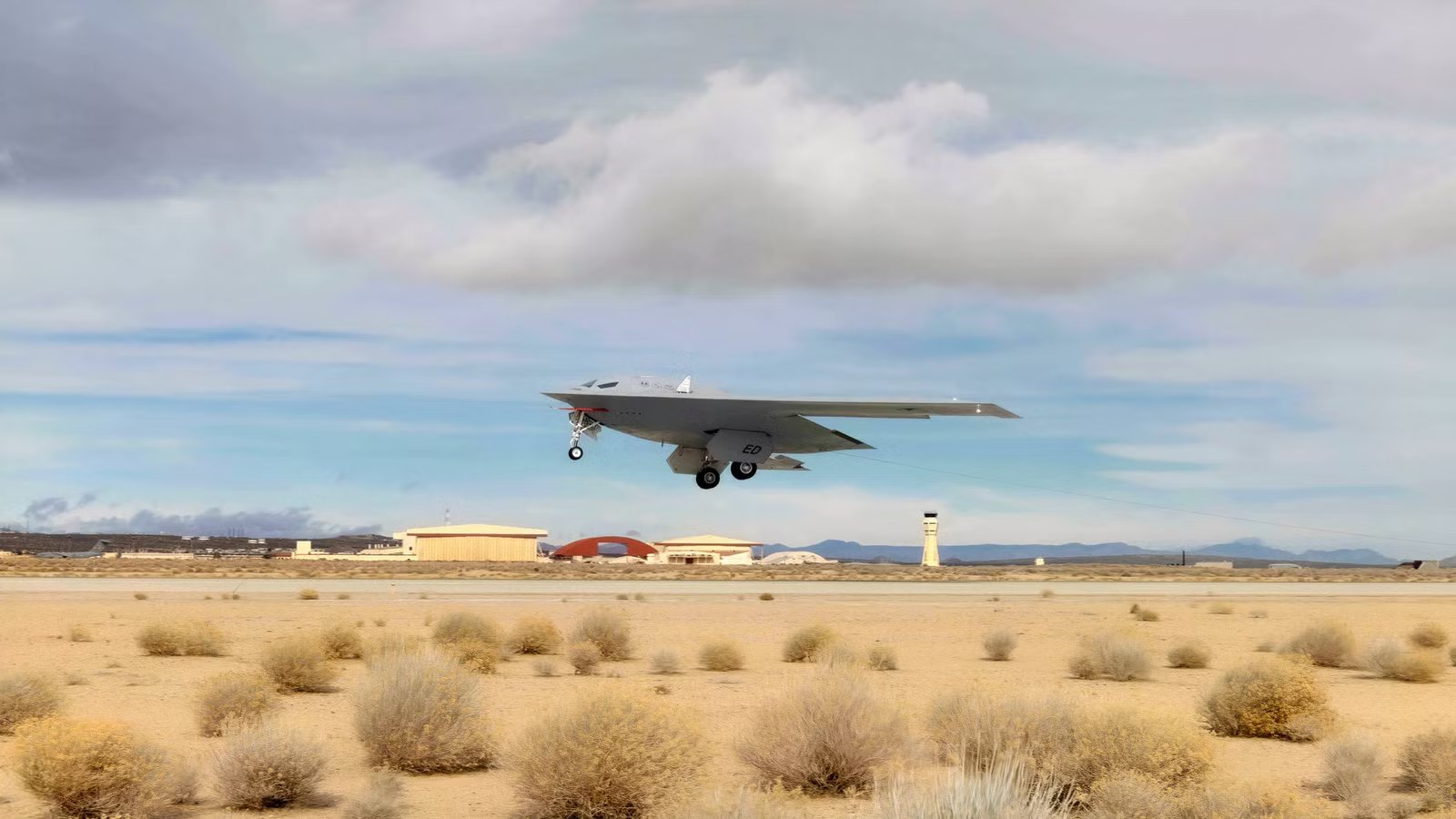
The Northrop Grumman B-21 Raider has been carrying out the majority of its testing and evaluation at Edwards Air Force Base (AFB) in southern California. These flights are being operated by the Air Force Test Center’s 412th Test Wing. These sensitive flights began in 2023, and the tempo of the evaluations has increased since 2025. On a recent test flight operating out of Edwards, a photograph has surfaced displaying the B-21’s control surfaces, which act as speed brakes.
The Raider is the United States Air Force’s newest stealth bomber. The aircraft is intended to be a direct replacement for the  Boeing B-1B Lancer and the Northrop Grumman B-2 Spirit, which are likely to be retired within the next 15 years. Further, the Raider will operate as a conventional, precision, and nuclear-strike aircraft, and is expected to reach initial operating capacity around 2027. Current projections indicate that the B-21 will have an estimated fleet size of 100–145 aircraft, and production is accelerating.
A Look At The Raiders’ Unique Control Surfaces And How They Work

Earlier this June, the first B-21 prototype carried out a test mission from Edwards AFB. As reported by the Aviationist, the Raider seen was operating under the call sign RAIDER17. As it was airborne, it was in the vicinity of two Boeing KC-46 Pegasus tankers and a Scaled Composite Hawker 4000 flying in orbit around the facility. The latter are generally used by the USAF for roles such as chase observation, sensor support, telemetry and range support, in addition to general test coordination activities.
Upon the test pilot notifying the flight control tower of their intention to land, the attendant aircraft broke their orbit, and the B-21 proceeded to make a safe landing. At this point, the B-21’s unique control surfaces—which function as speed brakes—were observed.
On the Raider, there is no publicly confirmed traditional speed brake system, as seen on many conventional aircraft. Modern stealth aircraft often avoid large external speed brakes because they increase drag and radar cross-section. Such systems are typically located where they can generate significant drag without compromising stability, such as on the fuselage, upper wing surfaces, or in some military designs near the tail. When engaged by the pilot, these surfaces deploy into the airstream, increasing drag and sometimes reducing lift, enabling the aircraft to decelerate or increase its rate of descent in preparation for landing.
However, with the B-21, rather than relying on traditional speed brakes that deploy as separate surfaces, the aircraft can use existing flight-control surfaces to generate additional drag when required. This approach integrates speed management into the same flight-control system that governs pitch, roll, and yaw. Given the B-21 Raider’s stealth flying-wing configuration, this method offers two key advantages. First, it avoids large surface discontinuities or protruding panels that could increase radar cross-section. Second, it allows drag to be introduced in a controlled and potentially symmetrical manner, thereby helping maintain stable handling during phases such as approach, aerial refueling, or descent.

In Pictures: A Look Back At The Historic 1st B-21 Raider Test Flight At Edwards Air Force Base
In 2024, the B-21 Raider soared over Edwards AFB in a historic achievement to unconventional aircraft designs and stealth technology.
Recent Developments In The Raider’s Testing Program

The B-21’s public flight testing program began on November 10, 2023, when the aircraft conducted its first publicly acknowledged flight from Air Force Plant 42 in Palmdale, California. For a new aircraft such as the Raider, the testing program can last years and encompass thousands of data points.
Military aircraft test and evaluation phases typically cover the following:
- Ground Testing
- Flight Sciences and Envelope Expansion
- Performance Testing
- Systems Testing
- Mission Systems Integration
- Stealth and Survivability Testing
- Aerial Refueling Testing
- Weapons Integration and Release Testing
- Operational Testing and Evaluation
- Certification and Capability Expansion
Recent flight evaluations have involved air-to-air refueling missions. One of these operations took place earlier this March and lasted approximately five and a half hours. Additionally, the USAF has publicly confirmed that the B-21 has been conducting aerial refueling from a Boeing KC-135 Stratotanker, as part of its ongoing aerial testing program.
Further, it has been reported that the Raider has completed a 180-day test phase in 73 days within the last two to three months. The recent interaction with USAF tankers is a strong indication that this phase was the refueling phase. This suggests that the aircraft has performed reliably across multiple sorties, suggesting that the test flight could accomplish several planned evaluations per flight, rather than being forced to land in order to investigate technical problems and begin a new round of assessments. Additionally, analysts have indicated that this rapid progress is a sign of high levels of software maturity and systems integration achieved prior to the initiation of testing.

Aerial Refueling Operations: How the US Military Extends Fighter Jet Range
Aerial refueling is a crucial force multiplier and U.S. military has relied on this capability since the Vietnam War.
The B-21 Is Rapidly Moving Towards Operational Status

As of this year, Northrop Grumman and the USAF are accelerating the Raider’s production capacity and have agreed to increase manufacturing by 25 percent. This move is extending the timeline for the aircraft to attain active-duty status. To this point, Northrop’s CEO, Kathy Warden, has stated that “Northrop Grumman has invested more than $5 billion in digital engineering and manufacturing infrastructure, and we are ready to produce B-21 faster.”
According to Secretary of the Air Force Troy Meink, “The B-21 is foundational to our long-range strike capability and to credible deterrence.” He further states that accelerating “…production capacity now ensures we deliver operational capability to combatant commanders faster — strengthening our ability to outpace, deter, and, if necessary, defeat emerging threats. This is disciplined execution at the speed the security environment demands.”
According to the company, the support infrastructure for the B-21 consists of 8,000 industry and USAF personnel, who design, build, and test the aircraft. The ecosystem that supports its manufacture comprises more than 400 suppliers across 40 states. The development and breadth of this wide supply chain indicates that the program has gained a very high degree of confidence and will remain in production, sustainment, and modernization for decades.
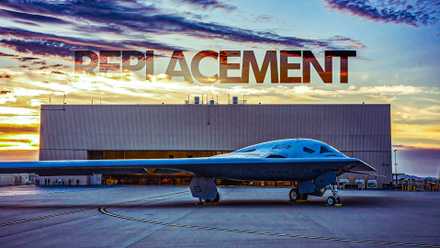
Here’s Why The Northrop Grumman B-21 Raider Is Replacing The B-2 Spirit
As the B-2 is aging, out of production, and not available in sufficient numbers, the Air Force needs a fresh next-generation replacement bomber.
The Utility Of Long Range Deep Strike Bombers

Long-range deep strike bombers provide capabilities and options that no other aircraft in the USAF arsenal provides. With their long range, large payloads, and onboard sensors, these bombers are ideal for conventional saturation strikes against fortified targets, or targets that were constructed deep beneath the earth, such as the mountains protecting some of Iran’s nuclear infrastructure. To this point, such targets can only be effectively engaged with extremely heavy bombs, such as the 30,000-lb (13,608 kg) GBU-57A/B Massive Ordnance Penetrator, which can only be delivered by the Northrop Grumman B-2.
Aircraft such as the B-2 and the B-1B Lancer have the capability to penetrate air defenses due to their stealth characteristics and engage in suppression of enemy air defense missions (SEAD). The destruction of the anti-aircraft missiles, radar, and other sensors at these sites opens a path for other aircraft to engage in their mission-sets. This critical mission can be carried out by fifth-generation fighters. However, the large payloads of the bombers ensure that many more targets are hit and destroyed per sortie, increasing mission effectiveness and reducing the risk to pilots.
Finally, the bomber fleet is unique in that it is capable of carrying nuclear weapons. In a crisis, these aircraft can be postured to reduce response time and their time to target. Additionally, they can be widely dispersed across numerous air bases in order to reduce their vulnerability to attacks. These aircraft also represent the most visible component of the US nuclear triad. Their ability to deploy, remain on airborne alert, return to base, or, if needed, proceed on their strike mission enhances the options of policymakers and displays resolve during a time of crisis.
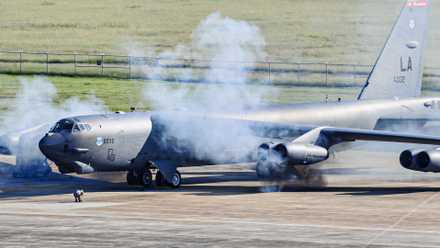
The Cold War Operation That Kept Nuclear-Armed B-52s Minutes From Soviet Airspace At All Times
The reason why the USAF kept nuclear armed B-52s on continual rotation just outside of Soviet airspace…for nearly a decade.
The B-21 Will Provide Key Capabilities As Older Bombers Retire

Due to the commitment to increase manufacturing capacity and the breadth of its supply chain, the B-21 is clearly viewed as a major defense priority. This is because the aircraft will, once operational, reinforce and strengthen America’s nuclear deterrence posture through its combination of stealth, survivability, and long-range strike capabilities. This is clearly a priority, as the B-1 and B-2 bombers will likely be retired over the coming decades, and a capable replacement is required at a time when strategic competition among major powers is rising and is expected to persist.
In conventional operations, the Raider will provide commanders and military planners with numerous options for precision strike, electronic warfare, suppression of enemy air defenses, and intelligence, surveillance, and reconnaissance missions. Future operations are likely to rely on the aircraft’s ability to help shape the battlespace before and during hostilities, increasing the effectiveness of follow-on military actions. From both a tactical and strategic perspective, the timely fielding of the B-21 is increasingly important in light of emerging security challenges.


![5,100 Miles: Inside The USA’s 11 New Longest Nonstop Domestic Flights [List & Map]](https://dailynewsnblog.com/wp-content/uploads/2026/09/united-airlines-boeing-767-400er.jpg)