dailynewsnblog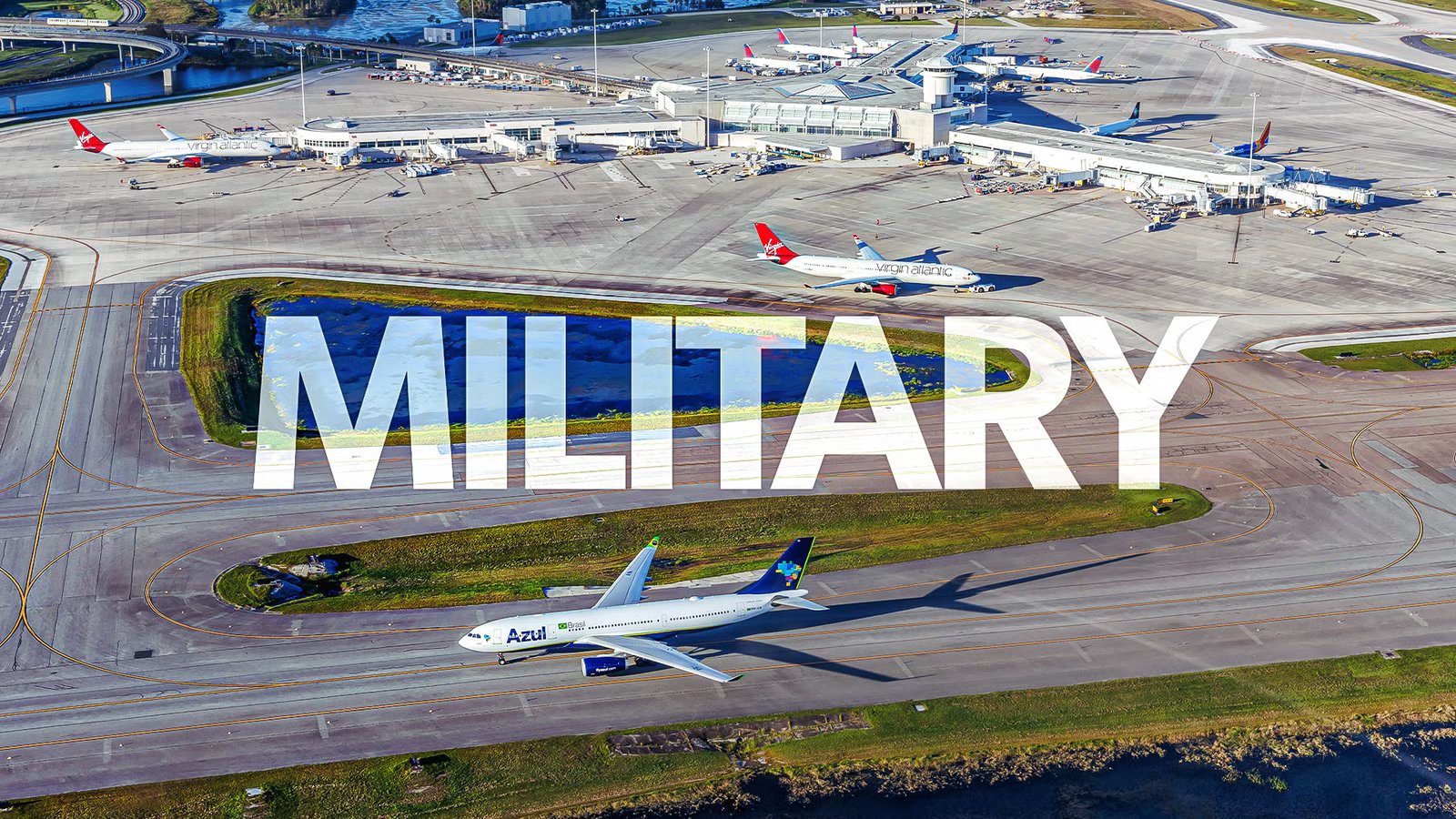
Commercial airports are often associated with bustling terminals, duty-free shopping, and millions of passengers passing through each year. However, many of today’s busiest aviation gateways began life with a very different purpose. During both World Wars and the early Cold War, military airfields were built to support combat operations, strategic bombing campaigns, and national defense.
As military priorities evolved after the war, several of these bases found a second life as civilian airports while retaining unmistakable reminders of their martial origins. In this article, we will highlight ten airports that successfully transitioned from military installations into major commercial aviation hubs. Beginning in the United States before moving through Europe and Asia, these airports demonstrate how wartime infrastructure became the foundation for modern air travel.
Orlando International Airport
From Strategic Bomber Base To Florida’s Busiest Gateway

Shutterstock
Today’s  Orlando International Airport (MCO) welcomes more than 57 million passengers annually, but its three-letter code is a reminder of its military past. The airport occupies the site of the former McCoy Air Force Base, named after Colonel Michael NW McCoy, who died during a B-47 training accident in 1957. Even after the Air Force closed the base in 1975, Orlando retained the MCO airport code as a tribute to its military history.
The installation originally developed from Pinecastle Army Air Field during World War II and later became a Strategic Air Command base during the Cold War. McCoy Air Force Base hosted long-range  Boeing B-52 Stratofortress bombers and Boeing KC-135 Stratotanker aircraft, making it a key component of America’s nuclear deterrent. During the Cuban Missile Crisis, the base became one of the nation’s most strategically important locations.
Although the military left decades ago, traces of McCoy remain throughout the airport. MCO’s exceptionally long runways were designed for heavy bombers, while historical displays inside the terminal commemorate the base’s service. Every airline ticket carrying the airport code ‘MCO’ preserves the legacy of McCoy Air Force Base.
Bangor International Airport
A Cold War Base That Still Supports Military Aviation

Bangor International Airport (BGR) in Maine owes much of its modern infrastructure to Dow Air Force Base, which operated from the early Cold War until its closure in 1968. Following military deactivation, the City of Bangor transformed the installation into a commercial airport while retaining many of its military facilities and an exceptionally capable airfield.
The airport’s long runway, extensive ramp space, and robust infrastructure were originally designed to accommodate Strategic Air Command bombers. Today, these same features make Bangor one of North America’s premier technical diversion airports for transatlantic flights. It also remains a frequent stop for military aircraft crossing the Atlantic, particularly US Air Force transport and refueling missions.
Bangor ranks highly because its military heritage remains operational. Civilian passengers regularly share the airfield with military traffic, while portions of the former base continue supporting defense-related activities. This former military airport integrates seamlessly with both commercial and military operations.
The United States’ 10 Oldest Airports Still In Operation
A closer look at America’s ten oldest continuously operating airports .
Rickenbacker International Airport
America’s Cargo Hub With Air Force Roots

Located south of Columbus, Ohio, Rickenbacker International Airport (LCK) occupies the former Lockbourne Air Force Base, which served the US Air Force from 1948 until 1981. During the Cold War, Lockbourne hosted Strategic Air Command bombers before becoming home to tanker aircraft supporting global operations, according to the US Army Corps of Engineers archive.
Following military base closure, civilian authorities converted the installation into an international cargo airport while preserving much of its military infrastructure. Today, Rickenbacker’s massive aprons, long runways, and spacious layout accommodate large freighters from operators including Cargolux, Kalitta Air, and other cargo specialists that benefit from facilities originally designed for military aircraft.
Unlike airports where military history has faded into the background, Rickenbacker’s origins remain immediately apparent. The airport still shares facilities with the Ohio Air National Guard’s 121st Air Refueling Wing, whose Boeing KC-135 Stratotankers continue operating from the former military base. This ongoing military presence makes the airport’s transformation especially distinctive.
Catch what other flight trackers miss
Emergency squawks, holds, NOTAMs — live signals, no signup.
Open tracker
Catch what other flight trackers miss
Emergency squawks, holds, NOTAMs — live signals, no signup.
Open tracker
Frankfurt Airport
Germany’s Global Hub Was Built For Military Aviation

 Frankfurt Airport (FRA) is now among Europe’s busiest international hubs, but its history stretches back to military aviation before and during the Second World War. The Rhein-Main airfield developed as both a civilian and military installation, serving the German military before later becoming one of the most important American air bases in Europe following the war.
After 1945, Rhein-Main Air Base became a central hub for the United States Air Force. It played a critical role during the Berlin Airlift of 1948-1949, with thousands of relief flights departing to supply West Berlin. For decades afterward, military transport aircraft shared facilities alongside an expanding civilian airport that rapidly became Germany’s primary international gateway.
Frankfurt’s military origins helped create one of the world’s premier aviation hubs, even though many wartime structures have disappeared. While Rhein-Main Air Base officially closed in 2005, portions of its former facilities have been incorporated into Frankfurt Airport’s continued expansion, illustrating how military aviation directly shaped one of Europe’s most important airports.
Keflavík International Airport
America’s Cold War Outpost Became Iceland’s Aviation Gateway

Keflavik International Airport (KEF), due to its strategic location between two continents, owes its existence directly to military necessity. Construction began in 1942, after the United States entered the Second World War, when American forces built two airfields on Iceland’s Reykjanes Peninsula to protect vital North Atlantic shipping routes and ferry aircraft between North America and Europe, according to Gray Line Travel Iceland.
Following the war, the installation evolved into Naval Air Station Keflavík, becoming one of NATO’s most strategically important Cold War bases. American Navy P-3 Orion maritime patrol aircraft, Air Force fighters, and other NATO assets operated from Keflavík for decades, monitoring Soviet submarines moving through the Greenland-Iceland-United Kingdom (GIUK) Gap. The base remained active until the withdrawal of permanent US forces in 2006.
Today, millions of passengers pass through the same runways while connecting between Europe and North America on Icelandair and numerous international airlines. However, evidence of the airport’s military past remains easy to spot, from hardened aircraft shelters and former military infrastructure to the expansive airfield layout that was originally designed to support wartime operations.
7 Commercial Airports With Runways So Long They Were Originally Built To Handle Space Shuttles
Many forget that airports are not always designed with airliners in mind. Many are actually designed with craft that fly much higher.
Rome Ciampino Airport
Italy’s Original Capital Airport Began As A First World War Military Airfield

Before Rome Fiumicino Airport (FCO) became Rome’s primary international gateway, nearly all scheduled flights serving the Italian capital operated through Rome Ciampino Airport (CIA). While today it is best known as a base for low-cost carriers and government flights, the airport’s origins are firmly rooted in military aviation, dating back more than a century.
Ciampino was established in 1916 during the First World War as a military airfield supporting Italian Army aviation and airship operations, including Zeppelins and other lighter-than-air craft. Throughout the interwar period, it remained under military control while gradually accommodating pioneering civil flights. During the Second World War, the airport once again became an important military installation, supporting Italian and later German military operations before suffering extensive Allied bombing.
Although modern passenger terminals have transformed the airport, its military heritage remains surprisingly visible. Ciampino still hosts the Italian Air Force’s 31st Wing, which operates government and VIP transport aircraft, including flights carrying senior Italian officials. Military aircraft remain a common sight alongside Ryanair and Wizz Air jets, making Ciampino one of Europe’s clearest examples of a dual-use airport whose wartime roots never completely disappeared.
Moscow Vnukovo International Airport
A Soviet Military Airfield That Still Serves State Aviation

Moscow Vnukovo International Airport (VKO) opened in 1941, just as Nazi Germany invaded the Soviet Union, and immediately became part of the Soviet war effort. During the Second World War, the airport handled military transport missions, logistics operations, and aircraft movements supporting the defense of Moscow. Its strategic location quickly established it as one of the Soviet Union’s most important aviation facilities.
Following the war, Vnukovo evolved into one of the USSR’s principal civilian airports while retaining an important government and military role. Unlike many former military airfields that became entirely commercial, Vnukovo has continued supporting official state aviation throughout its history. Today, the airport serves scheduled passenger airlines as well as Russia’s Special Flight Squadron, which operates aircraft that transport the country’s president and other senior government officials.
Vnukovo’s military legacy has never truly ended. Modern passenger terminals stand beside facilities dedicated to state aviation, and a military detachment continues operating on airport grounds. Vnukovo demonstrates an uninterrupted continuity between wartime operations, Cold War service, and present-day government aviation, making it one of the clearest surviving examples of a military airfield successfully adapted for commercial use.
Kyiv Zhuliany International Airport
Ukraine’s Historic Airfield With A Military Legacy

Located just a few miles from central Kyiv, Kyiv International Airport Zhuliany (IEV) is one of Eastern Europe’s oldest continuously operating airports. Opened in the 1920s, the airfield assumed an increasingly important military role during the Second World War and throughout the Soviet era, serving both military and civilian aviation. During the German occupation, the airport was used by the Luftwaffe before returning to Soviet control as the Red Army advanced westward.
After the war, Zhuliany became a mixed-use airport supporting military transport, pilot training, and scheduled passenger services. While the larger Boryspil Airport (KBP) eventually became Ukraine’s primary international gateway, Zhuliany continued to handle domestic and regional flights while maintaining facilities associated with military and government aviation. Its compact location within the city meant that many of its original airfield characteristics remained intact and were not redeveloped.
Even today, Zhuliany’s military heritage is evident beyond its runway layout. The airport is home to the State Aviation Museum of Ukraine (Oleg Antonov Aviation Museum), one of Eastern Europe’s finest collections of Soviet-era military and civilian aircraft. Visitors can see everything from MiG fighters and Sukhoi attack aircraft to strategic bombers and transport aircraft, providing a tangible reminder that the airport’s history extends far beyond commercial aviation.
The World’s 5 Largest Air Cargo Hubs In Operation
From North America to Asia, which are the world’s largest air cargo hubs?
Gimpo International Airport
Built By Imperial Japan, Reborn As South Korea’s Domestic Hub

Long before Incheon International Airport opened in 2001, nearly every international traveler to South Korea arrived through Gimpo International Airport (GMP). However, the airport’s origins date back to one of the darkest periods in Korean history. Construction began in 1939 under Japanese colonial rule, when the Imperial Japanese Army built the airfield as a military base to support operations during the Second World War. Following Japan’s surrender in 1945, the United States military assumed control of the airfield.
The US then transferred it to the newly established Republic of Korea. During the Korean War, Gimpo became one of the conflict’s most strategically important airbases. United Nations forces and the US Air Force launched fighter, transport, and logistics missions from the airport, while control of the base changed hands several times during the fighting. After the war, its military-grade infrastructure provided an ideal foundation for South Korea’s expanding civil aviation sector.
Although Incheon now handles most long-haul international traffic, Gimpo remains one of Asia’s busiest domestic airports and also serves international routes to destinations such as Tokyo, Osaka, Beijing, Shanghai, and Taipei. Despite decades of modernization, the airport’s expansive airfield, military-style layout, and adjacent Republic of Korea Air Force facilities continue to reflect its wartime origins, making it one of the continent’s best-preserved examples of a military airport successfully transformed into a civilian gateway.
Don Mueang International Airport
Asia’s Oldest Operating Airport With Military Origins Still On Display

Don Mueang International Airport (DMK) rounds out this list, and not many former military airfields have retained such a close connection to their original purpose while simultaneously becoming major commercial airports. Opened in 1914 as a Royal Thai Air Force base, Don Mueang is one of the world’s oldest continuously operating airports and served military aviation throughout both World Wars. During the Second World War, Japanese forces used the airfield after occupying Thailand.
After the war, Don Mueang rapidly emerged as Thailand’s principal international airport, welcoming airlines from across Asia, Europe, and beyond. Even after Suvarnabhumi Airport (BKK) became Bangkok’s primary international gateway in 2006, Don Mueang experienced a remarkable revival as one of the world’s busiest airports for low-cost carriers. Today, airlines such as AirAsia, Nok Air, Thai Lion Air, and several international operators handle tens of millions of passengers.
For Don Mueang, military history remains integral to the airport’s daily operations. Commercial airliners taxi past Royal Thai Air Force facilities, military aircraft regularly operate alongside scheduled passenger flights, and the airport’s original military purpose remains evident more than a century after it opened. Bangkok’s historic Don Mueang illustrates the seamless evolution from a military base to a commercial aviation hub as clear as a blue sky.