dailynewsnblog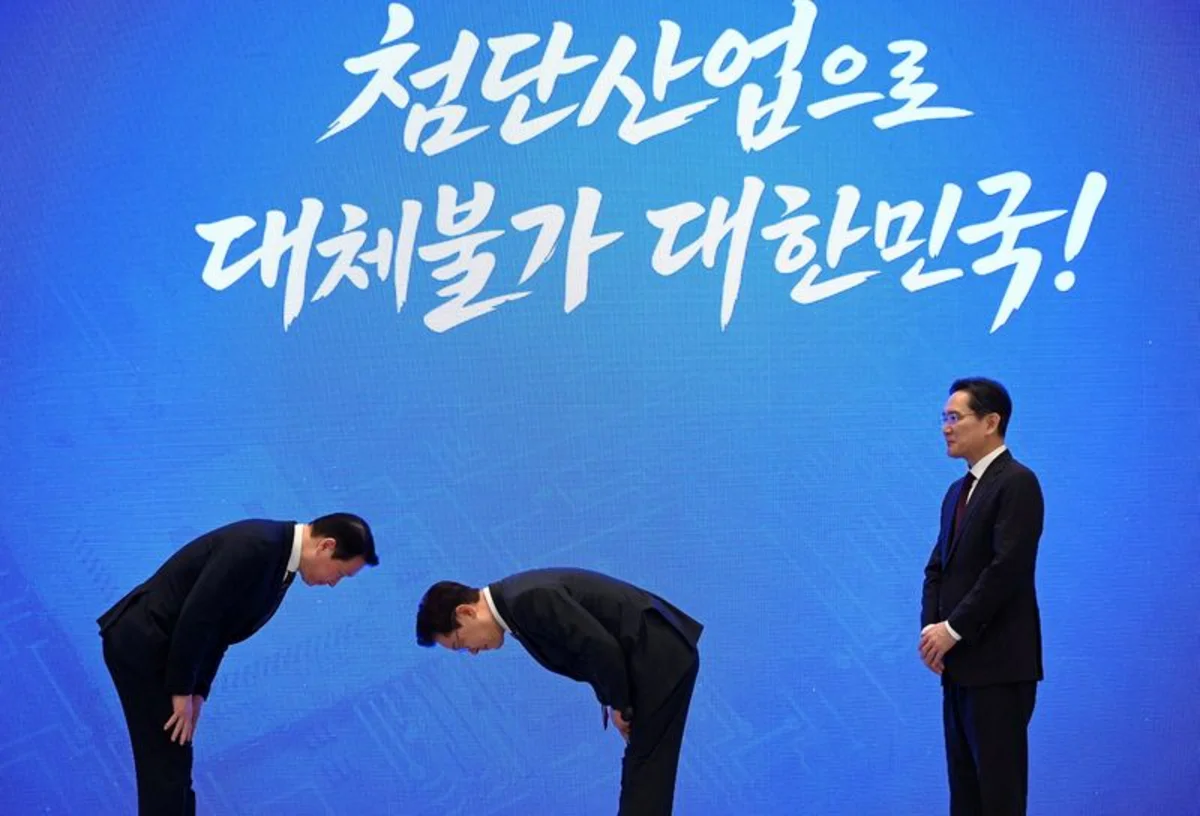
By Hyunjoo Jin and Heekyong Yang
SEOUL, June 30 (Reuters) – Samsung Electronics and SK Hynix are making one of the biggest bets yet on the artificial intelligence boom with investments worth hundreds of billions of dollars, but the planned capacity buildout is stoking fears of a painful reckoning if AI spending cools.
The tech giants won praise – and a deep bow – from President Lee Jae Myung after throwing their weight behind the government’s semiconductor push, in an apparent departure from a previously restrained approach to capacity expansion shaped by decades of painful boom-and-bust cycles in the memory industry.
Under the plan, the government hopes South Korea can double its memory chip production capacity within five years. Samsung and SK Hynix will also accelerate construction of fabs in the existing Yongin semiconductor cluster, shortening the 7-12 year timelines and bringing additional capacity online sooner.
Together, the world’s two biggest memory chipmakers pledged 3,200 trillion won ($2.07 trillion) of investment, encompassing a new 800 trillion won chip cluster in the country’s southwest as well as previously announced projects.
South Korea is emerging as a major winner from the surge in global AI investment, driven by Samsung Electronics and SK Hynix’s commanding position in high-bandwidth memory (HBM) chips essential to advanced AI processors.
The announcement comes as customers ranging from AI hyperscalers to electronics makers such as Apple press for more memory chips amid a global shortage. But analysts note that chip plants take years to build and ramp up, meaning much of the new capacity will not arrive until well into the next decade.
“We see memory pricing remaining a function of demand and supply, and accelerating capex over the next decade further increases the risk of an oversupply longer term,” said Morningstar analyst Jing Jie Yu.
The memory chip boom remains reliant on whether AI hyperscalers would keep expanding at the current rate, he added.
Lee Jong-ho, a professor at Seoul National University’s Department of Electrical and Computer Engineering, said the investments appeared to have been pushed through too quickly.
“It is the kind of investment that could determine a company’s future,” he said.
“No one knows what the situation will look like three years from now. We need to respond quickly while demand is strong, but after that, demand is uncertain and decisions should be made cautiously.”
FROM CAUTION TO EXPANSION
The soaring profitability of Samsung and SK Hynix’s memory businesses is a relatively recent phenomenon, driven by the global AI boom and an acute memory-chip shortage that has nearly doubled chip prices in the first quarter alone.