dailynewsnblog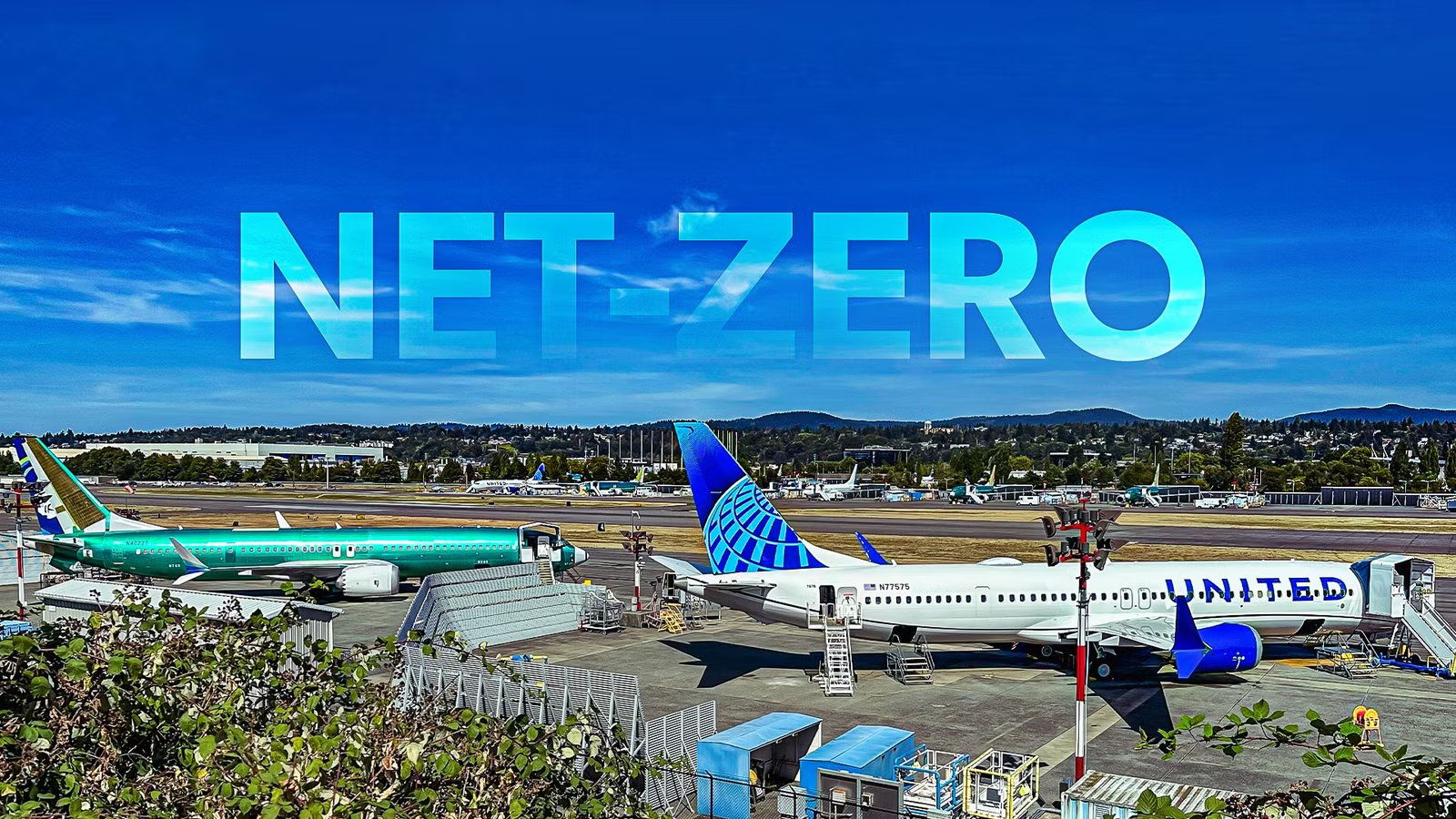
The majority of industries around the world are working towards making the planet more sustainable, and aviation is no exception. Aviation is a major contributor to climate change. Its fuel consumption accounts for around 2.5% to 2.8% of global carbon emissions each year. And, when non-carbon effects such as other gas emissions and contrails are included, aviation’s overall contribution to climate change could be as high as 5%.
The industry has acknowledged this impact and committed to reducing it. Five years ago, International Air Transport Association (IATA) airline members pledged to achieve net-zero carbon emissions from their operations by 2050. Since then, several efforts have been made to reduce emissions further. However, external challenges are putting pressure on that trajectory.
Inside IATA’s 2050 Net-Zero Roadmap

IATA approved a resolution for the global air transport industry to achieve net-zero carbon emissions by 2050 during its 77th Annual General Meeting (AGM) in October 2021. At the time, the association estimated that by 2050, around 10 billion people would fly in a single year, requiring the industry to abate approximately 1.8 gigatons of carbon in that year alone. To reach that level of reduction, IATA set out a combination of measures spanning the entire aviation value chain.
These include the use of sustainable aviation fuels (SAF), improvements in aircraft and engine technology, and operational efficiency gains across flight operations and infrastructure. The framework also accounts for longer-term solutions such as hydrogen and electric propulsion, which remain under development for commercial aviation. Furthermore, for emissions that cannot be eliminated directly within the sector, the association has pointed to out-of-sector mechanisms such as carbon capture and storage.
“We have a plan…A potential scenario is that 65% of this will be abated through sustainable aviation fuels. We would expect new propulsion technology, such as hydrogen, to take care of another 13%.” Willie Walsh, outgoing Director General of IATA, said. “And efficiency improvements will account for a further 3%. The remainder could be dealt with through carbon capture and storage (11%) and offsets (8%). The actual split, and the trajectory to get there, will depend on what solutions are the most cost-effective at any particular time.”
Aircraft Delivery Delays Are Slowing Fleet Renewal

Despite the industry’s commitment to net-zero, the timeline is becoming increasingly uncertain. Speaking during IATA’s 82nd AGM in Rio de Janeiro, Walsh said the 2050 target remains “still possible” to achieve, but acknowledged that “we are clearly off track.” One of the main reasons behind that is the persistent delay in aircraft deliveries. For airlines, one of the most effective ways to reduce emissions is through fleet renewal. As aircraft age, maintenance requirements increase and fuel efficiency declines.
Modern aircraft are designed to consume less fuel than their predecessors, benefiting from advances in aerodynamics, lightweight materials, and engine technology. For instance, aircraft powered by new-generation engines, such as the Airbus A320neo family, consume around 15% less fuel and produce proportionately lower carbon emissions than previous-generation models. Older aircraft, meanwhile, can consume notably more fuel, increasing both operating costs and environmental impact. However, delivery delays at Airbus and Boeing have left airlines waiting longer for the aircraft they intended to use as replacements.
Indeed, this has slowed fleet renewal efforts across the industry and forced many carriers to keep older aircraft in service for longer than planned.
“We are continuing to do everything we said we would do, but we can’t achieve net-zero in 2050 on our own,” Walsh added. “We said that from the very beginning, and we are very disappointed, particularly with the OEMs delaying the delivery of new aircraft, because that means our gross emissions are higher than they should be, which makes the gap even wider.”
Why Cargo Airlines Can’t Replace Their Aging Freighters Even Though They Desperately Need To
Cargo flats are getting older, and the end is getting further out of sight. With delays more common than ever, when will cargo operators modernize?
Why Aircraft Backlogs Continue to Grow

Indeed, the demand is there. During the first quarter of 2026, commercial aircraft manufacturers received nearly 570 orders for new aircraft, making it the strongest first quarter for orders since 2013. Deliveries, however, told a different story. Manufacturers handed over 261 aircraft during the same period, around 4% fewer than in the first quarter of 2025. According to IATA, the global aircraft backlog has now grown to more than 18,000 aircraft. But what is causing these delays? Well, several factors are contributing to the problem.
Supply chain constraints remain the industry’s biggest challenge, particularly those linked to labor shortages, and continue to affect manufacturers across multiple tiers of production. Due to a collapse in demand during the COVID-19 pandemic, manufacturers and suppliers reduced their workforces and scaled back production. However, air travel recovered much faster than many had anticipated, leaving companies scrambling to rebuild capacity and meet renewed demand for aircraft.
Additionally, the pandemic also saw a wave of early retirements as employees who were already considering leaving exited the industry during the downturn. That further widened the skills gap just as production began to recover. Manufacturers have spent the past several years hiring new employees and expanding production capabilities. That said, replacing experienced workers is not a quick process. New hires require extensive training before they can work on aircraft production lines, and it can take years for employees to develop the skills and experience needed for highly specialized manufacturing roles.
Engines And Interiors Are Also Slowing Aircraft Delivery Timelines

Furthermore, another major source of delay is coming from engine manufacturers. They are currently facing shortages of critical materials and components. As a result, engine output has not kept pace with airframe production, which is directly affecting aircraft delivery timelines. Besides, some engine manufacturers are facing technical and quality-related challenges. For instance, Pratt & Whitney has been managing ongoing issues related to its geared turbofan (GTF) engine family.
The situation has required additional inspections and maintenance actions, which have increased pressure on already stretched supply chains. In some cases, aircraft have been assembled but remain grounded or undelivered due to engine availability constraints. Aircraft interiors are also contributing to the delays. Seat manufacturers such as Safran and Collins Aerospace are struggling to keep pace with demand because of ongoing supply chain constraints and certification delays affecting some new products.
In certain cases, aircraft have left final assembly without cabin components, delaying entry into service. Lufthansa’s Allegris business class is one of the clearest examples of such delays. Another example is  Delta Air Lines’ planned transcontinental Airbus A321neo subfleet. These aircraft were intended to be delivered in late 2024 with a new DeltaOne seat based on the Safran VUE, but the seats have not yet received FAA certification.

Why Experts Believe It Will Take Years To Fix Aviation’s Challenges
Multiple factors prevent the airline industry from healing, and the current situation shows no indication of fast recovery.
IATA: SAF & CORSIA Are Falling Behind Net-Zero Expectations

Indeed, all these challenges are affecting aircraft deliveries and their entry into service. As a result, they are directly slowing the sector’s progress towards its climate ambitions. However, these are not the only issues affecting that trajectory. During the recent AGM, Walsh said that two fundamental components of the net-zero roadmap are now under pressure: CORSIA, the Carbon Offsetting and Reduction Scheme for International Aviation, and sustainable aviation fuel (SAF).
More than half of aviation’s planned decarbonization pathway depends on the development of SAF. The rest relies heavily on CORSIA, which allows airlines to offset emissions they cannot cut directly. Walsh noted that CORSIA was being “undermined” by government inaction (so far, only a few countries have made credits available), while global SAF production is expected to reach only 2.4 million tonnes this year—around 0.8% of airline fuel demand.
“The goal is 65% or 500 million tonnes by 2050. The gap is wide and not closing fast enough,” he said. He added that governments had already set an ambition through ICAO to achieve a 5% emissions reduction by 2030 through SAF usage, but warned, “to be blunt, there is no path to meet that outcome. There is still hope for 2050 – but that’s fading fast … We need an urgent dialogue to determine a realistic timeline given the current state of affairs.”
In a separate remark, Walsh commented that “it is still possible to achieve net-zero by 2050, but it requires all of these players who were very vocal in their commitment to net-zero to start taking action, rather than just standing there saying that they are committed to it. We need everyone to contribute their part…As an airline industry, we remain committed, but we can’t do it on our own.”
The Gap Between Aviation’s Targets And Reality Is Growing

It is becoming increasingly clear that the aviation industry is unlikely to stay fully on track to meet its net-zero target under current conditions. When IATA passed the resolution in 2021, it was not only airlines that committed to the goal. Airports, air navigation service providers, manufacturers, and fuel suppliers all pledged to play their part in the transition. However, progress has not kept pace with those commitments.
As discussed above, several factors contribute to the gap, and aircraft delivery delays are among the most significant. OEMs continue to face prolonged supply chain constraints, limiting their ability to deliver new aircraft on schedule. As a result, airlines are being forced to operate older fleets for longer periods. Compared to newer-generation aircraft, these aircraft are less fuel-efficient and produce higher emissions per flight, which slows the rate of emissions reduction across the sector.
Sadly, these delays are not expected to ease quickly. Supply chain pressures are likely to persist for several more years (at least until the end of this decade), which means fleet renewal is set to remain slower than originally planned. In turn, that will continue to push back the industry’s ability to close the gap towards its net-zero ambitions.