dailynewsnblog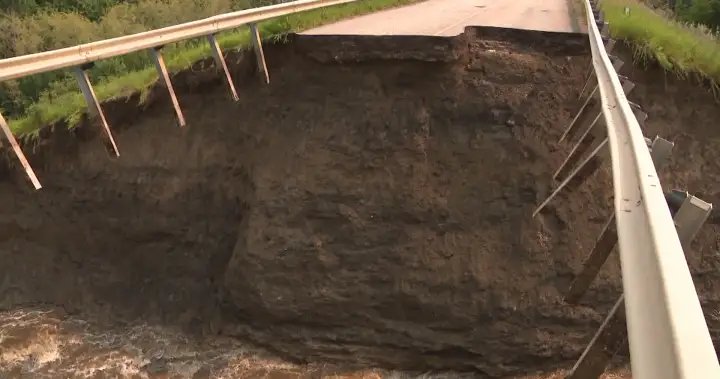
While the heaviest of the rainfall appears to have tapered off, residents across much of central and southern Alberta are still keeping a nervous eye on rivers and streams as the runoff takes place and water levels start to peak.

“We saw accumulations of up to 150 millimetres,” in the Bow River and Elbow River basins, said Frank Frigo, manager of environmental management for the city of Calgary. “That’s six inches of total water that fell in less than 24 hours.”
The huge amount of precipitation resulted in high streamflow warnings, flood watches and flood warnings being issued for dozens of waterways.
For the first time, water was diverted from the Elbow River into the Springbank off-stream reservoir over the weekend to help protect the City of Calgary, which is located downstream.
Global News
In Calgary, a high streamflow advisory was put in place for the Bow River while a flood watch was put in place for the Elbow River. For the first time, water was allowed to flow into the Springbank off-stream reservoir.
The normally dry reservoir was constructed west of Calgary at a cost of more than $800 million following the devastating 2013 flood to provide a place to temporarily store excess runoff, in hopes of preventing a similar flood from happening again.
Crews from the City of Calgary are seen measuring the streamflow in the Elbow River, near the Springbank off-stream reservoir on Monday.
Global News
Calgary Fire Department public information officer Alex Kwan also warned that people and their pets should stay away from riverbanks. Kwan said not only is the water very cold (about 12C), but the current is also strong and full of debris.

Get breaking National news
Get breaking Canada news delivered to your inbox as it happens so you won’t miss a trending story.
“We’ve had a lot of high winds accompanying the rainfall, so that’s where we’ll see more branches and trees in the water, which become hazards,” said Kwan.
“Being in the water, you’re going to move a lot quicker than you typically would —so trying to steer and navigate becomes more challenging. There’s the potential to be pushed into what’s called a sweeper, or strainers, which is objects like trees that can sit just below the water line, and that current can pin you against it … making it very, very difficult to get out of those situations,” Kwan added.
In Akenside, a rural residential area in Strathcona County, east of the Edmonton area, where about 60 millimetres of rain fell between Friday night and Monday morning, there was a gaping hole left in the road where the bridge crossing Oldman Creek was washed out.
What used to be a bridge along Township Road 534 in the village of Akenside, east of Edmonton, is now just a gaping hole after it became one of the casualties of the weekend storm.
Global News
Area residents told Global News that some beaver dams washed downstream and started blocking the culvert about a week ago.
The water couldn’t get through and, with all the rain, the pressure built up to the point that the backed-up culvert finally burst, taking the bridge downstream with it.
“We’ve been watching it every single day,” said Leanne Robinson. “It was really high — at least two metres higher than it usually is up the bank. Finally we heard some trees crumbling. We have had problems with beavers in the past, so we thought it was beavers, and then the next morning, it’s just missing.”
Kristen Nichols, who lives near the bridge, was scared the flooding might take her house, too.
“The weekend previous, we got all that rain and there was a beaver dam there and the beaver dam broke, so it clogged the whole system. I tried to call the county; they weren’t too concerned,” said Nichols.
“Then we got more water and rain over the last weekend and the water was creeping up to our property and then all of a sudden it kind of receded and we’re like, ‘Oh, they must be fixing it.’ Unfortunately when we were down there … everything was caving in. Everything fell in with the road and then it blocked the creek, so water wasn’t going through at all,” said Nichols.
Nichols said they started to unload their house, thinking it “could get swept away.”
“Who knows if it gets that high, if they’ll do anything tonight. So thankfully they did. The excavator came in and took it out and water is flowing.”
Emergency alerts also remain in place in Beaver County and Lac Ste. Anne County with overland flooding continuing to block many roads.
Officials in both counties say damage assessments and road repairs are underway, and while most residents are hoping the worst of the rain and flooding is behind them, emergency officials are warning motorists to avoid travel, or if they must travel, to check Alberta 511 for the latest closures and road conditions.
While it appears the heaviest of the rain is over, Environment Canada’s forecast says there is a possibility of some showers or thundershowers over the next few days.

© 2026 Global News, a division of Corus Entertainment Inc.