dailynewsnblog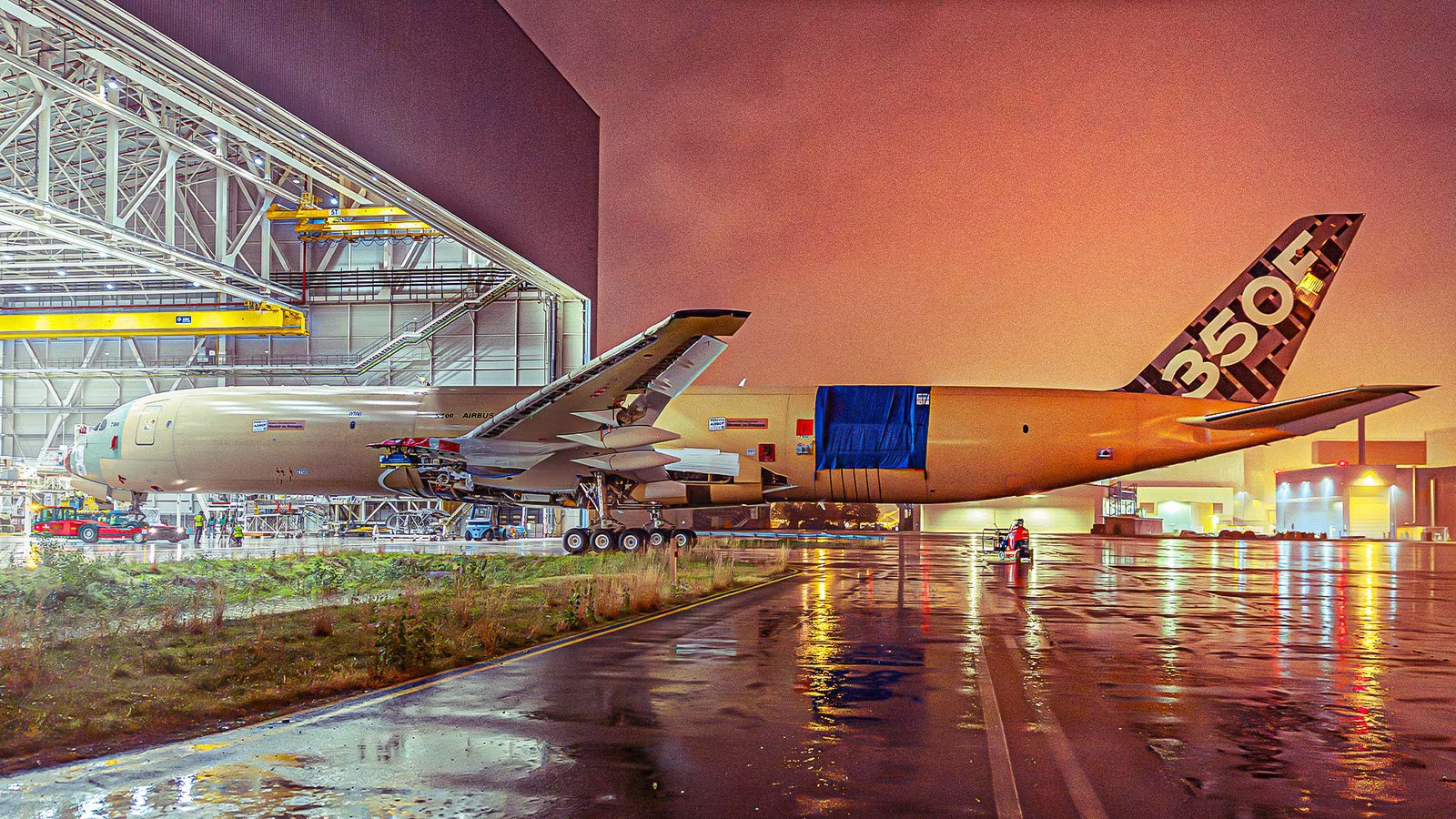
Here is the single most important fact about the Airbus A350F’s main deck cargo door: at 14 feet, 9 inches (4.5 meters) wide, it exceeds the width of the Boeing 747F’s hinged nose door, the access point that has defined the benchmark for oversized cargo loading in commercial aviation for more than 50 years, as well as the fuselage exterior width of the Embraer E175 and of the Bombardier CRJ900, approximately 10 feet, 9.6 inches (3.3 meters) and 10 inches (2.7 meters), respectively. The side door opens in seconds, without requiring the entire nose of the aircraft to swing away on hydraulic hinges. That comparison is the operational case for the A350F in the one cargo segment, where the aging 747F fleet has historically held a monopoly. The door arrived at Airbus’ final assembly line in Toulouse on April 21, and what it represents commercially is more significant than the engineering achievement the press releases emphasize.
The door’s dimensions are only part of the story. Its rear-fuselage location, composite construction, and role in the transportation of engines such as the General Electric GE9X and Rolls-RoyceTrent XWB reveal how Airbus is positioning the A350F for a market that will soon need replacements for hundreds of aging freighters. This article examines how the door compares with existing cargo aircraft, why Airbus designed it this way, and what it reveals about the future of long-haul air freight.
The Door That Exceeds A 50-Year Industry Benchmark

The 747F’s hinged nose door, introduced on the original 747-200F in 1971, became the global standard for oversized cargo access not because Airbus or anyone else designed a better alternative, but because, for over 50 years, nothing else needed to. The nose door opens the entire front fuselage cross-section to cargo loading: a full circular cut measuring approximately 13 feet (3.9 meters) at its widest point, allowing straight-in loading of cargo too large to turn through a conventional side door.
Cargo operators built entire business models around that access geometry. Engine manufacturers designed their logistics around it. Ground handlers trained generations of crews to work with it.
The 747F’s nose became the default answer to the question of how you load something very large onto a commercial aircraft. The A350F’s main deck cargo door measures 14 feet, nine inches (4.5 meters) wide and 14 feet, one inch (4.3 meters) tall — a total opening area of 208 square feet (19.35 square meters). According to Airbus’ official technical description of the door, the A350F’s opening is 15% wider than the 777F’s 12-foot (3.7-meter) side cargo door and wider than the 747F’s nose door opening.
That means the A350F’s side door can accept cargo items that currently require the specific geometry of a nose-loading aircraft. The implications for 747F replacement are direct: an operator transitioning from a 747F to an A350F does not lose the ability to carry the oversized cargo that justified the nose door, because the A350F’s side door can accept the same item, and it does so in a fraction of the time.
The Engine Mission: Why One Hour Of Loading Time Drove The Entire Design

The door’s dimensions were reverse-engineered from a specific cargo requirement generated by the commercial aviation industry in enormous quantities: the transportation of assembled commercial turbofan engines as single items. Every large commercial aircraft engine must be shipped periodically for overhaul, replacement, or delivery to airlines. These are items measuring roughly 14 feet (4.3 meters) in diameter at the fan face, weighing 15,000 to 20,000 pounds (6,800 to 9,000 kg), and unable to be disassembled for transportation without extensive technical procedures.
As mentioned in Airbus’ technical documentation on the A350F door, loading one of these engines through the 777F’s 12-foot (3.7-meter) side cargo door takes approximately one hour of ground repositioning and maneuvering: careful rotation, alignment adjustments, and incremental movement that requires specialized handling equipment and ground crew time at every step.
The same engine loaded through the A350F’s door takes only minutes because the door opening is wide enough that no rotation or repositioning is required. The engine enters at roughly the angle at which it exits the ground vehicle, and the loading operation is complete. For cargo operators running high-frequency engine logistics routes, 55 minutes of reduced ground time per aircraft movement, multiplied across dozens of weekly flights, represents a material operating cost reduction that drives fleet decisions.
As Simple Flying has reported in its coverage of the A350F door milestone, the door is positioned in the rear fuselage, an unusual location for a large main deck cargo door, specifically to maintain optimal center of gravity during loading operations. A door of this size located at the forward end of the main deck would shift loading weight toward the aircraft’s nose during loading cycles, creating a balancing challenge for ground crews. Positioning the door aft keeps weight distribution manageable during the loading sequence and allows the cargo floor system to be designed for efficient front-to-back loading rather than center-biased loading. Every element of the door’s location and dimensions is derived from the operational requirements it was engineered to meet.
The Aircraft Replacing The Iconic Boeing 747 Freighter
A look at the the next heavy hauler of the sky.

A door of this impressive size, attached to an aircraft that cruises at 35,000 feet (10,668 meters) and has a pressurized main deck, is an engineering feat of considerable structural complexity. It must bear the full differential pressure loads generated by cabin pressurization during flight, resist fatigue cracking across the aircraft’s design service goal of tens of thousands of flight cycles, seal against the fuselage cut-out to within fractions of a millimeter, and open reliably on demand in cargo handling environments ranging from hub airports with mature ground support equipment to less-equipped remote stations.
The A350F’s door was built using advanced composite materials throughout, the same carbon-fiber-reinforced polymer technology that constitutes approximately 70% of the entire A350 airframe by weight, rather than the aluminum alloy construction typical of older freighter doors.
The internal structure of the door alone comprises more than 500 individual parts: 12 structural frames, stiffeners, attachment pins, clips, seals, and components of the actuation system. That actuation system is electrically powered, a design choice which replaces hydraulic and pneumatic systems with electric equivalents wherever possible to reduce weight, maintenance complexity, and the number of fluid systems that can fail or leak. According to Airbus’ own engineering documentation on cargo loading system testing published in May 2026, a dedicated “Cargo Door Actuation System Integration Bench” (CDAS SIB) was developed specifically to validate the door’s electrical opening and closing mechanisms before they were installed in the first test aircraft — part of a systematic effort to eliminate flight test risk by completing as much system integration testing as possible on ground rigs.
The door was manufactured at Airbus’s Illescas facility in Spain, the same composite manufacturing site that produces A350 fuselage panels and other large structural components. When the completed door arrived at the Toulouse Final Assembly Line on April 21, 2026, A350F Chief Engineer Joel Rocker confirmed its significance in real time at an Airbus cargo media event in Hamburg and Bremen, as according to AircraftInsider.
“The door has arrived today and was delivered to Toulouse at noon. We are going to start the integration of the door tomorrow already, and it’s about a month’s work all in all […] This was the last big hardware element missing.”
Catch what other flight trackers miss
Emergency squawks, holds, NOTAMs — live signals, no signup.
Open tracker
Catch what other flight trackers miss
Emergency squawks, holds, NOTAMs — live signals, no signup.
Open tracker
The 18-Month Road From Cargo Door To Certification

The door’s arrival in Toulouse was the last major hardware milestone before MSN700 could be declared ready for ground testing. Two A350F aircraft, MSN700 (carrying test registration F-WXLD) and MSN701, are being built for the certification campaign, which Airbus has indicated will involve approximately 400 total flight hours: 300 hours on MSN700 and 100 hours on MSN701.
The A350F shares its basic aerodynamic configuration with the A350-1000 passenger variant, allowing the certification campaign to focus on freighter-specific modifications rather than recertifying the entire airframe from scratch, which meaningfully compresses the timeline.
Airbus is targeting the third quarter of 2026 for the MSN700’s maiden flight; European Union Aviation Safety Agency (EASA) certification is planned for the second quarter of 2027, and entry into service remains targeted for the second half of 2027. According to Aerospace Global News, Airbus is simultaneously supplying certification documents to both EASA and the US Federal Aviation Administration, with FAA type validation expected to follow EASA certification on a schedule compatible with US customer delivery timelines.
A dedicated “Cargo Zero” test rig, a partial full-scale replica of the A350F’s cargo hold, was developed at Airbus’s Bremen facility specifically to validate the cargo loading system, door operation, and ground-handling procedures before the first flight-test aircraft takes to the air. This investment in ground test infrastructure reflects Airbus’ determination to eliminate as many variables as possible from the flight test campaign, a lesson the industry has learned repeatedly from programs where inflight discovery of ground-testable issues extends certification timelines by months.
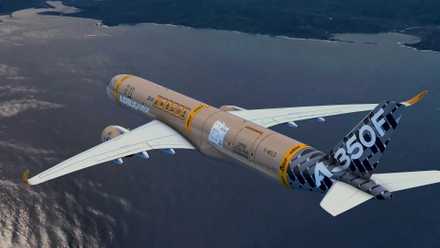
Why Might The World’s Newest Cargo Aircraft Have Boeing Worried?
A lightweight and efficient large freighter to threaten Boeing’s market dominance.
The 747F Retirement Problem The A350F’s Door Uniquely Solves

The commercial case for the A350F’s door size is inseparable from the retirement trajectory of the 747F fleet. According to Simple Flying’s analysis of how many 747 freighters will need to be replaced over the next five to ten years, more than 300 Boeing 747 freighters remain in service globally, including more than 100 747-400Fs, nearly all of which will reach their economic end-of-life between now and the early 2030s. The 747 production line at Everett, Washington, closed in 2022 with the final 747-8F delivery, meaning no new 747s can be ordered. The entire global market for outsized cargo currently transported by 747Fs must eventually transition to a replacement platform. The only currently available replacement for the nose-loading capability that the 747F’s hinged nose provides is the 777F — and the 777F’s 12-foot (3.7-meter) side door cannot accept the items the 747F’s nose door currently handles. The A350F’s 14-foot-9-inch (4.5-meter) side door fills that gap.
The transition away from the 747F is already well underway. Atlas Air, which operates one of the world’s largest 747 freighter fleets, signed an order for 20 A350Fs on March 16, 2026, becoming the program’s largest customer and the first major US-based operator to commit to the type. As Simple Flying reported on the Atlas Air order, the deal moved the A350F’s firm orderbook from 81 aircraft into triple digits and brought in a US operator of central strategic importance to the cargo market.
Atlas cited the A350F’s payload and range advantages, fuel efficiency, and sustainability profile — but the door’s cargo access capability was also highlighted as a key factor. An operator that has built 50 years of business on nose-loading 747s, ordering the only side-door freighter that can match that access geometry, is not a coincidence. It is the product recognition of what the door actually does.
The A350F’s performance envelope reinforces the commercial case. The aircraft carries a structural payload of up to 244,710 pounds (111 tons) over a range of 5,400 miles (8,700 km), delivers up to 20% lower fuel consumption and CO2 emissions versus previous-generation freighters, and is already fully compliant with ICAO’s 2027 CO2 standards — a regulatory deadline the 747-400F and many other freighters in service today will not be able to meet. The Rolls-Royce Trent XWB-97 engines that power the A350F are the same type used on the A350-1000 passenger variant, meaning operators with existing A350 passenger fleets share engine type rating, spare parts, and maintenance infrastructure with the freighter, a fleet commonality advantage the 747-8F, 777-8F, and 777F cannot offer an A350 passenger operator.
101 Orders, 14 Customers, And What The Orderbook Argues

As of the April 2026 door delivery milestone, the A350F had accumulated 101 firm orders from 14 customers, a number that grew meaningfully in the months leading up to that date. Atlas Air’s 20-aircraft order in March 2026 was followed by  Air China Cargo converting its previously disclosed purchase options into firm commitments for 10 aircraft, completing the Chinese carrier’s full investment in the program. Simple Flying previously detailed what aircraft will replace the Boeing 747F, the A350F’s order base spans a representative cross-section of the global cargo market:
  Etihad Airways (10 aircraft), STARLUX Airlines Cargo (10 aircraft), lessor AviLease (10 aircraft), and a growing list of carriers including Korean Air and Silk Way West. The geographic and operational diversity of those customers — Middle Eastern full-service carriers, Taiwanese niche operators, US legacy freighter operators, Asian flag carriers — confirms that the A350F’s commercial proposition resonates across the full range of cargo business models, not just in a specialized niche.
The 777-8F is the A350F’s most direct competitor, targeting a similar payload-range envelope with Boeing’s own answer to the next-generation large freighter requirement. The 777-8F carries a maximum revenue payload of approximately 247,500 pounds (112 tons) over comparable ranges, and targets entry into service around 2027-2028. Boeing’s established dominance in the cargo market gives the 777-8F a structural commercial advantage that no number of Airbus press releases can override. But the 777-8F’s main deck cargo door measures 10 feet, two inches wide by eight feet, 10 inches tall (3.1 meters by 2.69 meters) — substantially smaller than the A350F’s opening, and insufficient for the engine transportation mission that the A350F’s door was specifically sized to serve.
The 747F’s nose door defined an era. The A350F’s side door, wider than the nose door and positioned to outlast it by three or four decades of commercial service, is the engineering argument that the era’s most distinctive capability need not end when the 747F fleet retires. The argument Joel Rocker made when he called the door “the last big hardware element missing” was made decades ago by the operators who built their businesses around being able to fly engines anywhere on Earth. The A350F is the answer that took a generation to build.