dailynewsnblog
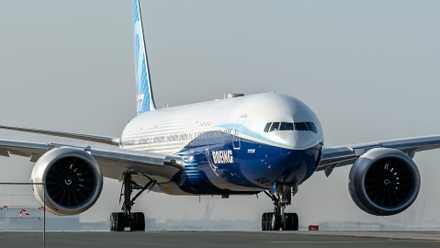
The Boeing 777X is the largest twin-engine airliner ever built, yet one question continues to surface as the program moves toward entry into service: why does it rely exclusively on a single engine option? The answer lies in an engine unlike anything else currently flying. With its huge fan, a certified thrust rating exceeding 100,000 pounds, and technologies developed over decades of research, the General Electric GE9X sits in a category of its own.
Examining data from GE Aerospace, FAA certification milestones, Boeing program information, and previous Simple Flying reporting, this article examines the key engineering, economic, and operational factors behind the GE9X’s unique position. We compare it with rival widebody engines, explore the technologies that enabled its development, review the testing challenges that delayed the 777X program, and examine why no realistic alternative powerplant currently exists for Boeing’s newest flagship aircraft.
A Fan Bigger Than A 737’s Fuselage

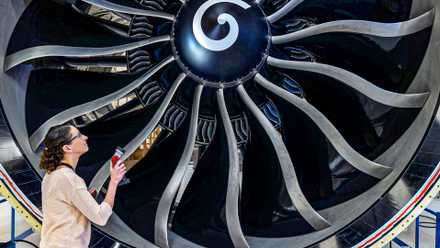
The most immediate thing about the GE9Xis its sheer scale. With a fan diameter of 134 inches (340 cm) and a nacelle diameter of 161 inches (409 cm), the engine is physically wider than the fuselage of a Boeing 737. As Simple Flying has previously detailed, the fan alone, made up of 16 composite blades spinning in a housing with a diameter of over 11 feet, generates the vast majority of the engine’s thrust through bypass airflow rather than combustion.
That bypass ratio of 10:1 is part of what makes the engine as efficient as it is powerful. During ground testing, the GE9X set a Guinness World Record by generating 134,300 pounds of thrust. Certified variants are rated at approximately 105,000 to 110,000 pounds of thrust in commercial service — still comfortably above any competing widebody engine. For context, the Rolls-Royce Trent XWB-97, the most powerful engine on the Airbus A350, produces up to 97,000 pounds of thrust. The GE9X leads that comparison by operating in a thrust class that no rival product has ever reached. The reason the 777X needs this kind of power is aerodynamics and payload, and not speed, as one might think.
The 777-9’s folding composite wing spans 235 feet (71.6 meters) at full extension and was designed to work in concert with the GE9X’s specific thrust output and fuel consumption curve. Swapping in a smaller engine wouldn’t just reduce performance: it would mean redesigning the wing, the nacelle geometry, the pylon structure, and the fuel system. At that point, you’d effectively be building a different aircraft.
Why Boeing Made The 777X A Single-Engine Program

Earlier 777 variants (the -200, -200ER, and -300) were offered with a choice of three engine families: the GE90, the Rolls-Royce Trent 800, and the Pratt & Whitney PW4090. That flexibility was commercially sensible and technically achievable because those aircraft operated within a performance envelope that multiple manufacturers could address.
Catch what other flight trackers miss
Emergency squawks, holds, NOTAMs — live signals, no signup.
Open tracker
Catch what other flight trackers miss
Emergency squawks, holds, NOTAMs — live signals, no signup.
Open tracker
The 777X was a fundamentally different proposition. When Boeing defined the -8 and -9 variants, the required combination of thrust, efficiency, and fan diameter exceeded anything Rolls-Royce or Pratt & Whitney had on the drawing board, or any credible roadmap to get there. According to a detailed analysis published by Simple Flying, the GE9X became the sole engine choice not because of commercial exclusivity deals, but because the performance envelope required categorically exceeded what competitive offerings could provide. No other engine in service or development could match the specific combination of thrust-to-weight ratio, fan size, and fuel burn that the 777X’s design demanded. Boeing made the pragmatic decision to stop the multi-engine competition before it started and focus all development effort on a single, purpose-built powerplant. Here’s a comparison of key specifications of today’s leading widebody engines:
Engine | Aircraft | Fan Diameter | Bypass Ratio | Pressure Ratio | Certified Thrust |
|---|---|---|---|---|---|
GE Aerospace GE9X | Boeing 777X | 134 inches (340 cm) | 10:1 | 60:1 | ~105,000–110,000 lbf |
GE Aerospace GE90-115B | Boeing 777-300ER | 128 inches (325 cm) | 9:1 | 42:1 | 115,300 lbf |
Rolls-Royce Trent XWB-97 | Airbus A350-1000 | 118 inches (300 cm) | 9.6:1 | ~50:1 | 97,000 lbf |
Rolls-Royce Trent XWB-84 | Airbus A350-900 | 118 inches (300 cm) | 9.6:1 | ~50:1 | 84,200 lbf |
Pratt & Whitney PW4090 | Boeing 777-200ER | 112 inches (284 cm) | 6.4:1 | 34.2:1 | 90,000 lbf |
That single-supplier arrangement carries risk, as Boeing would learn. With no backup engine option available, any GE9X technical issue directly halted the entire program. But in 2013, the calculus was straightforward: the engine that could do the job existed at GE Aerospace, and nowhere else.
World’s Most-Delayed Commercial Aircraft? The Latest Boeing 777X Certification Hurdle
When will the Boeing 777X enter service?
From 22 Blades To 16: The Evolution Of GE’s Composite Fan

The GE9X’s fan is the product of three decades of continuous development in composite materials research. According to GE Aerospace, the company introduced the world’s first polymer composite fan blades into commercial service with the GE90-94B in 1995.
Those first-generation blades were revolutionary at the time; the GE9X’s fourth-generation blades are a different category of engineering altogether. Built on lessons learned from the GE90-94B, the GE90-115B, and the GEnx, which powers the Boeing 787, the new blades use a higher-stiffness carbon fiber and an advanced epoxy resin system that allows them to be thinner and lighter than any previous widebody fan blade while maintaining equivalent strength and bird-strike resistance. The implications of that thinness go beyond weight savings.
As Simple Flying has explained, the design philosophy behind the GE9X was to have the fan do more of the propulsive work and for the core to extract more energy from every pound of fuel burned. Thinner, lighter blades enable a more swept, three-dimensional aerodynamic profile that maximizes airflow efficiency. Combined with the 134-inch (340 cm) diameter, this results in a fan moving an enormous volume of air at relatively low velocity, which is precisely how high-bypass turbofans achieve low fuel burn and low noise simultaneously.
Perhaps the most striking expression of this technological maturity is the blade count. The GE90 required 22 blades to achieve its performance targets. The GE9X achieves superior efficiency with just 16, a reduction made possible by advances in 3D aerodynamic design and material strength that only became available after decades of flight hours and testing. According to GE Aerospace, the company had accumulated over 300 million flight hours with composite fan technology by the time the GE9X entered its final development phase.

The GE9X’s efficiency advantage relies not just on its fan. As documented by Simple Flying, GE Aerospace deployed a material that had taken decades to make reliably certifiable at a commercial scale, purposely to manage the heat and pressure deep inside the engine, in the combustor and high-pressure turbine, where temperatures approach 2,400°F (1,315°C): ceramic matrix composites, or CMCs.
CMCs are formed from silicon carbide ceramic fibers embedded in a silicon carbide matrix and coated with proprietary ceramic materials.
According to American Machinist, they are one-third as dense as the nickel superalloys they replace, yet capable of withstanding temperatures that would cause conventional metal components to fail. The GE9X uses five CMC components in its hot section: the inner and outer combustor liners, the high-pressure turbine Stage 1 shrouds and nozzles, and the Stage 2 nozzles.
The consequence of using these parts is significant: because CMCs require far less cooling airflow than metal alloys to survive at operating temperatures, the air that would normally be diverted to cool those components can instead remain in the engine’s flow path, directly improving combustion efficiency. That is one of the key mechanisms behind the engine’s overall pressure ratio of 60:1, the highest ever certified on a commercial turbofan. For comparison, the GE90-115B that powers the Boeing 777-300ER operates at a pressure ratio of approximately 42:1. Every additional unit of pressure ratio extracted from the thermodynamic cycle translates directly into lower fuel burn per pound of thrust, and the GE9X’s ability to push that figure so far beyond its predecessors is, in large part, a story about ceramics.
When GE Aerospace’s then-CEO, John Slattery, announced FAA certification of the GE9X in September 2020, he made the competitive position explicit:
“There is no substitute that can achieve the combination of size, power and fuel efficiency of the GE9X. This engine will deliver unsurpassed value and reliability to our airline customers.”
How The GE9X’s 134-Inch Fan Creates Problems No Other Jet Engine Faces
The engine is set to launch on the Boeing 777X in 2027.
The Price Of Operating At The Edge: Testing Setbacks And What They Mean

Building an engine with no commercial precedent means testing against failure modes that no one has encountered before, and the GE9X program was no exception. In 2019, second-stage stator vanes in the high-pressure compressor began deteriorating ahead of schedule, driving exhaust gas temperatures to exceed their intended range. GE pulled four compliance-test engines back to Ohio for a hardware redesign — enough of a disruption to push the 777X’s first flight from late 2019 to January 25, 2020.
In 2022, a routine borescope inspection flagged a temperature anomaly in one of the test engines. Boeing suspended the 777-9 flight-test campaign while GE investigated and resolved it — the sort of interruption that rarely makes headlines but quietly consumes months of a certification schedule.
The hardest stop came in 2024, when Boeing grounded the entire 777X test fleet after discovering severed titanium thrust links, critical structural components that transfer engine thrust into the aircraft’s airframe. Follow-up inspections found cracks at the same location on two more aircraft. The root cause was vibration-induced fatigue, and fixing it required a full redesign of the links. The fleet stayed grounded for five months.
Most recently, a January 2026 inspection turned up a crack in a mid-seal component, triggering another engineering review. Boeing maintained that first deliveries in 2027 remained achievable, but the finding was another data point in the same pattern. Each of these issues is, in one sense, a story about the gap between the GE9X and every other commercial engine in service. No rival powerplant has encountered these specific failure modes because no rival powerplant operates at these specific conditions. As Simple Flying has noted, the higher pressure ratios and elevated temperatures of the GE9X create an environment where even small design imperfections or material limitations can lead to durability concerns that simply don’t arise in lower-performance engines.
The paradox is unavoidable: the very technological gap that makes the GE9X the only engine capable of powering the 777X is also what has made certifying it so difficult. Operating at a 60:1 pressure ratio with CMC hot-section components at temperatures approaching 2,400°F (1,315°C) is, by definition, operating beyond the envelope of everything that came before.
No Alternative Exists, And That’s The Point

One question occasionally surfaces in discussions of the 777X program: could Rolls-Royce or Pratt & Whitney eventually develop a competing engine? Technically, yes — but the timeline and investment required would be enormous. GE Aerospace spent the better part of three decades building the composite fan technology, CMC materials capability, high-pressure compressor design tools, and manufacturing infrastructure that the GE9X relies upon.
The Trent XWB‘s maximum thrust of 97,000 pounds is a performance ceiling that reflects a different aircraft’s requirements, not a stepping stone to the 134,300-pound (597 kN) test thrust that the GE9X achieved on the stand. Bridging that gap would require a new engine program, not a derivative — and no aircraft program currently on the market would justify the investment. As Simple Flying has previously noted, comparing the GE9X’s specifications to those of the GE90 reveals just how staggering the engineering leap between generations was: larger fan, lower blade count, higher bypass ratio, higher pressure ratio, and a fundamentally different material system in the hot section.
For the airlines placing orders —  Emirates has committed to 270 777X aircraft,
  Lufthansato 20,
  Qatar Airwaysto 60 — the GE9X’s technical uniqueness translates into long-term dependence on a single supply chain. That is a risk they accepted because the aircraft’s performance case is compelling enough to justify it. A 10% improvement in fuel burn over the GE90-115B, across a fleet of this size, represents billions of dollars in operational savings over the aircraft’s service life.
The GE9X is not the only engine powering the 777X because Boeing ran out of options. It is the only engine powering the 777X because, after more than 30 years of materials science, aerodynamic development, and thermodynamic engineering, GE Aerospace built something that no one else was positioned to build. The 777X was designed around it. The two are inseparable — not by contract, but by physics.