dailynewsnblog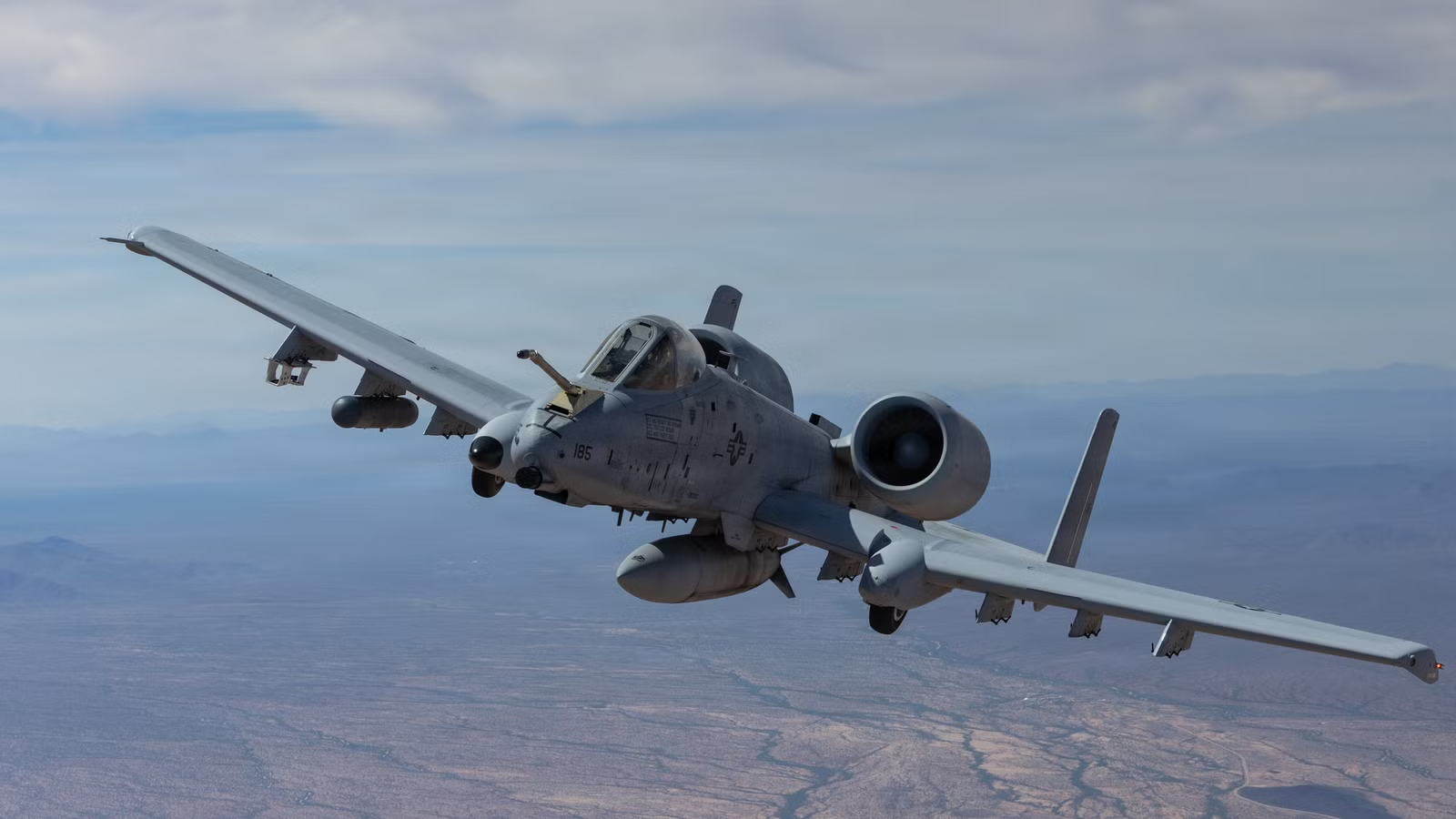
The Fairchild Republic A-10 Thunderbolt II ‘Warthog’ was built at a different time to solve a problem that no longer exists, but that doesn’t mean it’s useless, at least in niche use cases. It was an aircraft the Air Force never wanted; it has been asking to retire them for years. The Air Force’s first request to retire the A-10 Warthog came in 1984, the year it received its final Warthogs.
The story of the A-10 and why it remains in service is inseparable from the US Army, the 1948 Key West Agreement, the AH-56 Cheyenne, and the AH-64 Apache, so these will be discussed here for context. After 2026’s Operation Epic Fury, the Air Force has signaled it is willing to keep a residual three squadrons in service until 2029/2030. However, this does not reflect any fundamental change in the Air Force’s thinking.
How The A-10 Relates To The AH-56

In 1947, the US government finally broke the United States Army Air Forces away from the Army to form the independent Air Force. The new Air Force took practically all of the Army’s aviation with it, and the Army was forced to almost completely rebuild its Army Aviation. But this triggered a long-running feud between the two service branches. The 1948 Key West Agreement gave the Army ownership of rotary wing aircraft, although it lacked an attack helicopter until the 1960s.
An issue was defining what an attack helicopter was. Lockheed developed the fast and promising AH-56 Cheyenne helicopter, which was around twice as fast as the interim Bell AH-1 Cobra. The Air Force felt the advanced, fixed-wing-like helicopter encroached on its Close Air Support mission. The Air Force intensely lobbed against it, and a combination of lobbying, the end of the intense phase of the Vietnam War, and technical development issues saw the Cheyenne canceled.
The Army was compelled to develop another rotor-wing attack helicopter that would be more palatable for the Air Force. This eventually resulted in the AH-64 Apache. However, by forcing the Army to cancel the Cheyenne and insisting that Close Air Support was its wheelhouse, the Air Force had backed itself into a corner. It became indefensible (especially with the Fighter Jet Mafia in Washington) not to develop the A-10 Warthog.
The Fulda Gap

The Fighter Jet Mafia of the period believed that fighter jets like the F-15 had become too complicated and expensive and that the future of air combat was visual range, not beyond visual range. They lobbed against the F-15 and for the simple A-10 and F-16, although the F-16 subsequently evolved from air superiority to multirole.
The A-10 was specifically designed to offer dedicated close-air support to halt any massive Soviet armored thrust through the Fulda Gap. The Fulda Gap was a low-terrain corridor in West Germany that the Soviets were expected to use as their main route of advance into Western Europe. The A-10 was built as a tank-killer around its nose-mounted 30mm rotary GAU-8 Avenger cannon.
The low-flying A-10 was expected to face heavy attrition, even in the 1970s, and so it was built with a titanium ‘bathtub.’ By the 1991 Gulf War, the A-10 took out large numbers of Iraqi armor, although mostly with missiles, as its gun made it more vulnerable. Even so, the A-10 faced significant attrition with 65 A-10s receiving some combat damage. Of these, around 20 had significant battle damage, and 14 were written off or destroyed.
Can An A-10 Warthog Destroy A Tank?
The epic A-10 Warthog is known for its 30mm cannon, but can it really turn enemy tanks into flaming wreckage so easily?
The A-10’s Evolving Usefulness

Today, the A-10 remains in service, although in a diminished capacity. The year started with around 162 A-10s remaining in inventory (the Air Force received a total of 722), with the fiscal year’s budget allowing them to retire a third, reducing the number to 103. In a sense, the A-10 may not be fully retired, but it is mostly retired.
The A-10’s role has also evolved. As stated, it was designed to be the tip of the spear, being a tank buster against massed Soviet armor. However, this is now essentially a Cold War memory. Realistically, any adversary with significant armor would also have short-range air defense like Portable Air-Defense Systems. This would make the A-10 vulnerable, and the Air Force would likely elect to use stand-off munitions (including one-way attack drones) instead. In 2025, the A-10 was modified for a drone-hunting role.
In the 2026 air campaign over Iran, the A-10 played a supporting role and was certainly not the tip of the spear. It was filmed straffing militants in Iraq (and Syria in 2024), although those militants apparently lacked air defense. Importantly, it was used in its under-rated maritime role, attacking Iranian vessels in the Gulf. Finally, it was used to support the extraction of the downed F-15E pilots deep behind enemy lines.
A Niche Use Case

On the face of it, it would seem the Air Force had a change of heart following Operation Epic Fury, saying it would keep the A-10 in service until 2030. But the truth is more nuanced. Congress was only allowing the Air Force to phase them out incrementally and realistically; 2030 is only 0–2 more years than previously envisioned. The Air Force is still asking to retire half of its remaining fleet (49) in the 2027 fiscal year, reducing the fleet to just 54.
The Air Force is now focused on its Great Power Competition against China, where the A-10 is vulnerable and lacks the range to be useful. However, Epic Fury also shows the Warthog has some niche use cases, but not the front-line tank-busting role fans may think about. The Air Force may see a couple of squadrons as useful against drones, speed boats, and insurgents, as well as the public relations benefits of keeping the beloved Warthog in service.
If the Air Force retires 49 more Warthogs in the 2027 fiscal year, then, from its point of view, the Warthog will be mostly retired. As such, the cost of maintaining these aircraft for a few more years will be much smaller, allowing it to invest in next-generation platforms (e.g., CCAs, F-47s). It can work to retrain the pilots for other aircraft. The Air Force may think there is a niche use case for the A-10, but it doesn’t require large numbers.
The Air Force’s A-10 Warthog Retirement Plan

The plan is now to retire 49 Warthogs in Fiscal 2027 and retain a fleet of three squadrons, each with 18 aircraft each. This will include one active-duty squadron at Moody Air Force Base in Georgia and two squadrons at Whiteman Air Force Base in Missouri, where the B-2 Spirits are based. The two Whiteman squadrons will include one reserve squadron and one active duty squadron.
Under the plan, the reserve squadron will stand down in 2029, leaving the Air Force with 36 Warthogs. The final two squadrons would divest their A-10s in 2030, bringing the epoch to a close. It has to be emphasized that this is just a proposal at this stage, and it will not be clear what final agreement will be reached when the budget eventually passes.
Authorized/planned A-10 Warthog retirements (2020-2030) | ||
|---|---|---|
Fiscal Year | Divestments | Minimum required inventory per US budget documents |
2020 | 281 | |
2021 | 281 | |
2022 | 281 | |
2023 | 21 | 260 |
2024 | 42 | 218 |
2025 | 56 | 162 |
2026 | 59 | 103 |
2027 | 49 | 54 |
2028 | 54 | |
2029 | 18 | 36 |
2030 | 36 | |
Even after the budget passes, the topic may come back up in the 2028 fiscal year with changes. Another factor to note is that retiring A-10C aircraft are typically sent to the boneyard at Davis Monthan, meaning there is a chance (however small) that they could be reactivated if needed or sold to another country. Congress did discuss passing A-10s to Jordan in 2024, but nothing seems to have come of it.
Where Are The US Air Force’s A-10 Warthogs Based?
A-10s are currently permanently stationed in around 11 airbases in the US and abroad, although this number is dropping.
Close Air Support Is Permanently Changing

In May 2026, Air Force Chief of Staff Kenneth Wilsbach told lawmakers the service will not have a gap in close air support after the A-10 retires for good around 2030. With that being said, the days of the cavalry riding to the rescue with tree-top level strafing will be gone with the Warthog’s retirement. This is not how the F-35A or F-15EX are designed to fight in contested airspace, and realistically, it has already been gone with the Warthog for decades.
The A-10’s vulnerability has been masked by the fact that the US has fought low-intensity conflicts post 2000. These were not representative of a high-level conflict. Even if the A-10 were to be used in tree-top level strafing in a sustained high-level conflict, it would likely be attrited quickly. Both Ukraine and Russia used their analogue Su-25 Frogfoots for CAS missions in the current conflict, and both fleets have sustained high attrition rates.
Surviving aircraft are now rarely used in that sort of Close Air Support role anymore, instead relying on stand-off munitions. The future of Close Air Support is likely a combination of high-end fast jets with stand-off munitions, artillery, a range of drones of varying capabilities, and other systems working together.