dailynewsnblog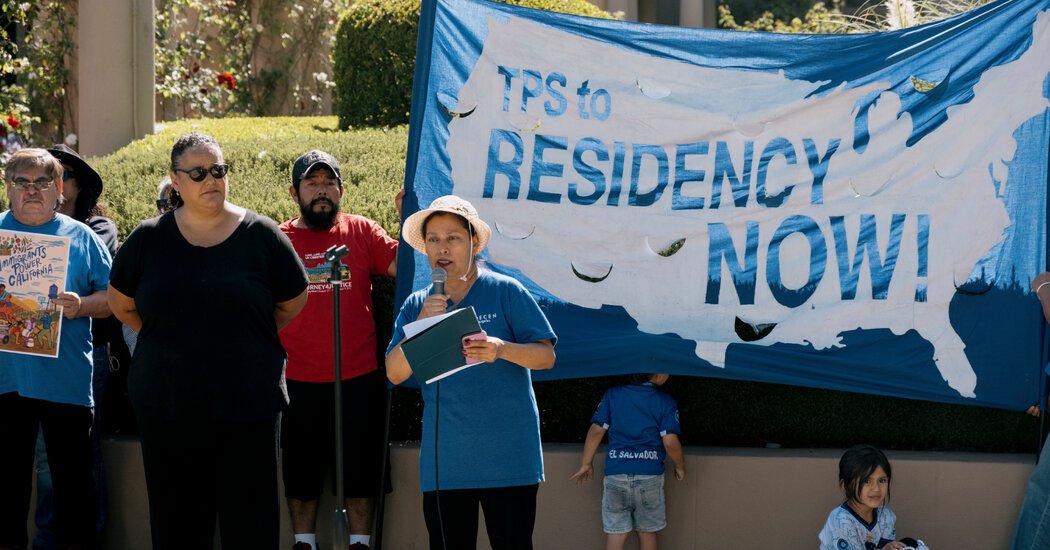
A week ago, the sanctuary at Notre Dame d’Haiti in Miami was immersed in intense prayer. The congregation gathered, hands open, in a long, rhythmic invocation in Creole for the preservation of Temporary Protected Status, which has allowed more than 330,000 Haitians to live and work lawfully in the United States for years.
Once Mass was over, the Rev. Reginald Jean-Mary said that all they were doing now was “praying and waiting.”
On Thursday, the long-awaited ruling by the Supreme Court landed like a bomb on the Haitian community in South Florida, the largest in the country. It quickly reverberated through Massachusetts; New York; Springfield, Ohio; and other places where Haitians have settled in large numbers.
Father Jean-Mary, after learning of the Supreme Court’s decision, seemed in shock. He declined to comment.
While focused on Haitians and several thousand Syrians with the protection, the court’s decision has implications for all 1.3 million T.P.S. holders in the United States, from more than a dozen countries. Some of them have been in the United States for many years.
El Salvador, Lebanon and Ukraine are among the countries covered by T.P.S. while efforts to terminate it for several other nations, including Afghanistan, Honduras and Nepal have been on hold because of legal challenges.
Officials in the Trump administration have said that T.P.S. has become essentially permanent because it has been repeatedly renewed for some of the troubled countries it covers.
For President Trump, ending T.P.S. tracks with his broader crackdown on immigration, both lawful and unlawful. But critics have pointed to the president’s derogatory comments about immigrants from Haiti, Somalia and other countries as evidence that the push to end T.P.S. has been driven by prejudice.
Justice Samuel A. Alito Jr., writing for the 6-to-3 majority, said that the courts were barred from reviewing the Department of Homeland Security’s process for terminating a country’s T.P.S. designation.
The court rejected the Haitian plaintiffs’ claims that the administration’s decision was unconstitutionally motivated by racial bias against people from Haiti, a predominantly Black country.
Lawyers for the plaintiffs had also argued that the Trump administration’s move was politically motivated and preordained, and that, in the case of Haiti, it had failed to assess conditions on the ground that made it impossible for Haitians to return there safely.
Haitians who have been covered by T.P.S. were in disbelief on Thursday. “I did not expect this at all,” said Sadrac Delva, a Haitian-born real estate agent in Springfield, Ohio, who was in the middle of closing on a house for a Haitian family when the ruling was issued.
Viles Dorsainvil, executive director of a Haitian community center in Springfield, where thousands of Haitians have settled in recent years, said: “Families are here. Folks are going to work. The Supreme Court just put all that at a stop and put all those people in limbo.”
It was not clear how quickly Haitians and Syrians would become vulnerable to removal from the United States, but the ruling makes them deportable. Their work permits will expire, and they will lose their jobs and driver’s licenses.
Thamara Labrousse, executive director at Sant La Haitian Neighborhood Center in Miami, has been inundated with calls asking, “Will I lose my job? When does it go into effect? How much time do we have?” she said.
“There is a lot of anxiety because conditions in Haiti have gotten worse than when they granted the T.P.S. to begin with,” she said.
Some T.P.S. holders have pending asylum applications, but it remains unclear whether the administration will spare them from enforcement if they crossed the border unlawfully.
If a country in acute crisis receives a T.P.S. designation, its citizens who are already inside the United States are protected from deportation. They are allowed to stay and work, regardless of whether they originally entered the United States legally or not. The homeland security secretary typically decides whether to renew the status, which lasts 12 or 18 months, after reassessing conditions.
Geoff Pipoly, the lead lawyer for the Haitian plaintiffs, said his heart was broken.
“Many, many people are going to needlessly die,” he said, because Haitians would be forced to return to a country engulfed in violence.
The administration has made it clear that it intends to end the program, rather than renew it, for many countries whose designation is close to expiring.
T.P.S. for El Salvador, with 200,000 T.P.S. recipients, many of whom have had the protection for decades, is set to lapse in early September. President Trump tried during his first term to end the protection but was blocked by the courts.
“We have roots here,” said Jose Ramirez, 64, who lives in Los Angeles and has had T.P.S. since 2001, after two major earthquakes devastated El Salvador.
T.P.S. for more than 100,000 Ukrainians who have found refuge in the United States since Russia invaded their country in 2022 will expire in October.
Business and community leaders have come together to help more than 20 Ukrainian families settle in eastern Iowa.
Now, Angela Boelens, who has led the efforts, fears the end of T.P.S. for Ukrainians is imminent. She is now preparing to help families make their exit plan to another country in South America or back to Ukraine, where conditions remain perilous.
This ruling “is not what I was hoping for,” said Ms. Boelens, founder of the nonprofit IA Nice.
Greg Gannon, a retired bank executive in the region, said he was desperately looking into other ways he and others could help sponsor the families.
“They have done everything that they were supposed to do, and we are changing the rules on them,” Mr. Gannon said. “We need these folks.”
A Syrian man who was a plaintiff in the Supreme Court case said he was “shocked” by the ruling.
“It doesn’t work in my mind, like, even logistically, for the U.S. government to do such a thing, because I’m like, how are they going to send people to Syria when in the first place they’re deeming it as a ‘do not travel’ category?” said the man, who was identified in the lawsuit using a pseudonym, Mustafa Doe. He spoke on the condition that he be identified using that name, out of fear that he could be targeted for deportation.
In Massachusetts, home to about 45,000 Haitians, Dieufort Jean Fleurissaint, senior pastor at Total Health Christian Ministries, in Milton, said that he was strategizing with allies and elected officials about solutions.
Among his congregants were families who have been in the United States for more than a decade. “They have lived, worked, worshiped, and contributed to the fabric of American society for many years,” he said.
“They serve on the front lines” in essential industries like health care, transportation and education, he said, adding, “so those families deserve stability, dignity and fair opportunity to continue contributing to the nation we all call home.”
Haitian T.P.S. holders cannot go back to his broken country, he said. “They have nowhere to go.”
Haiti was first designated for T.P.S. in 2010 after a devastating earthquake. The status was last granted by the Biden administration in 2021, after the assassination of the country’s last elected president set in motion a surge in gang violence and ongoing political instability.
Some Haitians said they were not going anywhere, unless they were forced to.
“I would not go to any other country,” said a Haitian man in Miami named Michel, 56, who said he had been in the United States for 15 years. He declined to give his last name out of concern that it would make it easier for authorities to track him down.
“I will just stay here until they tell me I have to go back,” he said, walking slowly down the street holding a small radio to his ear to follow developments.
Reporting was contributed by Heather Beasley Doyle in Boston, Luis Ferré-Sadurní in New York, Ann Klein in DeWitt, Iowa, and Ana Facio-Krajcer in Los Angeles.