dailynewsnblog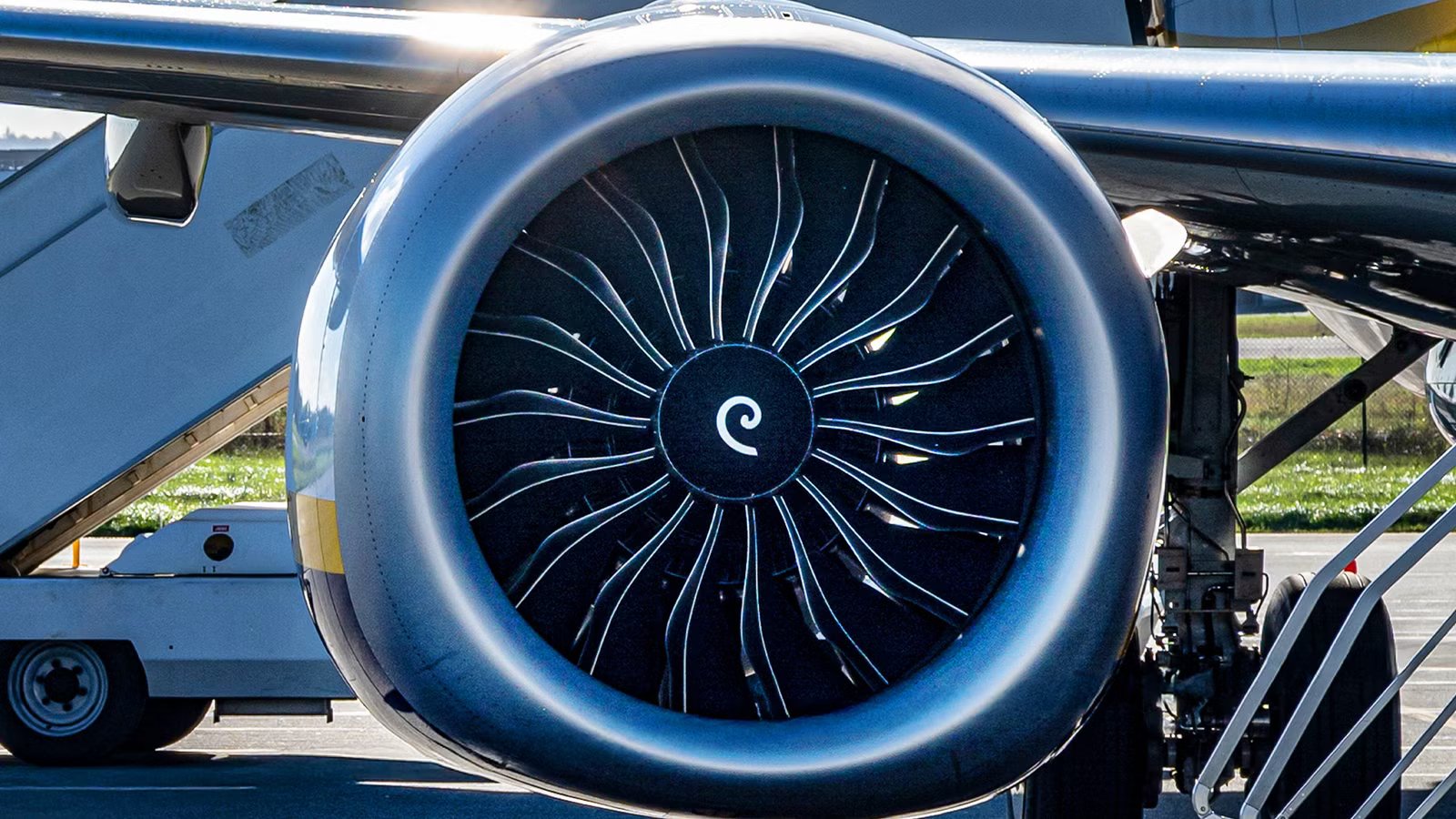
The very first powered flight took place back in 1903 when Orville and Wilbur Wright lifted off from Kitty Hawk, North Carolina, aboard the Wright Flyer. The aircraft was powered by a four-cylinder engine with a cast-aluminum block and produced around 12.5 horsepower, while weighing roughly 200 pounds (90 kg), including fuel and coolant. Since then, both aircraft and engine technology have advanced significantly. Over the years, engine manufacturers have introduced successive generations of propulsion technologies, from early turbojets to turbofans, high-bypass turbofans, and, more recently, geared turbofans.
Each new generation has delivered significant gains in performance. Modern engines consume less fuel, generate less noise, require fewer unscheduled maintenance interventions, and achieve higher levels of reliability than their predecessors. Engine technology continues to evolve; advances in materials science, digital engine controls, manufacturing techniques, and aerodynamic design are delivering further improvements in performance and efficiency.
Two Manufacturers Lead The Narrowbody Engine Market

When it comes to modern narrowbody aircraft, the market is mainly dominated by two engine manufacturers: Pratt & Whitney and CFM International. Both companies have spent decades developing engines for the world’s single-aisle fleets. Today, their engines power thousands of Airbus A320 family and Boeing 737 aircraft operating around the world. Pratt & Whitney, which is a subsidiary of RTX Corporation, was founded in 1925. The company initially built piston engines and later moved into turbojet and turbofan technology.
In recent years, it has placed more focus on improving efficiency by developing its Geared Turbofan (GTF) engine family. We will discuss the GTF in more detail later in this article, but in simple terms, the engine represented a significant departure from traditional engine design. On the other hand, CFM International, a 50/50 joint venture between the American company GE Aerospace and the French company Safran Aircraft Engines, was founded in 1973.
At the time, the partnership between two major manufacturers was considered unusual, but it ultimately proved highly successful. The company’s first defining product was the CFM56 engine.  Boeing selected the engine for the Boeing 737 Classic and later the 737 Next Generation families, while Airbus adopted it for the original A320 family. More recently, CFM developed the LEAP engine as the successor to the CFM56.
The engine remains the sole powerplant option for the Boeing 737 MAX and one of two options available on the Airbus A320neo family. Indeed, over the years, both manufacturers have established strong reputations in the narrowbody segment and continue to invest heavily in new technologies. Their latest products pursue many of the same objectives, including lower fuel consumption, reduced emissions, and improved operating economics. The way they achieve those goals, however, differs considerably.
How Pratt & Whitney Changed Traditional Engine Design

Pratt & Whitney introduced the GTF engine back in the 2010s. It challenged a design principle that had shaped commercial jet engines for decades. Traditionally, turbofan engines were designed with a large front fan and a low-pressure turbine (at the rear) connected by a common shaft, forcing both components to rotate at the same speed. The arrangement worked well, but it also required a compromise because the fan and turbine were linked together, meaning they could not operate at their most efficient speeds.
Pratt & Whitney addressed that limitation by introducing a reduction gearbox between the two components, allowing each to operate independently at its optimal speed. This fundamentally altered how the engine works. The front fan can now rotate more slowly, at approximately 3,000 revolutions per minute, helping to optimize airflow and reduce noise. At the same time, the low-pressure turbine can spin much faster, reaching speeds of nearly 10,000 revolutions per minute, allowing it to extract more energy from the engine.
Feature | Pratt & Whitney GTF (PW1100G / PW1500G) |
|---|---|
Fan Diameter | 81–82 inches (206–208 centimeters) |
Bypass Ratio | 12:1-13:1 |
Architecture | Geared Two-Spool |
Thrust Range | 19,000–35,000 lbf |
Fuel Burn Improvement vs. Previous Gen | 16–20% |
Noise Reduction | Up to 75% |
According to Pratt & Whitney, this architecture delivers a 16% to 20% improvement in fuel burn compared with previous-generation engines, reduces the noise footprint by up to 75%, and cuts nitrogen oxide (NOx) emissions by 50%. The GTF family has since been adopted across multiple aircraft programs. It powers the Airbus A220 family, the Airbus A320neo family, including the A320neo, A321neo, and A321XLR, as well as Embraer’s latest-generation E-Jet E2 family.
To date, Pratt & Whitney has delivered more than 2,700 GTF-powered aircraft to over 90 customers worldwide. The program has not been without challenges, however. In recent years, the manufacturer has faced durability issues affecting certain GTF engine components, particularly those involving contaminated powdered metal used in the manufacturing process of some parts. The issue resulted in inspections, engine removals, and the grounding of hundreds of aircraft worldwide. It also prompted the manufacturer to launch a $3 billion remediation program.

Pratt & Whitney’s New GTF Advantage Engine: What’s The Latest?
The GTF is a high-bypass geared turbofan engine.
CFM’s Answer To The Next Generation Of Narrowbody Engines

On the CFM International front, the company launched the LEAP engine family in the early 2010s as the next-generation of narrowbody propulsion. It was designed from the outset to meet stricter fuel-efficiency, noise, and emissions requirements. One of the most significant changes the company introduced with the LEAP was its use of advanced materials. The CFM56 relied largely on conventional nickel-based alloys and titanium components.
The LEAP, however, introduced several technologies that were either unavailable or not mature enough for large-scale commercial use when the CFM56 entered service. One example is the fuel nozzle. The LEAP became the first commercial engine to use 3D-printed fuel nozzles on a large scale. This reduced the number of individual parts required while also improving durability. The engine also made extensive use of advanced materials.
CFM incorporated ceramic matrix composites (CMCs) in the turbine section, where temperatures are among the highest anywhere in the engine. These materials can withstand much higher temperatures than traditional metallic components while requiring less cooling air. Furthermore, it also introduced 3D-woven carbon fiber composite fan blades and a composite fan case. In addition to materials and manufacturing, the company introduced improvements throughout the engine’s core design.
The LEAP’s high-pressure compressor operates at a compression ratio of 22:1, significantly higher than that of the CFM56. Combined, these advances allow the engine to extract more energy from the same amount of fuel. According to CFM International, the result is a 15% reduction in fuel consumption and carbon emissions compared with the CFM56, while the noise footprint is reduced by up to 50%.
What’s Next For Narrowbody Engine Technology?

Indeed, both the GTF and LEAP families have delivered significant improvements compared with previous-generation narrowbody engines. The manufacturers continue to develop new propulsion technologies. Pratt & Whitney, for instance, reached a major milestone in early 2025 when the Federal Aviation Administration (FAA) certified the GTF Advantage engine, which is a new variant that builds on the existing GTF architecture and provides additional thrust while incorporating durability improvements.
According to the company, the engine extends the fuel efficiency advantage of the GTF family and offers greater capability for Airbus A320neo-family aircraft, particularly longer-range variants such as the A321XLR. CFM International is also looking beyond the current generation. It has launched the Revolutionary Innovation for Sustainable Engines (RISE) program, which is centered on an open-fan architecture, a concept that differs significantly from the conventional turbofan engines used today.
Instead of enclosing the fan within a nacelle, the design leaves the blades exposed, allowing a much larger volume of air to move through the propulsion system at lower speeds. The concept is aimed at achieving more than a 20% improvement in fuel efficiency compared with today’s most advanced engines. A major contributor is the engine’s extremely high bypass ratio, which could exceed 50:1, compared with roughly 11:1 on the LEAP family. The program is also being developed to be compatible with 100% sustainable aviation fuel and potential hybrid-electric technologies.

Airbus, Boeing & The Open-Fan Gamble: Why CFM Has A Plan B
CFM is quietly developing an alternative in case open-fan engines don’t hit the mark.
Rolls-Royce Is Targeting Narrowbody Segment Again

Furthermore, for now, the narrowbody engine market remains dominated by Pratt & Whitney and CFM International. That could change during the next decade. The British engine manufacturer Rolls-Royce, has announced plans to re-enter the segment through its proposed UltraFan 30 program. It builds on the company’s wider UltraFan program, which successfully completed demonstrator testing in 2023. The narrowbody variant uses the same Power Gearbox concept, which allows the fan to rotate at a much lower speed than the core turbine. The approach is similar in principle to Pratt & Whitney’s geared architecture.
The manufacturer believes the engine could deliver a significant improvement in efficiency compared with today’s narrowbody powerplants. The company has stated that UltraFan 30 is being developed with the goal of achieving a 25% reduction in specific fuel consumption compared with current-generation engines such as the LEAP and GTF. If achieved, that would represent one of the largest efficiency improvements seen in a single generation of commercial aircraft engines.
Additionally, one of the major factors behind this program is the timing. Airbus and Boeing are both currently studying the potential successors to the A320neo and 737 MAX families. Industry expectations point to new aircraft programs during the late 2020s and entry into service during the following decade. Rolls-Royce’s current planned timeline placed the narrowbody engine within the same window, potentially giving it an opportunity to compete for the next-generation narrowbody aircraft.
The Search For Even Greater Efficiency Continues

Overall, the next chapter in narrowbody engine development is likely to come from a mix of new technologies, refined architectures, and ideas that manufacturers could not commercialize in the past. Both Rolls-Royce’s proposed UltraFan 30 and CFM International’s RISE program point to a future where manufacturers are looking beyond conventional turbofan architectures to achieve further efficiency gains.
Concepts like open-fan architecture were explored decades ago but failed to gain commercial traction because, at the time, noise concerns, limited computing power, and the materials available to manufacturers restricted what could realistically be achieved. That environment has changed considerably. Advances in computational fluid dynamics, blade design, digital engineering, and composite materials have given manufacturers new tools.
Whether open-fan engines will be the next major step in narrowbody propulsion remains to be seen, but the pace of development suggests that engine manufacturers are still finding new ways to improve efficiency more than a century after the Wright Flyer first left the ground.