dailynewsnblog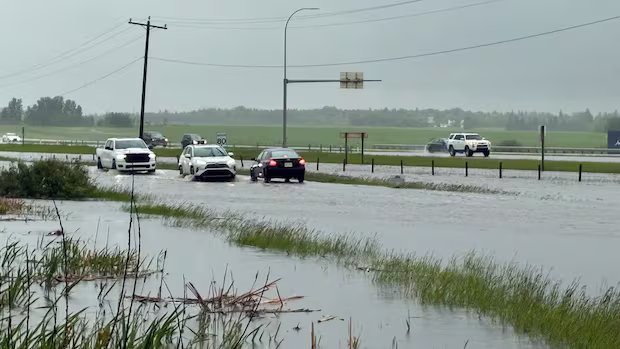
UPDATE: At 8:04 p.m. on Monday, the City of Edmonton cancelled its water supply and flooding alert.
Days of heavy rain has the city of Edmonton and many surrounding communities contending with overland flooding, washed-out roads and wastewater systems pushed past their limits.
As the deluge continued Monday, Edmonton residents are being asked to restrict non-essential water use and ensure their property drainage systems are working properly to guard against flooding.
The advisory for Edmontonians is among a string of municipal warnings and travel alerts issued across central Alberta Sunday as heavy rain threatened roads, businesses and homes.
Edmonton and the surrounding areas received between 50 and 100 millimetres of heavy rainfall over the weekend, establishing this as one of the wettest Junes on record and putting the region on track to break the record set more than a century ago.
Environment Canada meteorologist Chloe Katsademas said as of Sunday, Edmonton has seen 189.9 millimetres of rainfall this month, matching the second-rainiest June recorded in 1965.
The rainiest June on record was in 1914 when 216.5 millimetres fell on the capital region, Katsademas said.
Rain was expected to continue falling in Edmonton on Monday. The Tuesday forecast calls for clear, sunny skies but more rain is in the forecast for the weekend, which could tip the scales to make this June the rainiest on record, she said.
“We’ll definitely settle into second place for rainfall amounts for June, but it is possible that we could, if enough rainfall occurs, surpass the 1914 record.”
Edmonton alert
The emergency advisory alert issued Sunday evening for Edmonton cautioned that heavy rainfall over the weekend has pushed the region’s stormwater system to capacity, with localized flooding and backups being reported in neighbouring communities.
If the stormwater system continues to operate over capacity, the risk of flooding and sewer backups will continue to increase, city officials warned.
Residents of Edmonton are requested to avoid unnecessary indoor water use including limiting showers and baths, delaying laundry and dishwasher use, as well as ensuring sump pumps and downspouts are functioning properly to direct water away from homes.
Martin Kennedy, senior communications director at Epcor, said at a news conference Monday afternoon the advisory will be revisited, but he anticipates Edmontonians will be asked to conserve water for one more day.
“My money would say that’s highly likely given the current state,” he said.
Kennedy said on previous occasions when the city’s residents have been asked to restrict their water use, Edmontonians modifying their behaviour has made a big difference, cutting water use by about 10 per cent.
Mayor Andrew Knack said the city is more flood resilient after years of preparation that has included building out stormwater ponds. He said he’s confident Edmontonians will do their part to help.
“In the rare times this has happened during my time on council, every time Edmontonians have stepped up.”
600 calls for service
In a news release Sunday, officials with Epcor — the municipally owned utility company responsible for managing Edmonton’s water systems — said it had received more than 600 calls for service on Sunday about concerns such as water pooling and flooding.
“We are asking customers to immediately take steps to reduce their water use,” officials with Epcor said.
“What seem like small steps or inconveniences can be the difference in helping neighbours avoid flooding and sewer backups.”
Kennedy said some areas of the city had been hit particularly hard, including Castle Downs, Beaumaris and southern parts of Mill Woods.
“Our thoughts go out to all Edmontonians, including folks on our own teams who’ve been affected by water in their basement or by backups,” he said.
“It is a really tough experience to go through.”
Pleas to restrict water use were also issued Sunday in multiple municipalities in the Edmonton area, including in the hamlet of Wabamun, about 50 kilometres west of Edmonton, and the bedroom communities of Beaumont and St. Albert.
As of 1 p.m. Monday, an emergency alert in St. Albert was cancelled. Municipal officials said the city’s wastewater system had stabilized as the rain let up.
Overland flooding alerts were also lifted for Stony Plain Monday afternoon. An alert remained in place for Lac Ste. Anne County on Monday afternoon due to extensive flooding and washouts on several roads. Stony Plain is 40 kilometres west of Edmonton, while Lac Ste. Anne County is about 75 kilometres northwest of the city.
A similar alert has also been issued for Beaver County, about 115 kilometres east of Edmonton, due to extensive flooding and road closures which have put the region’s emergency capacity under threat.
Flooded basements and backyards
Residents across the region spent the night bailing water out of basements and window wells, tending to their downspouts and attempting to divert the deluge of rain away from their properties with pumps and buckets.
Taralyn Bieganek and her husband Edward stayed up all night, dealing with flooding in the basement suite of their north Edmonton home. Bieganek said their tenant called around 11 a.m. Sunday to let them know water was trickling into his dining room and kitchen.
Bieganek said she and her husband took shifts, taking turns running their shop vacuum and mopping up the mess.
“We took shifts and we stayed up and every 45 minutes went down and vacuumed up more,” she said in an interview Monday.
Bieganek said they have a sump pump installed in their basement but it wasn’t enough. Their tenant and his cat are staying with friends until the flooding subsides. Bieganek hopes the rain stops soon so her family can get any necessary repairs in hand before their vacation this week.
“I think with all our work overnight, we might have saved it from most of the damage,” she said.
‘We have a problem’
Jolene Milberry and her husband, Kyle, also had no rest. The lawn of their acreage in Strathcona County is covered in knee-deep water and looks like a swamp, she said.
“We’ve been pumping non-stop in the yard since … probably 10 a.m. yesterday and the water hasn’t gone down,” she said.
“We’ve been here for three years and there’s never been any kind of pooling, nothing, so this is crazy for us.”
Milberry said they first noticed water in their house on Sunday morning as she and their three children woke up to prepare a Father’s Day breakfast.
“We noticed the water was rising a little bit outside but it was manageable,” she said. “Then my husband comes out of the bedroom and says, ‘We have a problem.’
“We had about an inch of water in our basement and then we stepped outside to go look at the yard and there was a good foot of water all over.”

Milberry said they used towels and rags to sop up the water in the basement and put out a call for spare pumps and hoses to deal with the yard. Their own pump broke last week and they had to rely on their neighbours and relatives for equipment.
The couple are worried about potential long-term damage to a log cabin that they use as a guest house, as well as the risk of mould getting a foothold in their house, Milberry said.
“We’re just thankful that, of our whole family, we’re the only ones affected right now. ”
‘Intense weather system’
According to a weather summary issued by Environment Canada Monday, an intense weather system brought heavy rains across central and northern Alberta.
According to preliminary data from Environment Canada, as of 4 a.m. Monday, some of the highest total rainfall amounts recorded during the weekend storm ranged from 95 millimetres in the city of Edmonton to 123 millimetres in Stony Plain.
The highest total recorded in the region was in Elk Island National Park, east of Edmonton, where 133 millimetres fell over the weekend.
Environment Canada officials say lighter rain will continue throughout Monday before the intense storm system weakens and pulls away from Alberta.