dailynewsnblog
Modern aircraft are often compared using easily measured figures such as range, cruise speed, payload capacity, or fuel burn. While those metrics are important to airlines and aircraft manufacturers, they reveal relatively little about what pilots experience from the flight deck. Two aircraft with similar performance specifications can feel fundamentally different to operate because of variations in flight-control architecture, cockpit design, engine characteristics, and automation philosophy.
As a result, a pilot first getting to grips with a new aircraft type is often less about evaluating raw performance and more about understanding the engineering principles that shape the aircraft’s behavior. This process has become increasingly important as commercial aviation has evolved from mechanically controlled aircraft to highly computerized technology.
Many modern aircraft incorporate fly-by-wire systems, advanced flight-management computers, sophisticated automation, and engines that are significantly more efficient than those of previous generations. Manufacturers such as Airbus and Boeing have also adopted distinct design philosophies that influence everything from control inputs to cockpit ergonomics. With this in mind, what are the main things that are noticeable to pilots when flying new planes?
Flight-Control Feel
Different Design Philosophies Become Obvious Almost Immediately

Shutterstock
The first few minutes in an unfamiliar aircraft often reveal more about its character than pages of technical specifications ever could. Whether in the aircraft for real or training in a simulator, after pilots rotate off the runway and begin maneuvering in the air, they quickly notice how the aircraft reacts to control inputs. Some aircraft can feel highly responsive, requiring only subtle movements to change attitude, while others respond more gradually and reward smoother handling techniques.
Wing design, aircraft weight, stability characteristics, and control-surface effectiveness all contribute to these differences, creating a unique flying experience even among aircraft that perform similar roles. The type of flight-control system has a major influence on how an aircraft feels in the air. Traditional designs rely on mechanical linkages, cables, and hydraulic actuators that physically connect the pilot’s controls to the flight surfaces.
Fly-by-wire systems replace much of that physical connection with computers that interpret pilot inputs and determine the most appropriate control-surface movements. Rather than directly commanding an elevator or aileron position, pilots often request a desired aircraft response that onboard computers then translate into action. Aircraft manufacturers have historically approached this challenge in different ways.
Airbus introduced digital fly-by-wire technology to commercial aviation with the A320 in 1988 and built its philosophy around computerized flight-envelope protections that help prevent the aircraft from exceeding certain operational limits. Boeing, while adopting fly-by-wire technology on newer aircraft such as the 777 and 787, has generally sought to preserve handling characteristics that feel familiar to pilots transitioning from earlier Boeing models.
Industry safety data from Airbus has shown significant reductions in loss-of-control accidents, around 90%, among aircraft equipped with advanced envelope-protection systems. However, pilots often find that adapting to a manufacturer’s design philosophy is just as important as learning the aircraft itself.
Catch what other flight trackers miss
Emergency squawks, holds, NOTAMs — live signals, no signup.
Open tracker
Catch what other flight trackers miss
Emergency squawks, holds, NOTAMs — live signals, no signup.
Open tracker
Flight Deck Ergonomics: Old Vs New Aircraft
The Cockpit Layout Can Change the Entire Flying Experience
A pilot’s first impression of a new aircraft is shaped not only by how it flies but also by how information is presented. Modern cockpits contain an extraordinary amount of data, from navigation information and weather radar to engine performance and aircraft systems monitoring. When first getting to grips with a new aircraft, pilots can quickly determine whether critical information is easy to locate and whether the cockpit layout supports efficient decision-making during demanding phases of flight.
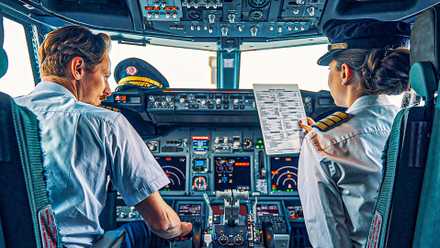
Differences between manufacturers also become immediately apparent. Airbus adopted side-stick controllers, eliminating the traditional control column and creating additional space in front of the crew. Boeing retained the central control yoke, partly because it provides visual and tactile cues that allow pilots to observe one another’s control inputs. These contrasting approaches reflect broader design philosophies that extend throughout the flight deck and influence how pilots interact with the aircraft.
Catch what other flight trackers miss
Emergency squawks, holds, NOTAMs — live signals, no signup.
Open tracker
Catch what other flight trackers miss
Emergency squawks, holds, NOTAMs — live signals, no signup.
Open tracker
The importance of cockpit ergonomics has grown significantly as aviation has evolved from traditional analog ‘steam gauge’ instrument panels to highly integrated glass cockpits. Pilots transitioning from older aircraft may find themselves adapting to flight decks where navigation data, engine indications, weather radar, traffic information, terrain awareness alerts, electronic checklists, and aircraft systems monitoring are consolidated onto a handful of large digital displays.
This contrasts greatly with the previous approach of being spread across dozens of individual gauges, or in some older aircraft, where it isn’t present at all. While these systems provide vastly greater situational awareness and reduce the need to scan multiple instruments, they also require pilots to process information differently.
Why Do Airbus And Boeing Jets Have Completely Different Cockpit Philosophies?
How can two competing manufacturers have such wildly different views of how a cockpit should work? Boeing and Airbus have proven just that.
Engine Response
Not All Powerplants Deliver Performance the Same Way

Engine behavior is another characteristic that stands out almost immediately when flying a new aircraft. Regardless of how much simulator training a pilot has completed, there is no substitute for experiencing how an aircraft accelerates, climbs, and responds to throttle movements in the real world. The relationship between power input and aircraft response becomes a major focus during takeoff, climb, descent, and landing.
The type of engine installed, as well as how many, has a profound effect on that experience. Piston engines, common in general aviation aircraft, typically provide relatively direct throttle response but produce modest power compared to turbine-powered aircraft. Turboprops use gas turbines to drive propellers and are particularly effective at lower altitudes and shorter runways. Modern airliners rely on high-bypass turbofan engines.
These generate most of their thrust by accelerating large volumes of air around the engine core rather than through it. This approach dramatically improves fuel efficiency while reducing noise levels. Another consideration is the number of engines. A pilot transitioning from a single-engine to a multi-engine aircraft will notice a huge difference in control characteristics, especially in the case of an engine failure. The same principle goes for pilots moving from a twinjet to a tri/quadjet.
The scale of that evolution is remarkable. Earlier commercial turbofan engines often featured bypass ratios near 5:1, while modern engines such as the Rolls-Royce Trent XWB and General Electric GEnx operate at approximately 9.6:1. These advances have contributed to substantial reductions in fuel consumption compared with previous generations of widebody aircraft, with manufacturers citing efficiency improvements ranging from roughly 15% to 25% depending on the aircraft being replaced
Braking & Ground Handling
Some of the Most Important First Impressions Happen Before Takeoff

For many pilots, an aircraft begins revealing its personality long before it leaves the runway. Taxiing provides valuable insight into steering sensitivity, braking effectiveness, visibility from the cockpit, and how easily the aircraft can be maneuvered in confined spaces. These observations become especially important at busy airports where precise ground handling is critical for safe operations. Aircraft size and weight significantly influence how they behave on the ground.
Smaller aircraft often respond immediately to steering inputs and can be positioned with relative ease. Larger aircraft require more anticipation because of their momentum, wider turning radii, and longer stopping distances. Pilots quickly learn how aggressively the aircraft reacts to nosewheel steering commands and how much planning is required to negotiate taxiways, intersections, and parking stands.
Modern braking systems are far more sophisticated than those found on earlier generations of aircraft. Features such as anti-skid protection, automatic braking modes, brake temperature monitoring, and electronically controlled braking systems have become increasingly common. While these technologies improve safety and consistency, they also create distinct handling characteristics that pilots must learn, and the first landing often provides the clearest lesson.
Automation Logic
Understanding How the Aircraft ‘Thinks’

Modern aircraft increasingly operate as highly integrated information systems rather than simply machines controlled through physical inputs. While performance figures such as speed and fuel efficiency remain important, many pilots transitioning to a new aircraft type find that understanding its automation presents the greatest challenge. Flight-management computers, autopilot systems, autothrust functions, and electronic monitoring systems constantly process large amounts of data.
This means that pilots must understand not only what the aircraft is doing, but also why it is doing it. Manufacturers have taken different approaches to automation over time. Some systems assume a more active role in managing aircraft performance and operating limits, while others are designed to keep pilots more involved in system management and decision-making.
These differences influence tasks ranging from route changes and speed management to climb and descent behavior, meaning familiar actions can sometimes produce different outcomes in a new aircraft. The growing importance of automation is reflected across modern fleets. The Airbus A320 family, which has surpassed 12,000 deliveries, helped establish integrated automation and digital flight management as industry standards.
Boeing adopted a more gradual transition, introducing fly-by-wire systems on widebody aircraft such as the 777 and 787 while retaining a more traditional approach on the 737 MAX family. For many pilots, the challenge on a first flight is no longer simply learning the controls, but understanding the logic behind the systems managing the aircraft.