dailynewsnblog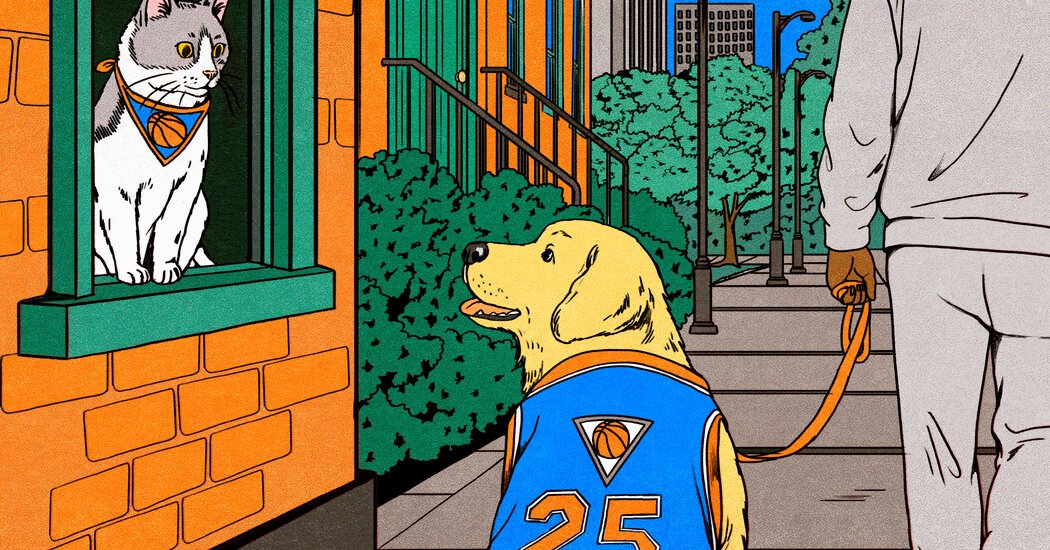
Everyone in New York City is talking about the Knicks, but perhaps as notable as the team’s winning the N.B.A. championship after a 53-year drought is the fact that people here are talking to one another at all. The city’s famous indifference, the anonymity-preserving armor that most inhabitants wear every day, has been disintegrating since the N.B.A. finals began, and seemed to disappear entirely after the Knicks won the chip.
In this transformed city, previously forbidding strangers are transformed into fellow fans. A blue-and-orange hat is a symbol of fellowship, license to start a conversation in line at the deli. You could stand in silence while waiting for the elevator, or you could ask the person next to you if he saw the game. You could let the old man in the Knicks Forever tee with matching neon sneakers shamble on by, or you could nod and give him a thumbs-up, which, miraculously, is returned. The feeling is one of temporary wonder: Can you believe Brunson and Co. came through? Can you believe you and I are talking to each other right now?
New Yorkers mythologize their tendency to mind their own business as a form of self-sufficiency and sophistication. Unflappable, unconcerned with others, a perfect performance of what the sociologist Erving Goffman called “civil inattention,” acknowledging strangers with a respectful glance that never engages. Elsewhere this behavior would be seen as cold, antisocial, but in New York it’s become a modus vivendi.
But regardless of where you live, you’ve likely experienced that feeling of separateness from the people around you. People are going about their lives, busy with their families and jobs, often too preoccupied to acknowledge others. It’s only when that invisible armor falls — when someone ventures a “How are you?” at the gym, when the cashier asks if the probiotic soda you’re buying is any good — that you realize you’ve been keeping yourself separate. New York in the thrall of the Knicks presents this shift in the extreme. It’s a crucible, a laboratory of connection made all the more notable for the trademark dispassion it’s replaced.
I want to bottle this connection, this communal experience that’s so precious because it is, as my colleague Matt Flegenheimer put it, “good, gleeful, uncomplicated.” Knicks fever has given people an entrée to communicate with people they wouldn’t otherwise, a rare pathway to intimacy. Now that we’ve experienced it, now that we’ve admitted we want to connect with one another — that it feels good to chat and high-five and smile at people we don’t know — how do we perpetuate it?
The British anthropologist Victor Turner called it “communitas,” that feeling of ecstatic kinship when our usual scripts are dispensed with, when we replace society’s regular structure with this warm “humankindness.” I’m already grieving the return to normalcy that will follow communitas, the inevitable retreat back into our eyes-down, you-talking-to-me bubbles of self-regard. But Turner cautioned against trying to institutionalize the good feeling. He saw resumption of normal life, with its clear boundaries and customs, as essential for a functioning society. People, he said, “return to structure revitalized by their experience of communitas.” If we can remember what it felt like to be this uninhibited, if we can remember that the guy we’d never in a million years think to talk to was once the guy in the OG Anunoby jersey we spent 10 delightful minutes dissecting plays with at a street-corner watch party, who knows what else is possible? The new season tips off in October.
THE LATEST NEWS
Iran Peace Deal
The Hunt: With about $600,000 to spend, a couple and their two young kids searched for a three-bedroom home in Atlanta. What did they pick? Play our game.
Hugo spritz: Has the Aperol spritz met its match?
Black market: People are buying what they believe to be a weight-loss drug from WhatsApp groups and Chinese labs. What is it, really?
Male mental health: Dads get postpartum depression, too. Researchers say men are at highest risk three to six months after their babies are born.
ADVICE FROM WIRECUTTER
How to pick the perfect vacuum
There are countless vacuums on the market. Selecting the right one comes down to the kind of home you live in and your priorities. If you despise lugging out an unwieldy machine, get a cordless stick vacuum. If you live in a larger home, have wall-to-wall carpeting or deal with shedding pets, a plug-in upright or canister vacuum can give you the deepest clean, removing fur and dust and filtering allergens. Finally, for anyone in a smaller, pet-free apartment with only a couple of rugs, a robot vacuum may just do the trick. — Evan Dent
The United States beat Australia, 2-0, in a feisty and physical game before a rowdy Seattle crowd. It’s the first time since 1930 that the U.S. has started a World Cup with two wins, and the Americans are now assured a spot in the knockout rounds. They have looked so good that U.S. fans are starting to wonder: Could this team actually, you know, do it?
Other results from yesterday:
Week 1 breakdown
There’s lots of soccer to be played still, but we now have seen every team take the pitch at least once. The Athletic’s soccer experts reflected on the first round of group play. Here are a few of their takes:
Most impressive team
Simon Hughes: France. They weren’t great against a very powerful opponent in Senegal and still won, 3-1.
Most disappointing team
Charlie Scott: Ghana. The only way they could score against Panama was from three yards out, in front of an open goal.
Best player
Carl Anka: It’s still Messi. His remarkable hat trick against Algeria reminded us that he is (probably) the greatest player to ever do it.
After one round, who do you think is going to win it?
Jack Lang: On the basis that you shouldn’t let one result overturn an opinion you have held for months, I’ll stick with Spain.
Matt Slater: Is it really being left to me to say it? Do I have to? Cowards! It’s coming home. (England.)