dailynewsnblog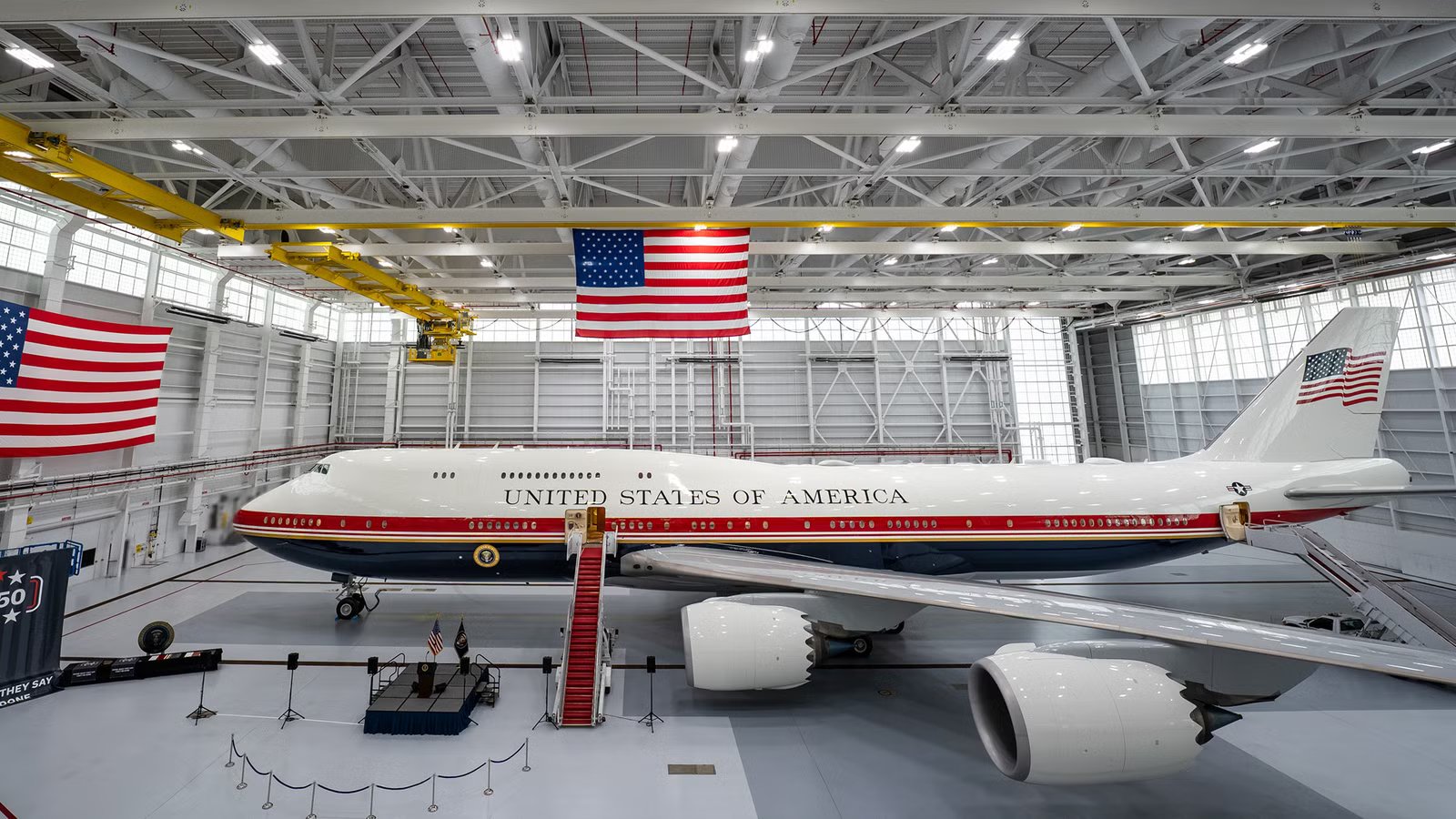
On June 19, President Donald Trump’s VC-25B ‘Bridge Air Force One’ arrived at Joint Base Andrews to relieve the long-serving VC-25A jets, which have been the primary aircraft for presidents for decades. The pair of Boeing 747-200 jumbo jets will not be retired as the new temporarily assigned Boeing 747-8 takes over as Trump’s primary aircraft until the end of his term.
The two legacy 747 jets will be used as part of the wider executive fleet, also known as ‘Air Force Two.’ They may fly the president again but will be backup aircraft. President Trump said that the planes will be given to museums after they are retired in 2029.
Record Turnaround Time For An Impossible Task

The outgoing VC-25A aircraft have been flying presidents since 1990, but the next-generation VC-25B fleet being built by Boeing is plagued by severe supply chain delays and labor shortages. Standard presidential aircraft overhauls typically take several years, but defense contractor L3Harris somehow completed a full transformation of a Boeing VIP into a military-grade flying embassy in a record 10 months.
A major portion of the time and cost involved stripping portions of the plane down to the literal cables to run forensic security audits, ensuring the foreign-sourced jet had no monitoring or recording devices installed. The full cost of the overhaul has not been disclosed and from initial indications, it appears that the interior of the plane was left unchanged.
Air Force Chief of Staff General Ken Wilsbach gave this statement:
“We are proud to deliver the VC-25B Bridge aircraft to the President. Many thought it could not be done, but the United States Air Force was able to execute and provide a secure, reliable airborne command post on an accelerated timeline.”
Catch what other flight trackers miss
Emergency squawks, holds, NOTAMs — live signals, no signup.
Open tracker
Catch what other flight trackers miss
Emergency squawks, holds, NOTAMs — live signals, no signup.
Open tracker
Modernizing The US Air Force Executive Airlift Fleet

The new VC-25B is based on a 13-year-old 747-8 accepted by the Pentagon in May of 2025 that was originally built for the Qatari royal family in 2012. At the beginning of his term, Trump personally inspected the plane as he hunted for a new plane while Boeing worked to deliver two purpose-built 747-8s under a $3.9 billion fixed-price contract signed in 2018.
Valued at roughly $400 million, based on the conversion price estimate from Air Force Secretary Troy Meink, the jumbo jet constitutes the largest unsolicited foreign gift ever accepted by the US government. The Air Force is still spending $1.17 billion over the next five years on the delayed primary VC-25B program. The Qatari plane will be donated to the Trump Presidential Library at the end of his term.
The sudden injection of the VC-25B Bridge and a $3 billion overhaul of the broader executive airlift fleet are fundamentally reshuffling the US Air Force executive airlift flight line. The USAF also plans to spend $2.2 billion to purchase 17 new C-37C Gulfstream jets between 2027 and 2031. Meanwhile, the Air Force is also looking to replace its aging Boeing 757 C-40 Clipper with new Boeing 737 MAX 9 single-aisle jets, according to Air and Space Forces magazine.
The Critical Capability Gap In The Ex-Qatari Luxury Boeing 747-8 Serving As Air Force One
Is Trump’s personal AF1 up to par?
Balancing The Air Force Budget: Where Does The Money Come From

In order to accelerate the executive airlift modernization efforts, funding for other programs was redirected, specifically the nuclear modernization program aiming to procure the LGM-35A Sentinel intercontinental ballistic missile and the Boeing E-7 Wedgetail airborne early warning and control aircraft.
The Sentinel program is the United States’ next-generation intercontinental ballistic missile system, meant to replace the 1970s-era Minuteman III. This program has experienced significant challenges as it is already over budget and behind schedule, while the nuclear missile silos suffer from severe readiness degradation as they await upgrade and overhaul.
The Wedgetail program is designed to replace the 1950s-vintage Boeing E-3 Sentry AWACS jets, which have an abysmal readiness level and operate using technology that is so antiquated, its makers have told the Air Force that it cannot be sustained. These jets are critical for air control during missions like Operation Epic Fury, where a high concentration of US and Allied Air Forces operate in the same space during combat.
One was lost in Saudi Arabia to an Iranian drone attack, constituting a loss of hundreds of millions of dollars. However, the Wedgetail is a multibillion-dollar asset itself, and procurement would severely drain funding. It is currently unclear what the future of the fleet will be as the Air Force grapples with budget balance issues and the price of the E-7 continues to steadily climb higher.