dailynewsnblog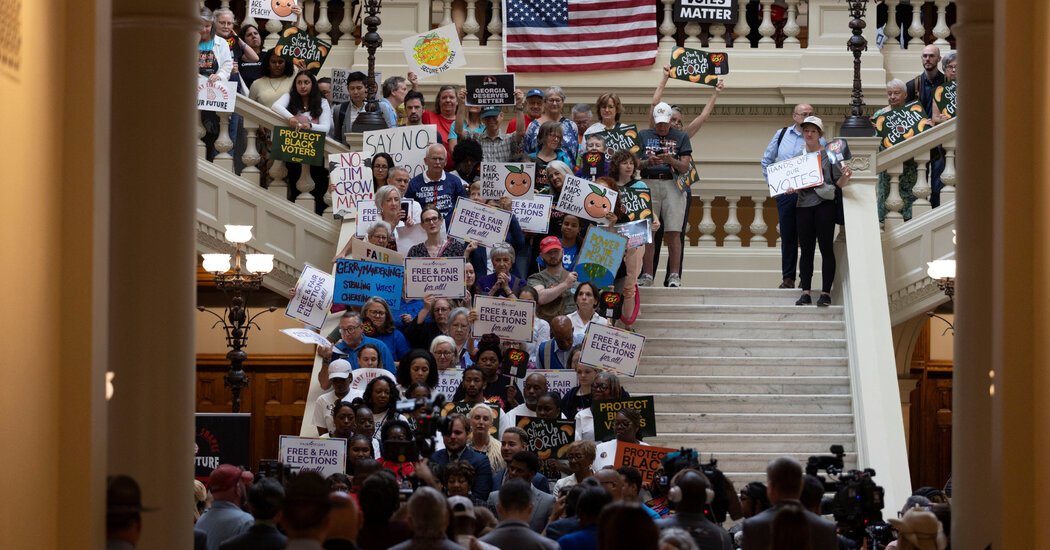
Republicans in the Georgia State Legislature, facing mounting anger from Black leaders, scuttled plans to take up redistricting on Wednesday during a special session that had been called expressly to erase U.S. House seats in majority-Black districts.
Gov. Brian Kemp called the session to draw legislative maps before the 2028 election with the aim of creating boundaries more favorable to Republicans. Georgia was to be the latest Southern state to consider redistricting after a recent Supreme Court ruling that weakened Voting Rights Act protections for Black representation.
But civil rights activists and protesters assembled in Atlanta, considered the cradle of the civil rights movement, determined to fight against the kind of aggressive legislative action they had seen play out across the South in recent weeks. Marches and demonstrations greeted lawmakers as they gathered for the special session.
Then, less than an hour before the legislative session was gaveled in, top Republican lawmakers stood under the capitol dome and announced redistricting was off, at least for now.
“House Republicans will not be taking up congressional or legislative redistricting maps for the 2028 election cycle during this special session,” Jon Burns, the Republican House speaker, said as the crowd gathered inside erupted in cheers.
Republican legislative leaders cited a desire for a more methodical process that included greater input from voters and a better understanding of how the legal challenges to the congressional maps rushed through by lawmakers in other states would hold up in court.
But it was also a recognition of the far more complicated landscape that Republicans face in Georgia compared to their counterparts elsewhere in the Deep South, including the possibility that they could pay a steep political price in the November election.
Demonstrators were happy to claim credit.
“They said protesting doesn’t work,” said Gerald Griggs, a civil rights lawyer. This time, it did, for now, he said, adding, “In the spirit of our ancestors, let’s enjoy this for about five minutes — and understand it’s a long fight.”
Before the session, some in the Republican Party had pushed to erase at least two Democratic seats, taking advantage of majorities in the legislature and an acquiescent Republican governor. That faction of the party argued again on Wednesday that there was no need to delay, raising the possibility of the matter being revived.
“Failure to deliver is not an outcome I am willing to accept,” Lt. Gov. Burt Jones, who lost a runoff on Tuesday in the Republican primary for governor, said on Wednesday, according to The Atlanta Journal-Constitution. “We need to do our jobs and get this done.”
But as the session approached, other Republicans grew concerned that redistricting for 2028 less than five months before Election Day this year could energize Democrats, given that pivotal statewide races are on the ballot. Those include the governor’s office being vacated by Mr. Kemp and the Senate seat held by Jon Ossoff, a Democrat seeking re-election.
“There’s plenty of time to get the maps right,” said State Senator Steve Gooch, a Republican.
A redistricting frenzy had been set in motion across the South after the Supreme Court ruling in April that weakened the Voting Rights Act of 1965 by effectively declaring that many intentionally drawn Black-majority districts were unconstitutional racial gerrymanders.
The decision landed amid a broader redistricting war across the country, which began as Republicans wanted to use friendlier boundaries to try to insulate the party’s slim House majority from what could be a tough midterm season.
Lawmakers in Tennessee, Alabama and Louisiana — states where Republicans hold the governor’s office and supermajorities in the legislatures — moved quickly to enact new maps for this year’s midterm election that wiped out districts that had traditionally elected Democrats.
There had been loud calls for Georgia to do the same. But Mr. Kemp refused to comply for the 2026 election, with early voting already underway ahead of the May primaries. Instead, he called a special session to consider new maps ahead of the 2028 election.
The impediments unique to Georgia Republicans went beyond the election calendar. The state has evolved into the most important swing state in the Deep South; Republicans still control most levers of power in Georgia, but Democrats are now competitive after years of a bleak run.
And Republican lawmakers would have to contend with Atlanta and its suburbs, longtime strongholds of Black and Democratic power big enough to render the redistricting particularly tricky.
Georgia’s 14-member U.S. House delegation includes four Democrats, all of whom are Black. The 13th Congressional District, one of Democrats’ safest, has been vacant since Representative David Scott, another Black Democrat, died in April.
Republicans have had their sights set on the only Democratic district outside the Atlanta metropolitan area, the Second, represented by Sanford Bishop. The Sixth, represented by Lucy McBath, might also be vulnerable to redistricting efforts.
An aggressive Republican gerrymander could weaken the strong Democratic majority in Georgia’s Fourth District, dominated by liberal DeKalb County, by pushing it eastward, and the vacant 13th District by pushing it west.
Republicans pressing for action now had their reasons. Changes to the map locked in this year could only be undone ahead of 2028 if the Democratic candidate for governor, Keisha Lance Bottoms, prevailed in November, and Democrats somehow won control of both chambers of the statehouse. Even as Democrats have gained ground in Georgia and feel confident about their prospects in November, such a feat for the party faced long odds.
“I’ve always been of the opinion that we should do it as soon as possible.” said State Senator Greg Dolezal, a Republican running for lieutenant governor.
For now, that argument has failed. Larry Walker, the Republican president pro tempore of the Senate, said the instruction from Mr. Kemp had been to consider redistricting for 2028, and that party leaders determined it was not prudent to rush the process.
His preference was to wait to see how the legal challenges to the maps drawn in other states for the November election would play out, so that Georgia could proceed with confidence that its map would withstand judicial scrutiny.
The Supreme Court decision on the Voting Rights Act “left no doubt that we would need to draw new maps,” Mr. Walker said. “The question was when.”
Democrats and other activists hailed the development on Wednesday as a sign that their influence, built up through the hard work of the civil rights movement and the efforts in more recent years to harness the state’s diversity, is growing.
“This is a victory, for now,” State Representative Saira Draper, a Democrat, said in an interview on Wednesday. “Certainly, it’s a very exciting moment. It shows that political civic engagement works when the people are paying attention and responding.”
On Wednesday morning, a crowd gathered in Big Bethel African Methodist Episcopal Church, long regarded as a cathedral of the civil rights movement in the heart of Atlanta. In speeches, civic and religious leaders drew a line from the activism for voting rights in the 1960s to the effort they were about to mount.
“We have been here before,” said Bishop Michael L. Mitchell, who leads the African Methodist Episcopal Church in Georgia.
The special session still convened on Wednesday. Lawmakers also have to weigh in on another agenda item: A law set to go in effect on July 1 would prohibit elections officials from using QR codes to tabulate ballots, which could cause major disruptions in carrying out the November election.
But for some Democratic lawmakers, redistricting was still on their minds, and they brought it up repeatedly on the Senate floor. They condemned what they saw as an assault on Black voting power, appealing to democratic ideals of governance.
Eventually, Mr. Jones, who presides over the Senate as lieutenant governor, piped up.
“Y’all know it isn’t happening, right?” he said. “I don’t know about you, but I’m ready to get out of here.”