dailynewsnblog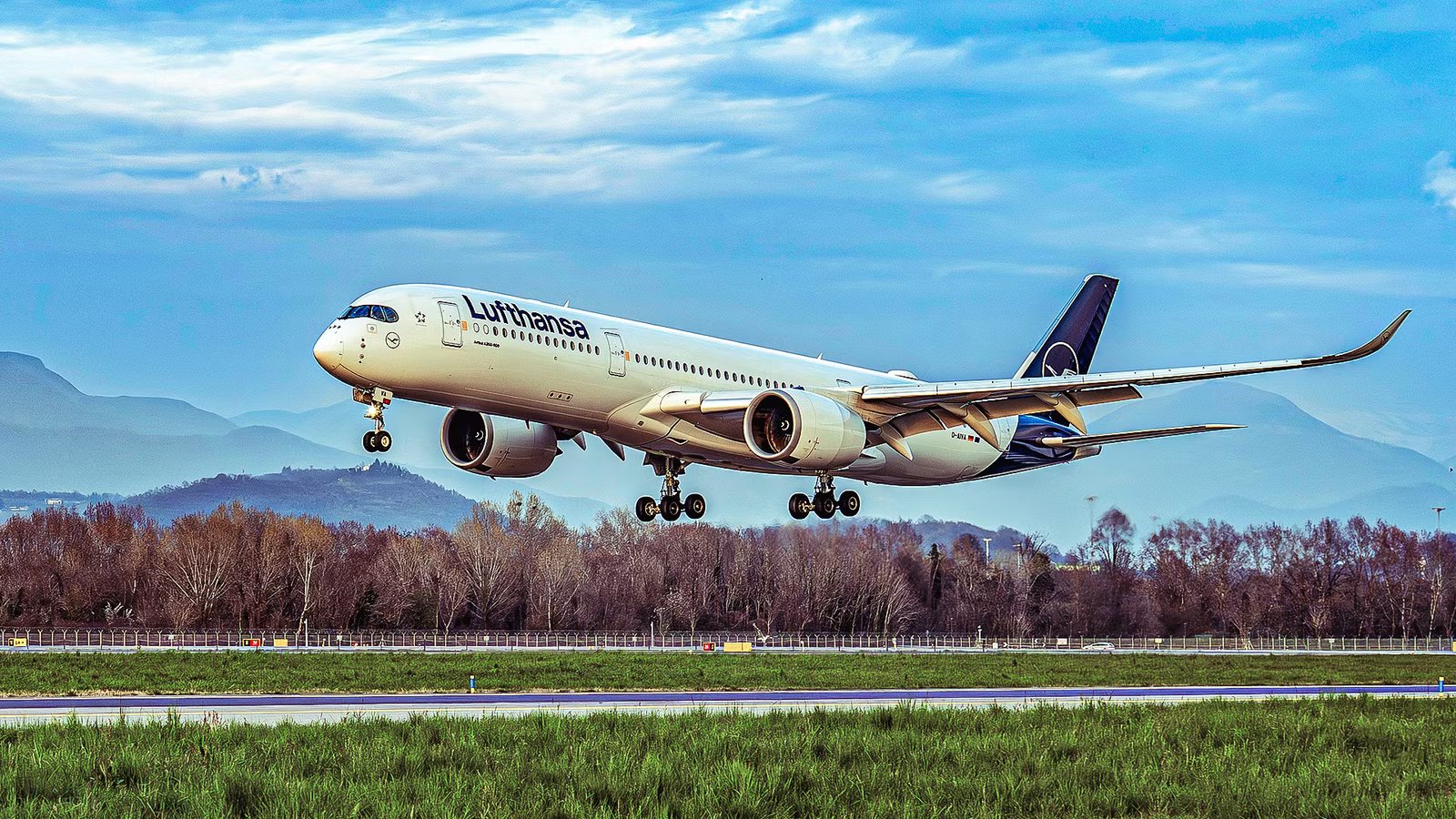
The Airbus A350 next generation widebody draws on a host of technology proven by both the superjumbo A380 and decades of pioneering development, including systems proven on the military-grade A400M. This pedigree of cutting-edge aerospace engineering spans a spectrum of innovation from the industry-leading use of composite material to some of the most advanced and resiliently redundant avionics ever installed in an airplane. The A350 not only ensures the safety of every soul onboard through uncompromising quality on the production floor, but also by empowering its pilots with the best tools available to make flying safer.
The A350 Xtra Wide Body jets have the most carbon fiber reinforced plastic of any commercial airplane currently in production, at 53% by weight. This incredibly tough and lightweight material was pioneered through both the Tactical Air Lifter and the superjumbo that came before it. The design logic, stress data, and safety margins calculated for the massive A380 and A400M gave engineers a powerful framework to create the A350’s cutting-edge airframe and avionics.
Military-Grade Composite To Build Tougher And Safer Jetliners

Airbus used the A380 and A400M to iteratively scale their industrial capabilities, moving away from metal component design. While the A380 introduced some new carbon fiber technology, the A400M military transport was Airbus’ true learning ground for large-scale composite structures. Military flight testing is inherently harsher than commercial flight testing. Airbus subjected the A400M test fleet to extreme operational environments and extensively tested how its CRFP, toughened with epoxy resin, withstood rough tactical airfield landings to refine its airliner tech.
The superjumbo was too massive to be built entirely of composites using early-2000s tech. However, Airbus achieved critical milestones by introducing CFRP to primary structural components. The massive core structure joining both wings was manufactured using CFRP, proving that composites could support extreme, heavy-aircraft loads. With the A350, Airbus leveraged its cumulative expertise to implement a four-panel fuselage design rather than using single-piece cylindrical barrels like the Boeing 787 Dreamliner does. Airbus’ 4-panel method allows them to tailor each section. The top and bottom panels are thick to handle vertical bending loads, while the side panels are noticeably thinner and lighter.
Airbus used the A400M program to study how resin micro-cracked under violent structural stress. While the A380 validated composite joints under heavy loads, the A400M militarized and significantly upscaled production. Heavy military testing revealed areas susceptible to delamination, or microscopic separation between cured carbon layers. Five years after launching the A400M, Airbus used that stress data to introduce interlayer-toughened epoxy for the A350.
To construct massive aero-structures efficiently, Airbus changed its production methods to Automated Tape Laying, where robotic gantries lay down microscopic, resin-impregnated carbon threads. Components like the A350’s intricate internal inboard wing flaps are built utilizing highly automated Liquid Resin Transfer Molding, where dry carbon fabrics are woven into a rigid mold, and liquid resin is vacuum-injected into the closed tool under pressure.
Catch what other flight trackers miss
Emergency squawks, holds, NOTAMs — live signals, no signup.
Open tracker
Catch what other flight trackers miss
Emergency squawks, holds, NOTAMs — live signals, no signup.
Open tracker
How The Superjumbo Helped Forge Airbus’ Xtra Wide Body

While the A380 was not a 50%+ composite aircraft like the A350, it was the critical platform where Airbus invented, tested, and certified the core composite structural concepts and multi-material joining techniques used today. The single most significant composite milestone on the A380 was the Center Wing Box, the structural heart of the aircraft that ties the wings directly to the fuselage. This was the first time in aviation history that a primary, heavily loaded structural component of this size was built out of CFRP.
By swapping aluminum for carbon fiber on the A380 CWB alone, Airbus saved nearly 1.5 metric tons of weight. After the CWB, Airbus looked at the rear pressure bulkhead. This component was typically a heavy, riveted aluminum structure of many parts in a single piece; instead, it became a continuous CFRP dome on the A380. To make it, Airbus perfected ‘resin infusion’ over a curved shape. This eliminated thousands of rivets, and with them, failure points for air leaks and structural cracks. The A350 directly adopted this exact single-piece composite dome design for its rear bulkhead, ensuring a lighter and vastly safer pressure cabin.
One of the reasons Airbus was hesitant to make the entire A380 fuselage out of pure carbon fiber was due to early concerns about impact damage visibility. Instead, they invented Glass Laminate Aluminium Reinforced Epoxy. GLARE gave Airbus engineers a decade of real-world flight data on how “sandwich” laminate materials handle extreme cabin pressurization cycles. This directly informed how they layered the 4-panel CFRP fuselage skins on the A350 to withstand identical flight stresses without micro-cracking.

What’s The Next Commercial Airbus Aircraft?
From hydrogen horizons to open rotor revolutions, the future of aviation is on the brink of a major transformation. Discover what’s next for Airbus.
Integrated Modular Avionics: Future-Proofing The A350

Looking beyond the skeleton and the skin of these cutting-edge airplanes, the A350 also owes its ‘digital brain’ to technology pioneered in its famous predecessors. Instead of hundreds of individual boxes, the A380 and the A400M introduced standardized, high-performance computers known as Core Processing Input-Output Modules. The A380 hosted 23 separate flight system functions on a centralized suite of shared CPIOMs. The A400M expanded with harsh, military-grade systems like terrain-following flight control networks and tactical computers alongside civilian-compliant equipment.
The ‘nervous system’ of these aircraft evolved from a traditional copper wire network composed of miles of individual strands into a full-duplex switched Ethernet grid. This aerospace-grade Ethernet network forced split-second data to arrive deterministically, with zero latency or communication collisions. While revolutionary, the A380 and A400M systems revealed processing boundaries that limited their maximum potential. Critical operations like anti-skid braking algorithms or rapid-fire landing gear control loops still had to be processed outside the core modules in independent avionic boxes.
Developed alongside partners like Thales, the A350’s IMA system functions with significantly higher efficiency, as Aviation Tech Today wrote. They dubbed this the ‘plus generation,’ or IMA2G. Instead of 23 systems, there can be as many as 40 systems consolidated by the IMA grid of the A350. While the jets that came before the A350 cut down the number of avionics boxes by half, the XWB cuts that in half again and integrates faster control loops for communication between systems.
The higher level of integration also makes the aircraft safer. If an A350 CPIOM computer physically fails due to an electrical short or damage, another module instantly assumes its tasks. Because the hardware is standard and uniform, software applications can migrate to backup processors seamlessly mid-flight with zero disruption to the pilots. For example, if a fire sensor goes off, the system instantly cross-checks cabin pressure and environmental air-flow loops to isolate the issue.
Why The Airbus A350 Has Such A Slow Landing Speed
A closer look at how and why the Airbus widebody glides so slowly.
Fixing The A350 Before It’s Broken: Airbus Predictive Maintenance

The systems powering the Airbus A350’s modern ability to stream real-time data directly to ground crews were pioneered by the A380 and the A400M. The technology cuts turnaround times and helps predict mechanical failures before they happen, to develop and refine systems that minimize turnaround times and find mechanical failures before they happen.
The A380 introduced a centralized software architecture called ‘Airman.’ Before the A380, aircraft maintenance data was highly fragmented. Technicians had to manually download data logs from various independent computer systems after a flight. It was designed to collect real-time fault messages and parameters from the aircraft’s IMA. For the first time, an airliner could transmit real-time warning logs to ground operations while still cruising via Aircraft Communications Addressing and Reporting System, or ACARS.
While the A380 proved that commercial avionics could stream fault codes, the military operational profile of the A400M forced Airbus to invent systems capable of tracking actual structural stress and component health under extreme conditions. Instead of waiting for a part to throw a fault code, the A400M’s sensors tracked everything, and algorithms translated this physical stress data into predictive degradation rates. Airbus engineers utilized this harsh operating data to learn exactly how to forecast when a mechanical part would eventually fatigue.
Why The Airbus A350’s Carbon Fiber Fuselage Makes It Nearly Impossible To Repair After A Hard Landing
A phenomenon known as barely visible impact damage makes composite aircraft like the A350 much more difficult to repair after rough landings.
Easy To Fix, Impossible To Break: 2H2E And The Open Avionics Bay

The final layout of the Airbus A350 combines mechanical survival systems with highly efficient maintenance designs. By incorporating the 2H2E Flight Control Architecture and an accessible, server-room-style avionics bay, the A350 provides pilots with total hardware fault tolerance while offering technicians instant access to the aircraft’s primary electronic systems. Both systems were directly adapted and evolved from engineering frameworks tested on the A380 and A400M.
Because of its massive size, the A380 used three separate avionics bays: Main, Upper, and Aft. The Main Avionics Bay pioneered walk-in accessibility. The A400M adapted the A380’s centralized bay logic, optimizing the computer racks for rapid access. Technicians could quickly access the core processing systems without opening external fuselage panels. The A350 integrates these exact concepts into a modern widebody aircraft. Located directly beneath the cockpit floor and accessed via a flush hatch, the A350 avionics bay functions like a commercial server room.
Legacy commercial airliners relied on three distinct hydraulic systems to move flight control surfaces, but the A380 completely removed the third hydraulic network. Instead, the system relies on a quad-redundant combination of two hydraulic circuits and two electrical systems, or 2H2E. If a catastrophic failure causes the loss of both main hydraulic systems, the aircraft switches to its electrical paths. The flight control computers command specialized Electro-Hydrostatic Actuators and Electrical Backup Hydraulic Actuators. These features self-contained internal hydraulic reservoirs driven by electric motors.
Airbus incorporated the 2H2E design into the A400M to survive battlefield damage. Testing the architecture under high-vibration tactical maneuvers proved that localized electrical actuators could handle rapid, aggressive inputs. Backed by millions of flight hours from its predecessors, the A350 launched with a refined 2H2E layout. Airbus completely removed all traditional mechanical linkages, producing a digital flight control system that remains fully operational even if multiple separate systems fail simultaneously.