dailynewsnblog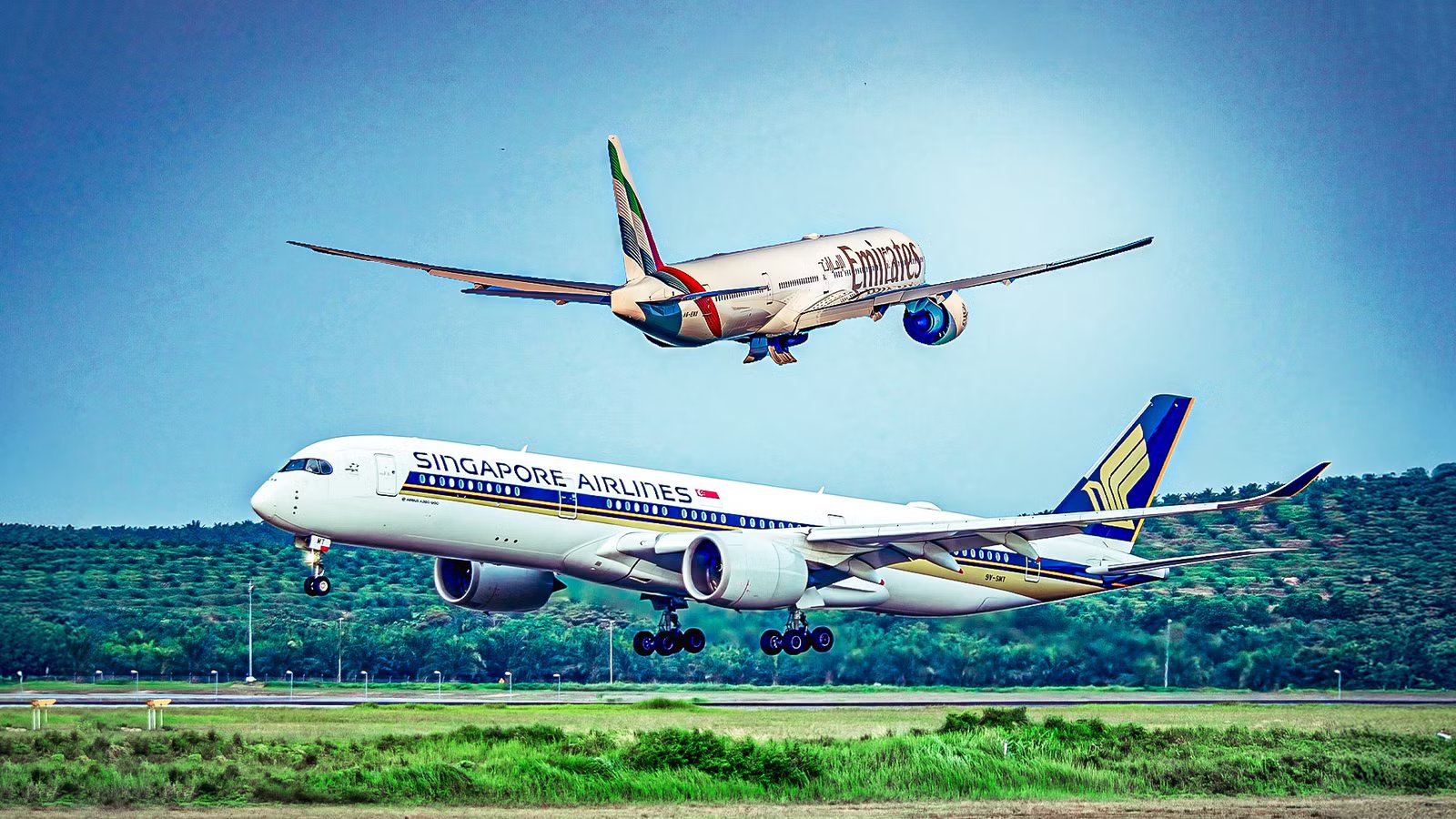
Most airline coverage focuses on product reviews. Analysts compare seat widths, meal service, airport lounges, and cabin design to determine which carrier offers the best experience. Yet the more interesting story is often hidden in the pricing. Why can one airline charge significantly more than its competitors on the same route and still fill its aircraft?  Singapore Airlines offers one of the clearest examples of this phenomenon.
On key long-haul markets connecting Asia and Europe, the carrier routinely commands a substantial premium over rivals, including Emirates and Qatar Airways. A 2024 teaching case from Singapore Management University found that, in the fare sample analyzed, Singapore’s business-class fares on the Singapore Changi Airport (SIN)–Frankfurt Airport (FRA) route reached premiums of roughly 105% versus Emirates and 88% versus Qatar Airways. The case used the route as an illustration of how brand strength, product differentiation, and revenue management can support extraordinary pricing power despite intense competition. While these figures represent observations from the case study rather than permanent market averages, they reveal an important reality: Singapore Airlines has built a business model that allows it to charge more than many of the world’s best airlines, and still win customers.
The Frankfurt Route Reveals Singapore Airlines’ Pricing Power

The Singapore–Frankfurt corridor is among the most competitive long-haul business travel markets linking Europe and Asia. Travelers can choose Singapore Airlines’ nonstop service or connect through Doha with Qatar or Dubai with Emirates. In theory, such competition should compress fares and limit any airline’s ability to sustain a premium.
Yet Singapore Airlines consistently occupies the upper end of the pricing spectrum. Business-class tickets on the route generally range from approximately US$1,800 to US$5,500 round-trip, depending on season, booking window, and fare class. Singapore Airlines often prices toward the higher end of that range despite the availability of cheaper alternatives. The airline is effectively betting that a meaningful share of travelers values convenience, service quality, and brand reputation enough to justify paying more.
The strength of that pricing power was highlighted as noted in the aforementioned SMU study. Drawing on fare comparisons in its analysis, the case found Singapore Airlines charging business-class premiums of roughly 105% over Emirates and 88% over Qatar on the Singapore–Frankfurt market. The case also noted directional pricing differences, with Frankfurt–Singapore fares significantly lower than Singapore–Frankfurt fares, a pattern consistent with revenue-management strategies aimed at capturing higher-yield corporate demand originating in Singapore.
Catch what other flight trackers miss
Emergency squawks, holds, NOTAMs — live signals, no signup.
Open tracker
Catch what other flight trackers miss
Emergency squawks, holds, NOTAMs — live signals, no signup.
Open tracker
Nonstop Flights Create An Economic Advantage

One of Singapore Airlines’ greatest competitive advantages is also one of its simplest: it flies nonstop between Singapore and Frankfurt. Emirates and Qatar Airways generally require passengers to connect through their Middle Eastern hubs before continuing to Germany.
For leisure travelers, a connection may be a minor inconvenience worth accepting in exchange for a lower fare. Corporate travelers evaluate the trade-off differently. Every additional hour spent in transit represents lost productivity, greater fatigue, and a higher risk of disruption. Missing a meeting or arriving exhausted for a client presentation can easily cost more than the fare difference between airlines.
The result is a structural yield advantage. Airline industry studies consistently show that nonstop services command higher fares than connecting itineraries because travelers place a monetary value on their time. While Singapore’s service quality contributes to its premium, part of its pricing power comes simply from offering the fastest and most convenient journey available.
What Are The Benefits Of Flying Singapore Airlines’ First Class?
A closer look at the unparalleled luxury and exclusivity of Singapore Airlines’ First Class experience.
A Soft-Product Moat Competitors Struggle To Replicate

Many airlines compete aggressively on aircraft type, seat design, and onboard technology, but Singapore Airlines has long leaned into what industry observers call the soft product, the service elements that define the passenger experience beyond the seat itself. This matters economically because aircraft and cabin interiors can be replicated or leased from the same manufacturers, while service culture, training systems, and operational consistency take decades to build. Singapore has repeatedly ranked among the world’s top carriers in global airline awards and passenger satisfaction surveys, reinforcing its ability to sustain premium pricing power even on highly competitive long-haul routes.
One of the clearest examples of this strategy is the airline’s Book the Cook program, which allows premium-cabin passengers to pre-select meals before departure from an extensive curated menu. On long-haul flights, this can include regionally inspired dishes and chef-designed options that go beyond standard onboard catering constraints. Combined with a cabin service model that typically features high crew-to-passenger ratios in premium cabins, the program creates a level of personalization that is rare in commercial aviation. These details may appear incremental, but in aggregate they contribute to measurable differences in customer satisfaction scores and repeat booking behavior among frequent flyers.
The airline also offers one of the widest business-class seats in commercial aviation, measuring approximately 28 inches (71 cm) across on many long-haul aircraft such as the Airbus A350 and Boeing 777 variants. However, even this physical advantage is arguably secondary to its service reputation. Singapore Airlines’ cabin crew are consistently ranked among the best in the world by industry benchmarks such as Skytrax awards, and the airline has won multiple “World’s Best Cabin Crew” titles over the past decades. That consistency is a key differentiator: while competitors can purchase similar aircraft and install comparable seats, they cannot easily replicate decades of institutional training, service culture, and brand trust that underpin Singapore Airlines’ premium positioning.
Loyalty Economics Make Higher Fares Easier To Justify

Frequent-flyer programs have evolved into some of the most valuable assets in aviation. For many premium travelers, the decision to book a flight is influenced not only by the ticket itself but by the long-term value of the loyalty ecosystem attached to it.
Singapore Airlines benefits enormously from the strength of KrisFlyer. The program is widely regarded as one of the most attractive loyalty currencies in Asia, offering competitive redemption rates and broad access across the Star Alliance network. A round-trip business-class redemption between North America and Singapore typically requires around 214,000 KrisFlyer miles, while comparable long-haul premium-cabin redemptions through Emirates often require substantially more miles at around 256,500 Skywards miles.
These economics matter because they create switching costs. A traveler who has accumulated hundreds of thousands of KrisFlyer miles may be reluctant to switch carriers even when competitors offer lower fares. Access to more than two dozen Star Alliance airlines further strengthens the value proposition, allowing members to earn and redeem rewards across a vast global network. The result is greater customer retention and more pricing flexibility for Singapore Airlines.
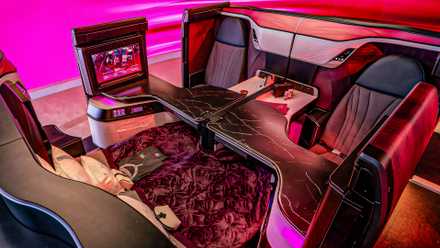
How Qatar Airways’ Qsuite Next Gen Stacks Up Against Every Rival Business Class Suite In 2026
Qatar Airways unveils Qsuite Next Gen, a business class suite designed to silence doubters and maintain its position at the top of luxury travel.
Corporate Travelers Are Less Sensitive To Price

Not all airline customers behave the same way. Leisure travelers typically pay for their own tickets and therefore prioritize price. Corporate travelers often operate under a different set of incentives.
For executives traveling between major financial and commercial centers, convenience, reliability, and schedule flexibility often matter more than finding the lowest fare. Singapore Airlines has spent decades cultivating relationships with multinational corporations throughout Asia, positioning itself as the preferred choice for premium business travel.
This customer mix is crucial because business travelers generate disproportionately high profits. Revenue-management systems are designed to identify passengers with lower price sensitivity and allocate premium inventory accordingly. The directional pricing identified in the Singapore Management University case reflects this strategy. By charging more on routes and travel directions associated with stronger corporate demand, Singapore Airlines can maximize revenue without significantly reducing bookings.
The Next Phase: Closing The Product Gap With Qatar Airways

Singapore Airlines’ pricing power is not unchallenged. Among premium carriers,  Qatar Airways remains one of its strongest rivals, with its Qsuite widely regarded as a benchmark business-class product thanks to its privacy doors, suite-style layout, and innovative cabin design. Recognizing that hard product is one of the few remaining areas where competitors can still gain an edge, Singapore announced a USD 834 million retrofit program in November 2024 covering 41 A350-900 aircraft. The upgrade includes new business-class seats, refreshed premium-economy and economy cabins, and a new first-class product for ultra-long-haul aircraft, making it one of the airline’s largest cabin investments.
The investment is strategically important because it reinforces Singapore’s premium positioning. While the carrier already relies on service excellence, nonstop convenience, and loyalty-program strength, upgrading its onboard product helps ensure those advantages are not eroded by competitors with more modern cabins. Although the rollout has been delayed from 2026 to 2027 due to supply-chain and certification issues, the commitment signals confidence that premium demand will remain resilient even at higher price points.
Ultimately, Singapore’s ability to charge more than Emirates and Qatar reflects a deliberate strategy rather than a single advantage. The broader reality is that the airline has built a brand strong enough to justify significantly higher fares through a combination of convenience, service quality, loyalty economics, and reliability. Instead of competing on price, it has positioned itself around value creation, where passengers are willing to pay more not just for the journey itself, but for the consistency, predictability, and premium experience that come with it.