dailynewsnblog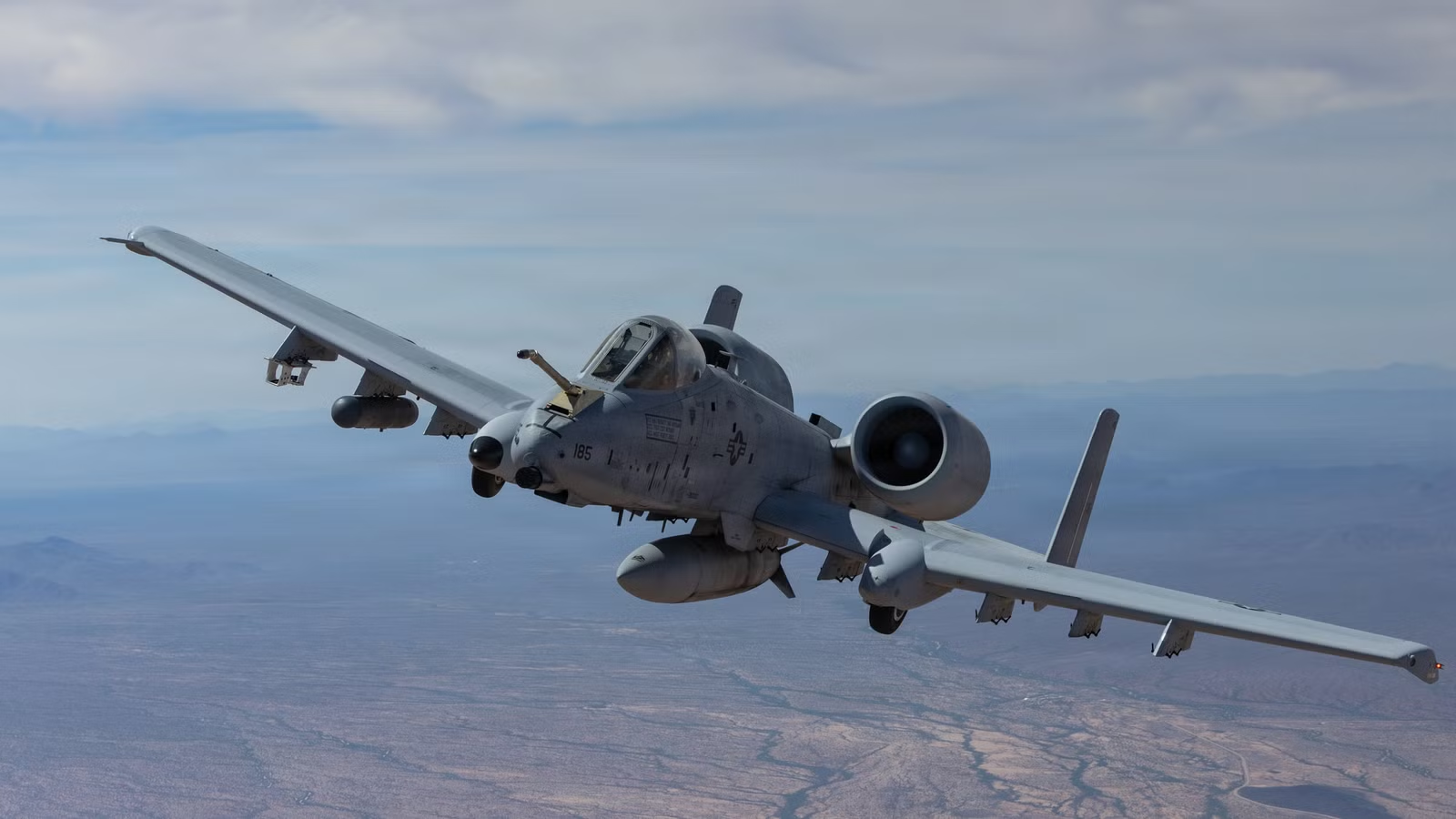
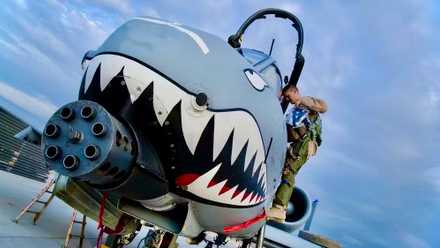
The venerable Fairchild Republic A-10 Thunderbolt II (Warthog) is now not expected to fully retire until Fiscal 2030, although this remains the topic of back-and-forth debate in Washington. However, the sun is setting, and most Warthogs have been sent to the boneyard. The Air Force withdrew the last of its A-10s from South Korea in 2025, replacing them with F-16s.
But as the US phases down its A-10s and transitions from a focus on lower-level counterinsurgency operations to high-end peer-on-peer deterrence against China, questions are being asked about the future of Close Air Support (CAS). Often discussed separately, but also related to the A-10 Warthog and CAS, is the Army’s ongoing doctrinal shifts with its AH-64 Apache attack helicopters. Here are some things to know about the gap left by the departure of the A-10 and how the Air Force and Army plan to fill it.
Remaining Inventories Of Warthogs

Fiscal Year 2026 budget documents show the Air Force had 162 A-10s remaining in service at the start of the year. However, it received permission from Congress in its Fiscal 2026 budget to reduce its fleet to no fewer than 103 (the Air Force had requested to retire all). This allows it to divest 59 more Warthogs or 36% of the remaining fleet in Fiscal 2026. As of the time of writing, it’s mid-2026, and it’s unclear if it has sent more aircraft to the boneyard, or if its inventory levels remain closer to 162.
During 2026’s Operation Epic Fury, dozens of A-10s were active in offensive operations. The aircraft was notably active in targeting Iraqi militias (who had minimal air defense capabilities), Iranian naval vessels, and in the epic multi-day rescue operation to extract a downed Colonel F-15E Weapon Systems Officer deep behind enemy lines. One A-10 was hit and crashed during the operation, although it went down over friendly territory with the pilot safely ejecting.
While many Warthog fans highlight its original anti-armor role, the 2026 operation highlighted its underrated anti-maritime role. The Warthog remains useful for some, increasingly niche missions. Notably, in 2025, the A-10 was jerry-rigged with laser-guided 70mm Advanced Precision Kill Weapon System II (APKWS II) rockets, transforming it into a drone-hunter.
The Feud That Created The Warthog

It is not uncommon for military development programs to be deeply political; even so, the politics behind the Warthog are notable. It was partly a product of the 1960s/70s “Fighter Jet Mafia” that fought against what they saw as increasingly prohibitively high-end and complex fighter jets like the F-15 Eagle. Instead, they championed similar platforms that would be affordable. The mafia advocated against high-end beyond visual range engagement in favor of aerodynamic performance and brute-force close-quarters combat.
The result was the rugged, close-quarters A-10 Warthog and the F-16 Fighting Falcon. Ironically, the F-16 was designed as a simple, highly maneuverable air superiority fighter jet but evolved into a complex multirole fighter jet anyway. Limits on the A-10’s design meant it could never be upgraded into a multirole platform in the same way. Another factor was bitter inter-service rivalry. The US military has never had the toxic inter-service rivalry of Japan in WWII, but it is not immune to these issues plaguing certain programs and budgets.
Fairchild Republic A-10 Thunderbolt II “Warthog” (per USAF) | |
|---|---|
Number built | 716 |
Number remaining in service | 162-103 |
Speed | Mach 0.56 |
Range | 695 nautical miles |
Final retirement | 2030 (in debate) |
After the Army Air Force was separated from the Army as the Air Force in 1947, conflict soon erupted. The Air Force lobbied against the Army purchasing aircraft, with the compromise that the Army could largely only purchase rotary-wing aircraft (Key West Agreement, 1948). The Army developed the Lockheed AH-56 Cheyenne attack helicopter, but the Air Force lobbied hard to get it canceled, arguing Close Air Support (CAS) was its responsibility. Eventually, the Air Force had its way, but needed the A-10 to provide CAS that it had denied the Army.
The US Air Force Sent 39 A-10 Warthogs To The Boneyard At Davis-Monthan AFB In 2024
At least 39 A-10s were mothballed in 2024 and the Air Force likely has around 200 Warthogs remaining in service.
An Unwanted Aircraft

Importantly, the A-10 was a jet the Air Force never wanted. Congress, the Mafia, and rivalry with the Army meant it had to acquire the A-10 to provide Close Air Support to the Army. Without the extremely promising Lockheed AH-56 Cheyenne attack helicopter, the Army went on to develop the AH-64 Apache. As a caveat, it should be noted that there were also other factors in the cancellation of the Cheyenne, such as costs, technical difficulties, and the end of the Vietnam War.
Since the AH-64 Apache entered service, it and the A-10 have been the primary CAS assets for frontline troops. As the final Warthog was delivered, the Air Force asked Congress to retire all of them in 1984. While that was perhaps more of a signal than a serious request, it does highlight the tension the Air Force has had with the aircraft since the beginning.
It remains an open question how tactically useful the A-10 ever was. Some point out that it is vulnerable, others say it was built to take hits and keep flying, others counter that it’s true, but those aircraft were written off and never flew again. Much is said about its role in the Gulf War, but much of that was done with missiles (e.g., Mavericks), not its gun. However, the A-10 has been incredibly useful for morale. It epitomized the idea of the cavalry riding in to save the day for frontline soldiers in trouble. Morale and public messaging are important, but often underreported, roles for US military aircraft.
Catch what other flight trackers miss
Emergency squawks, holds, NOTAMs — live signals, no signup.
Open tracker
Catch what other flight trackers miss
Emergency squawks, holds, NOTAMs — live signals, no signup.
Open tracker
No Replacement For The A-10

The F-35 program was developed as a Swiss Army Knife of fighter jets. It was built to (at least partially) replace F-16s, F-15s, F-14s, F/A-18s, Harriers, European Tornados, and A-10 Warthogs. Critics point out that its CAS capabilities pale in comparison to the A-10 and that there is no comparison between the A-10’s GAU-8/A Avenger autocannon, with 1,174 30mm rounds, and the F-35A’s GAU-22/A Gatling autocannon, with 182 25mm rounds.
The answer to that is: yes. Talk of the F-35A filling the low-flying strafing CAS role as the A-10 was intended to do is generally regarded as propaganda. Congress can’t be seen as scrapping its CAS aircraft and risk being accused of not caring about the lives of frontline servicemen. This is not happening in a vacuum.
The closest Soviet analog to the A-10 is the Su-25 Frogfoot. While the Frogfoot remains in combat service with both Russia and Ukraine, it has seen heavy attrition, and has been gradually disappearing from the front lines. An under-reported story is the shift in the Army’s Apache doctrines. Not only is the Air Force phasing out the A-10, but the Army is deemphasizing the CAS role of its Apaches and emphasizing deep strike and other missions. While neither service is scrapping CAS doctrines, they are both reducing the number of manned aircraft for those roles.
CAS Will Be Hard To Sustain In Peer-On-Peer Conflict

The uncomfortable truth is that there is nothing completely filling the gap left by the A-10 and Apache. While the Air Force and Army planners may still reckon on providing CAS for soldiers in lower-end conflicts, it’s another topic for higher-end conflicts. Realistically, the F-35A can perform CAS, but not in the same strafing doctrinal style as the A-10. Using its cannon in CAS roles makes it, in some ways, more vulnerable than the A-10, at least for flakfire, as the F-35 lacks much of the A-10’s armor.
In a future higher-end conflict, US military planners are turning to a range of mostly unmanned platforms. If aircraft aren’t going to be survivable on the modern battlefield, then the military needs assets that are attritable, like drones. The CAS gap will be filled, or partially filled, by a range of systems, with manned fighter jets like the F-35A still playing some measured role.
The US prides itself on being in a capability league without equal and able to protect, supply, and evacuate all its forward troops on the zero line. Even so, it may struggle to sustain this in a future peer-on-peer conflict. Russia and Ukraine are not the United States Air Force, and both have far fewer capabilities, but they may be a sign of what is to come. Soldiers on both sides have largely come to accept that low-flying manned CAS missions are fading into a thing of the past, with the role increasingly filled by drones, stand-off glide bombs, and other capabilities.
Can An A-10 Warthog Destroy A Tank?
The epic A-10 Warthog is known for its 30mm cannon, but can it really turn enemy tanks into flaming wreckage so easily?
CAS: Evolving Or Disappearing

Both the A-10 and AH-64 are remembered as “tank busters,” but those are now largely memories from the 1980s and 1990s. An opponent with armor is also likely an opponent that will have many short-range air defense systems (like MANPADS) that would make such strikes risky. In these settings, the military would likely be more comfortable using stealthy fighter jets (e.g., F-35As) or a range of drones (e.g., LUCAS or other one-way attack drones).
A total of 716 A-10s were delivered to the Air Force, of which between 103 and 162 remain in service (14–23%). These are expected to be phased out over the next four years. The Air Force’s possible decision to postpone its final retirement to 2030 does not represent any major rethinking or doctrinal shift. The decision is likely a combination of public messaging, a significantly boosted Fiscal 2027 budget, and the A-10’s performance in 2026, demonstrating it retains some value (e.g., anti-maritime).
But the CAS gap remains. It is politically problematic for Washington to openly say it can no longer provide CAS to its frontline soldiers as it has in the past. It is also salient to point out that it retains substantial CAS capabilities and that it is working on solutions that will work on the modern battlefield. At the same time, whatever those solutions will be, they will likely be partly drone-based, attritable, and a mixture of fast fighter jets, advanced CCAs, precision munitions, etc. The debate often centers on whether CAS is disappearing or evolving, although treetop-level strafing is undoubtedly fading.