dailynewsnblog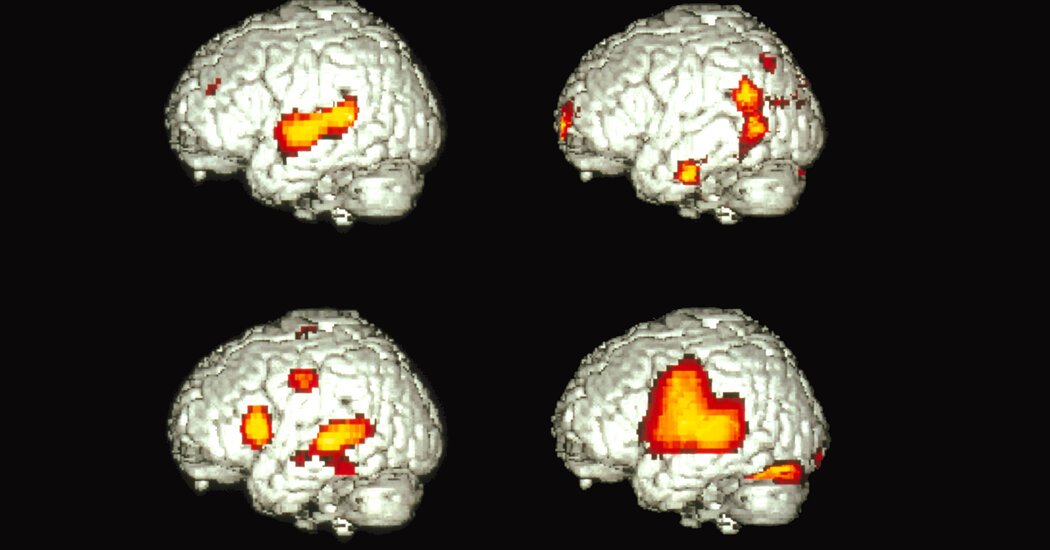
Speak a language your whole life and its grammatical rules become ingrained. That’s why you might correctly guess that the present participle of the verb “absquatulate” is “absquatulating,” even if you are completely unfamiliar with the word.
But the rules of grammar can vary widely between languages, and neuroscientists long theorized that bilingual speakers must process different languages with separate patterns of brain activity.
In a new study, however, researchers found that these patterns were more alike than had been expected. When deciding how to make a word singular or plural, for instance, bilingual people exhibit strikingly similar brain activity regardless of whether they are speaking in their first or second language.
“It wasn’t obvious that it was going to be so shared,” said Esti Blanco-Elorrieta, a psychologist and neuroscientist at New York University and an author of the study, which was published on Monday in the journal JNeurosci. “I think this is arguably one of the first very fine-grained findings of how truly integrated two languages in the brain are.”
Early research viewed bilingualism as an “add on” or “disruption” to the processing of one’s native language, said Judith Kroll, a psycholinguist at the University of California, Irvine who was not involved in the new study.
Subsequent studies have found that bilingual brains tend to display physical differences, such as more efficient white matter and changes to the gray matter, and to perform better on memory and concentration tasks.
Now scientists are probing further, to understand whether core aspects of the brain’s neural network does double or triple duty to process multiple languages.
For insight, Dr. Blanco-Elorrieta’s research team placed 23 bilingual Spanish and English speakers in a magnetoencephalography, or MEG, scanner and monitored their brain activity as they made words singular or plural.
While lying in the scanner, the participants were shown the word to be modified, such as “boats” or “tuna.” Then they heard a command — “one” or “uno” to make the word singular; “two” or “dos” to make it plural; or “say” or “di” to simply repeat the word without modifying it. The scanner took millisecond-by-millisecond images of brain activity before, during and after each of these internal calculations.
The research team found that the patterns of brain activity were roughly the same whether bilingual participants looked at Spanish or English words. Critically, this was true even when words didn’t have a cognate in the other language — like “taxi,” which has the same meaning in Spanish and English. It even held for “pseudowords” that sounded like Spanish or English words — such as “ailos” — but had no real meaning.
“That makes it harder to explain the effect as simply reflecting shared vocabulary,” Dr. Blanco-Elorrieta said, “and suggests the brain may be representing the grammatical operation itself.”
The finding is in line with other initial results in this area, said Mirjana Bozic, a cognitive neuroscientist at the University of Cambridge who was not involved in the study. For instance, the new study provided additional evidence that the front left side of the brain was typically involved in processing the grammatical structure of sentences across different languages. On the whole, Dr. Blanco-Elorrieta said in a news release, a single “grammatical engine” in the brain appeared capable of powering multiple languages at once.
Dr. Bozic said that the find, although not surprising, was “highly informative, providing elegant and convincing evidence that bilingual speakers rely on shared neural mechanisms. She added, “One question that remains is how far these findings generalize across language pairs that differ more substantially.”
To that end, Dr. Blanco-Elorrieta’s team hopes to study the patterns of brain activity behind other grammatical and linguistic processes, such as deciphering the syntax of sentences or identifying the range of objects that can be referred to by a single term, and across very dissimilar languages.
“The brain is much more plastic than what we once thought,” Dr. Kroll said. “Things are constantly changing.”