dailynewsnblog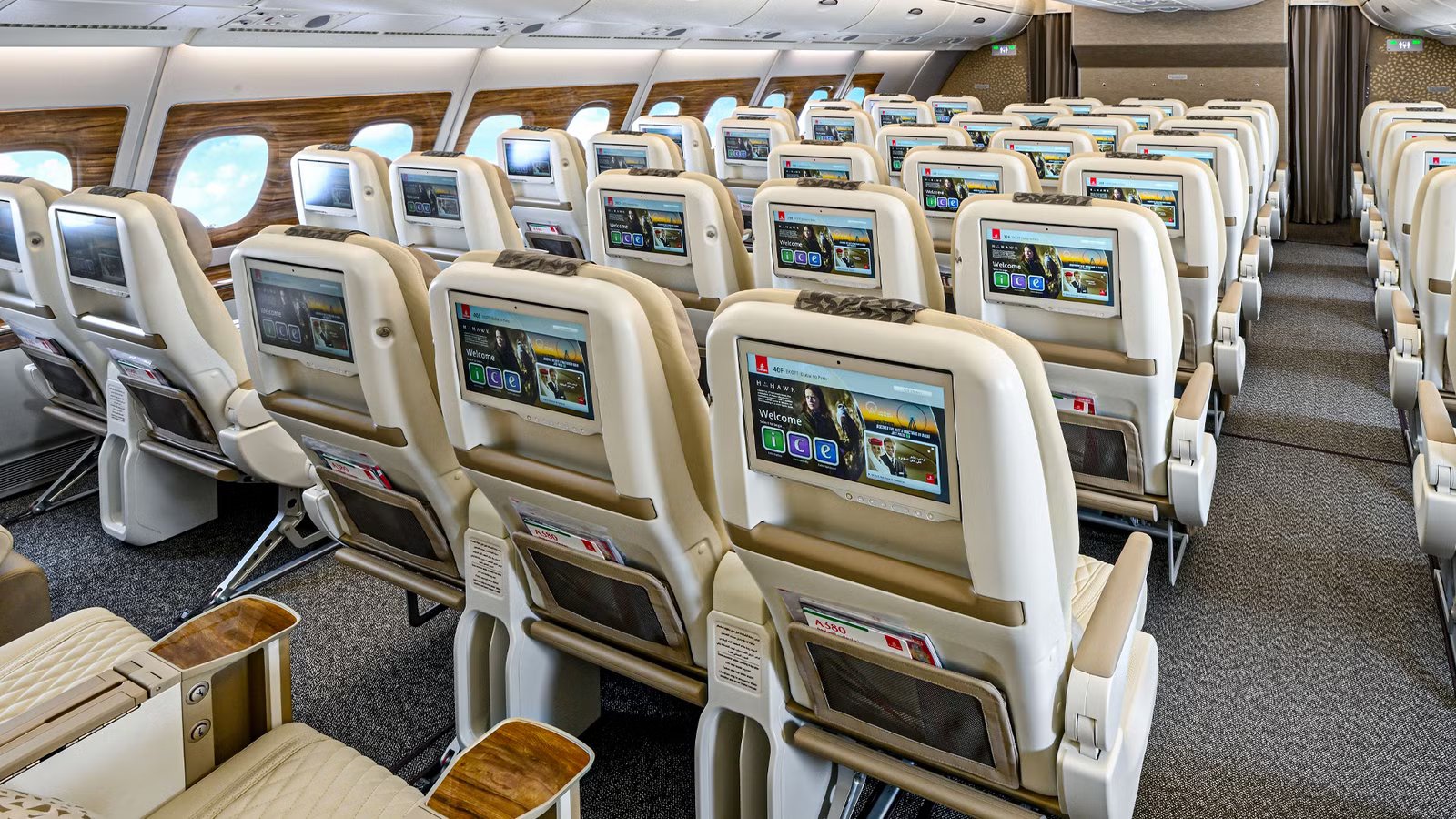
When looking across the airline industry as a whole, a common trend is rising, particularly amongst legacy carriers. For some time now, maximizing the sheer volume of passengers onboard widebody aircraft has been considered the most effective way to lower seat-mile costs on high-demand routes. However, a sustained shift in passenger purchasing habits has led network planners to rethink this traditional strategy, prioritizing high-margin premium spaces over mass-market economy seating. This guide explores the strategic and economic drivers behind a major cabin reconfiguration program that marks a turning point for the iconic  Emirates.
The real story here is not simply the addition of an intermediate cabin tier, but the deliberate choice to remove 46 net seats from a historically dense Airbus A380 to chase premium yields on secondary regional routes. As part of a massive five billion dollar modernization campaign spanning 219 total aircraft, the carrier is altering its fleet capabilities to adapt to modern travel trends.
From Volume To Premium Yields

The deliberate decision to eliminate 46 net seats from a high-density airframe marks a bold evolution in widebody asset management for Emirates. Filling large aircraft with maximum passenger numbers was once the norm for leisure corridors, but today modern network strategy heavily favors premium yield optimization. Making these adjustments works strongly in Emirates’ favor, as moving fewer passengers at higher individual ticket prices can generate superior financial returns.
The underlying driver of this operational pivot is a resilient, long-term surge in premium leisure travel across diverse international markets that has been growing exponentially since the industry’s rebound following the COVID-19 pandemic. Modern flyers are consistently demonstrating a willingness to pay significantly higher fares for enhanced comfort, even on shorter regional routes. Consequently, network planners are capitalizing on this behavior by deploying multi-class configurations to capacity-constrained regional airports where adding extra daily flights is impossible.
The art of moving away from low-yield mass transit means that Emirates can protect its seasonal revenue streams from economic volatility. This strategic approach allows the operator to extract higher financial margins from existing widebody capacity without increasing its total flight frequencies. Subfleet segmentation is not a new concept by any means, but to the extent it is being seen today, it is a totally different landscape than there has ever been.
Designing For Revenue

A complete restructuring of the double-decker aircraft’s internal cabin layout was needed to achieve this high-yield plan. Technicians remapped the upper deck layout to establish a beautifully balanced three-class environment, in true Emirates style. The precise configuration change successfully integrates a dedicated mid-tier cabin while simultaneously expanding the premium business class footprint, keeping these distinct cabin sections special in their own right.
Catch what other flight trackers miss
Emergency squawks, holds, NOTAMs — live signals, no signup.
Open tracker
Catch what other flight trackers miss
Emergency squawks, holds, NOTAMs — live signals, no signup.
Open tracker
The legacy layout was an operational success story that maximized pure passenger volume by packing a massive number of economy rows onto the airframe. However, by removing a substantial block of standard seats from the upper floor, engineers cleared the necessary space to install upscale hardware. The new cabin breakdown reflects a clear corporate emphasis on maximizing the revenue potential of every square inch, because today even the smallest details matter to stay profitable and ahead of competitors.
Cabin Class Configuration | Old Two-Class Fleet Standard | Retrofitted Three-Class Fleet Standard | Net Seat Quantity Change |
Business Class | 58 Seats | 76 Seats | +18 Seats |
Premium Economy | 0 Seats | 56 Seats | +56 Seats |
Economy Class | 557 Seats | 437 Seats | -120 Seats |
Total Aircraft Capacity | 615 Seats | 569 Seats | -46 Seats |
Emirates has long been the champion of the A380, making it work economically while others struggled. Today, the airline continues to rely on the type, growing the aircraft’s long-term earning capacity on highly competitive regional routes. While the total number of physical travelers onboard decreases, the proportion of premium, high-yield tickets spikes significantly. The resulting product mix offers a more resilient fare environment that helps shield the carrier from rising operational costs.

Massive 569 Seats: Emirates’ Brand-New Airbus A380 Now Has 9 Routes [Map]
Emirates’ new 569-seat A380 now brings premium economy to nine more destinations.
A Troubled Start?

Bringing this new retrofit into service means that certain locations need to be selected for its inauguration. Instead of focusing exclusively on primary long-haul trunk routes, Emirates is sending the modified aircraft to key regional capitals, which allows the airline to test premium demand dynamics in mature regional markets before making the aircraft a more common sight across its global network. The beginning of the aircraft’s service was rather hectic, however.
The official route deployment plan was to begin with the Dubai to Amman route, operating flights EK903 and EK904 on a temporary schedule from April 14 to May 31, 2026. Following this initial Middle Eastern deployment, the next step was the Prague corridor on June 1, 2026, but due to ongoing conflicts in the region, this had to be changed. The aircraft instead debuted on the Birmingham route with the first retrofitted completion, registered A6-EUX, leading to the dawn of the new A380 cabin era.
Focusing more on the original route strategy, these specific routes demonstrate how the carrier treats intermediate premium demand outside massive global financial hubs. Offering an upgraded mid-tier product on flights to Jordan and the Czech Republic, the airline captures affluent leisure travelers who bypass standard economy far more often than other destinations on the route map. This targeted approach maximizes ticket margins in highly competitive regional sectors, allowing the airline and industry observers to see consistently full aircraft taking off.
Industrial Acceleration

Achieving such an aggressive network rollout demands an unprecedented level of industrial efficiency and technical coordination within the engineering division. The prototype conversion required an extensive timeline to get it to a state where it would be operationally ready for the highly demanding customer base it caters to, but subsequent airframe retrofits must proceed at a vastly accelerated pace. Scaling up production speed is critical to meeting the airline’s upcoming seasonal deadlines and to staying ahead of competitors who are also completing retrofits on vastly more efficient aircraft.
The initial reconfiguration of airframe A6-EUX consumed approximately 35,000 man-hours of dedicated labor over a two-month period. Technicians managed over 2,500 distinct types of replacement parts to finalize the complex build. However, internal teams have optimized the workflow, slashing the turnaround time to just 30 days for future tail numbers.
Reconfiguration Stage | Required Engineering Labor | Turnaround Timeline | Component Volumetric Scale |
Prototype Airframe (A6-EUX) | 35,000 Man-Hours | Two Months | 2,500+ Unique Replacement Parts |
Subsequent Fleet Airframes | Optimized Internal Workflow | 30 Days Per Plane | Standardized Assembly Parts Kit |
Operating a highly synchronized engineering assembly line allows the carrier to complete these intense modifications completely in-house. Having this quality oversight, along with a high manufacturing cadence, ensures strict quality control of intricate cabin finishes without relying on third-party facilities. The streamlined process allows technicians to systematically refresh the massive double-decker fleet with minimal operational disruption.
Why The Same Emirates Airbus A380 Business Class Seat Can Cost $2,500 Or $10,000 Depending On When You Book
The answer largely comes down to the pricing strategy the airline uses.
Not Only The A380 Getting A Refresh

With the retrofit plan now fully underway, the future of the A380 in Emirates’ fleet plan has become a lot clearer. Industry analysts frequently question the massive capital layout required to overhaul existing quad-jets rather than waiting for next-generation factory deliveries. In reality, the A380 is not the only aircraft getting the retrofit refresh treatment.
The 15 converted two-class airframes represent just a fraction of a massive $5 billion fleet overhaul campaign. It is a historically unprecedented investment that covers the complete interior optimization of 219 total aircraft across the widebody network, upgrading existing assets to preserve critical capacity while ongoing manufacturing delays stall newer aircraft models. Emirates is one of many airlines dealing with the delay of the Boeing 777X, with 270 of the type currently on order. This adds a whole other layer of importance to the retrofit program, as it helps to ensure that even in the face of delays, the Emirates experience is still as sharp as it can be.
This enormous financial commitment shows very clearly the company’s long-term reliance on its double-decker flagship to anchor global operations. By standardizing the onboard product across hundreds of planes, the airline simplifies its global scheduling matrices. Investing heavily in current airframes allows the carrier to maintain an elite product standard worldwide, which is something that Emirates is so well known for.
A New Era For Subfleets

The ultimate success of this high-density transition hinges on meeting a strict production timeline before global travel demand shifts. Engineering teams are working around the clock to ensure the specialized subfleet achieves full operational readiness. Finalizing these upgrades remains a top priority for the airline’s seasonal capacity planning and must be completed on time if Emirates is to stay on top of its seasonal targets and extract as much yield as it can from its long-time icons.
A total of 15 high-density superjumbos are scheduled to complete this extensive three-class structural conversion by November 2026. For passengers, this rapid rollout means greater scheduling predictability and broader access to premium economy on regional routes. Travelers can increasingly expect an upgraded experience on traditionally low-yield sectors, which aims to give Emirates an edge over other carriers that, until now, have been able to offer a far superior and modern product.
Looking ahead, this density reduction proves that widebody efficiency is no longer tied strictly to maximizing raw economy passenger volume. Reallocating floor space to higher-margin seating brackets, the carrier sets a new benchmark for cabin economics. In short, Emirates has somehow managed to show the world that the A380 still has a place in the global airline market, even if others have tried and failed.