dailynewsnblog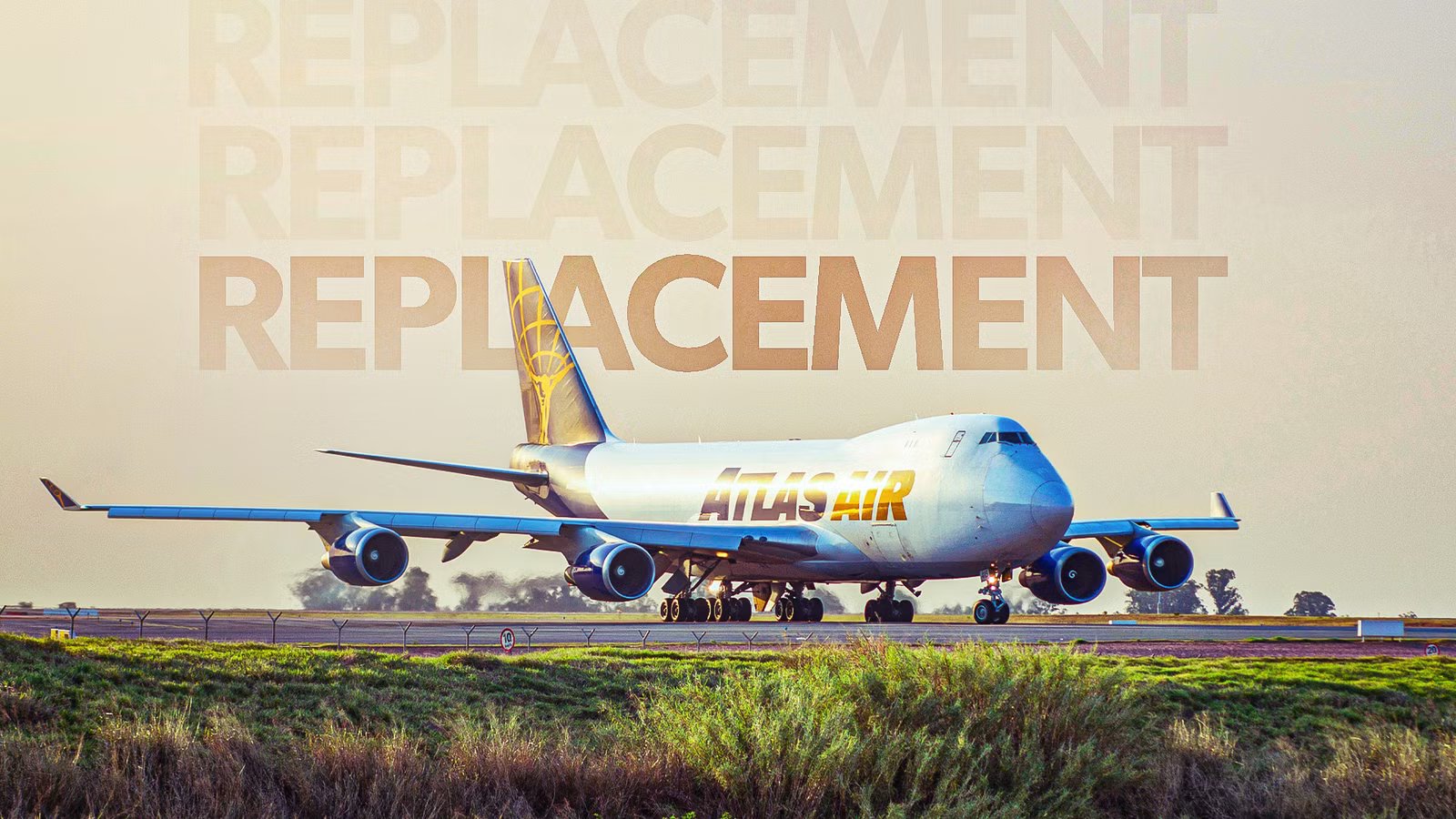
In the modern era of air cargo, there does not appear to be any future for four-engine commercial aircraft. With the production line of the Boeing 747 closed in 2023, the final freighters were delivered to Atlas Air, and the assembly line was shuttered for the last time. Twinjets have advanced to the same level in terms of reliability and safety, and save operators game-changing amounts of money on maintenance and fuel.
That leaves just a handful of potential successors to the storied legacy of the great 747 family. The cargo variants have proven to be the most capable outsized air freighters ever made. The Boeing 787 Dreamliner has set a new benchmark for the world of large commercial aviation, but it currently does not appear that a freighter model is in the works to join the lineup. There are two aircraft that are the front-runners to take up the 747’s mantle: the Boeing 777-8F and the Airbus A350F.
The Rise Of Twinjet Cargo Haulers

The Boeing 777-8F could essentially be described as a ”heavy lifter” for tomorrow’s Air Cargo industry. It has a larger internal volume capacity as well as a greater maximum payload than its forthcoming Airbus competitor. The aircraft is targeting customers who prioritize bulk volume and sheer mass. Meanwhile, the A350F is aiming for customers who are more concerned with efficiency and lower expenses per mission.
An important note is that the 777x is based on the legacy 777 series, which has an aluminum fuselage and composite wings, but the A350 has more composite throughout: 70% advanced materials (titanium and composites). The A350 also has another major advantage in the form of its extra-large main deck cargo door. While the 777-8F has a high-capacity main deck, its door is narrower than the A350F’s “XL” design.
Feature | Boeing 747-400F | Boeing 747-8F | Boeing 777-8F | Airbus A350F |
|---|---|---|---|---|
Engines | 4 (PW/GE/RR) | 4 (GEnx-2B) | 2 (GE9X) | 2 (Trent XWB-97) |
Max Payload | 113 – 124 tonnes | 140 tonnes | 112 – 118 tonnes | 111 tonnes |
Max Range | 4,445 nmi | 4,390 nmi | 4,410 nmi | 4,700 nmi |
Total Volume | 21,694 ft³ | 30,288 ft³ | 27,056 ft³ | 24,500 ft³ |
Nose Door? | Yes | Yes | No | No |
Main Cargo Door | 134 in Wide | 134 in Wide | 142 in Wide | 175 in Wide (XL) |
Wingspan | 211 ft 5 in | 224 ft 7 in | 235 ft 5 in (Foldable) | 212 ft 5 in |
The A350F has the “longer legs,” offering about 300 nautical miles more range at full payload than the 777-8F. This makes it particularly capable on ultra-long-haul routes like Hong Kong to Anchorage or Chicago. The 777-8F’s range is slightly shorter but sufficient for most major global air bridges.
With the first aircraft (MSN700) in the assembly stage and a first flight scheduled for 2026, the A350F program is marginally ahead of its industrial milestones as of late 2025. Due to multiple program delays, some analysts and customers anticipate that the 777-8F won’t go into service until 2029.
Catch what other flight trackers miss
Emergency squawks, holds, NOTAMs — live signals, no signup.
Open tracker
Catch what other flight trackers miss
Emergency squawks, holds, NOTAMs — live signals, no signup.
Open tracker
The 777-8X Freighter

Expectations are still very high for both passenger and freighter versions of the 777x, even though its original launch date was set for 2020 and the first aircraft is now anticipated in 2027. The 777-8x, the smaller of the two proposed options, will serve as the foundation for the new freighter. When it makes its debut, the 777-8F, second only to the 777-9X, will be among the biggest two-engine cargo jets ever built.
The 777-8F is intended to provide nearly identical payload and range capabilities to the 747-400F while achieving significantly higher efficiency. Compared to older 747 freighters, the 777-8F improves fuel efficiency and CO₂ emissions by 25-30%. Its operating costs per tonne are approximately 25% lower than the 747-400F.
The 777-8F has a full payload range of approximately 4,410 nautical miles (8,167 kilometers), allowing for nonstop service between major global trade hubs such as Hong Kong and Los Angeles. It has two GE9X engines, the world’s most fuel-efficient commercial jet engines, which replace the 747’s four engines. Fewer engines significantly reduce maintenance complexity and parts inventory.
The four-engine 747 is now less practical for long-term fleet planning due to stricter international emissions and noise regulations. The 777X uses folding wingtips to preserve the aerodynamic efficiency of its enormous 235-foot composite wing while still being compatible with the airport’s current infrastructure. This allows it to fit into standard Code E gates, sidestepping the infrastructure limitations that affected the larger 747-8.
With a revenue payload of more than 112 tonnes (247,500 lbs), the 777-8F is almost exactly the same as the 747-400F. July 2025 marked the start of the 777-8F’s official production. With 34 orders, Qatar Airways is the first customer. In 2027, the aircraft is anticipated to go into commercial service. Cargolux, Lufthansa Cargo, and ANA Cargo are other significant operators that are switching from 747 fleets to the 777-8F.
The Aircraft Replacing The McDonnell Douglas MD-11
The MD-11s are approaching their operational life, and newer, more efficient types are taking over their role.
The A350F Freighter

Airbus is not sitting idly by and allowing Boeing to dominate the future market. Its innovative A350 family, which responded to the 787 Dreamliner with a clean sheet design, will shortly welcome a new member. The A350F will be a new freighter built on the airframe of the A350-1000. Notably, the A350 cargo carrier is built on the larger of the two models in the fleet, owing to the A350’s smaller overall size than the 777x. As of late 2025, the A350F program is in the final assembly phase at Toulouse, with service scheduled in late 2027.
Compared to the four-engine 747-400F, the twin-engine A350F consumes approximately 40% less fuel and emits 40% less CO2. This translates to up to a 40% reduction in operating costs per tonne per trip. The A350F has a maximum payload of 111 tonnes and the same internal volume as a Boeing 747-400F.
A350 passenger fleets are also flown by numerous 747 operators. Pilot training and maintenance integration are made possible by the A350F and A350-1000’s 99% airframe similarity and the same engine types. Additionally, it also already satisfies ICAO’s 2027 emissions limits, making it “future-proof” for airlines that must contend with increasingly stringent environmental regulations worldwide.
Airbus has 82 confirmed orders for the A350F as of December 2025. Several of the operators listed in the log books are replacing their 747s, including Singapore Airlines, which is replacing all of its 747-400 freighters. Additionally, KLM Cargo is switching from 747-400Fs to A350Fs. It is anticipated that Etihad, Cathay Pacific, and Air China Cargo will follow suit.
Why Might The World’s Newest Cargo Aircraft Have Boeing Worried?
A lightweight and efficient large freighter to threaten Boeing’s market dominance.
The End Of The Quadjet Era

The Airbus A350F and Boeing 777-8F lack the famous nose-loading door that the Boeing 747 freighter has. While this absence eliminates some specialized “straight-in” loading capabilities, newer designs compensate with substantially improved side-door architecture and far greater economics.
The 777X cannot directly mimic the 747’s nose door, but it compensates with various technical improvements. Similarly, the A350F, which lacks the 747’s nose-loading door, features the industry’s widest main deck cargo door (175 inches wide). This enables it to transport huge next-generation engines (such as the Trent XWB or GE9X) without disassembly.
The 747’s nose swings upward, making it possible to load incredibly long objects—up to 185 feet—like oil pipes or wind turbine blades directly into the fuselage. Pallets up to 12.5 feet wide can also be accommodated. The A350F has floor beams built for the highest running loads in the industry to make up for the absence of nose-loading.
This makes it possible to more easily distribute dense, heavy cargo among the majority of main-deck pallet positions. Airlines won’t lose overall capacity even if they lose the nose door because the 777-8F offers almost the same volume as the 747-400F. The new aircraft maximizes profitability in order to make up for the lower absolute “lift force.”

The Aircraft Replacing The Boeing 767 In Cargo
The most likely candidate to replace the 767 freighter is the 777-8F, the freighter variant of the upcoming and long-delayed 777X.
Inspired By The Dreamliner

When the Boeing 787 Dreamliner went into service in 2011, it significantly changed the aviation industry’s focus to high-efficiency twin-engine aircraft. The Dreamliner’s technological innovations were leveraged in the development of both the Airbus A350 and the Boeing 777X, and these features are now fundamental to their freighter versions. The 787 was the first aircraft to use “unconstrained” wing designs, which are distinguished by high aspect ratios and sophisticated curvature.
The 777X program was launched in 2013 as a mix of the proven 777 airframe with the 787’s groundbreaking technology. The 777X (and 777-8F) uses the 787’s computational and network infrastructure, as well as improved flight controls and “smooth ride” technologies to reduce turbulence. Airbus first pitched the A350 as a straightforward improvement to the A330. However, after airlines rejected it as a temporary solution to the 787, Airbus committed to a completely new XWB design.
The 787’s carbon-fiber fuselage served as inspiration for the A350, which uses more than 50% composite materials. In contrast to the 787’s single-piece barrel design, Airbus balanced risk and maintenance by using massive composite panels. This lightweight airframe is carried over to the A350F. The A350 gained sophisticated flight decks in the style of the 787, complete with integrated maintenance systems and big touchscreen displays. These features are now standard in the A350F cockpit.
The A350F has an advanced wing that can automatically change shape (flapping) in flight to reduce drag and fuel consumption. The folding wingtip mechanism allows for the aerodynamic benefits of a massive 787-style composite wing (235 ft) while fitting into 747-sized gates (212 ft).
The freighter variants benefit from the Central Maintenance Systems introduced on the 787. These systems monitor aircraft health in real time, allowing cargo operators to anticipate component failures before they occur. This is critical for the “on-time” requirements of express freight carriers such as FedEx and DHL, which are replacing older 747s with these more dependable twin-engine jets.