Ottawa offers millions in loans to airlines struggling with high jet fuel costs


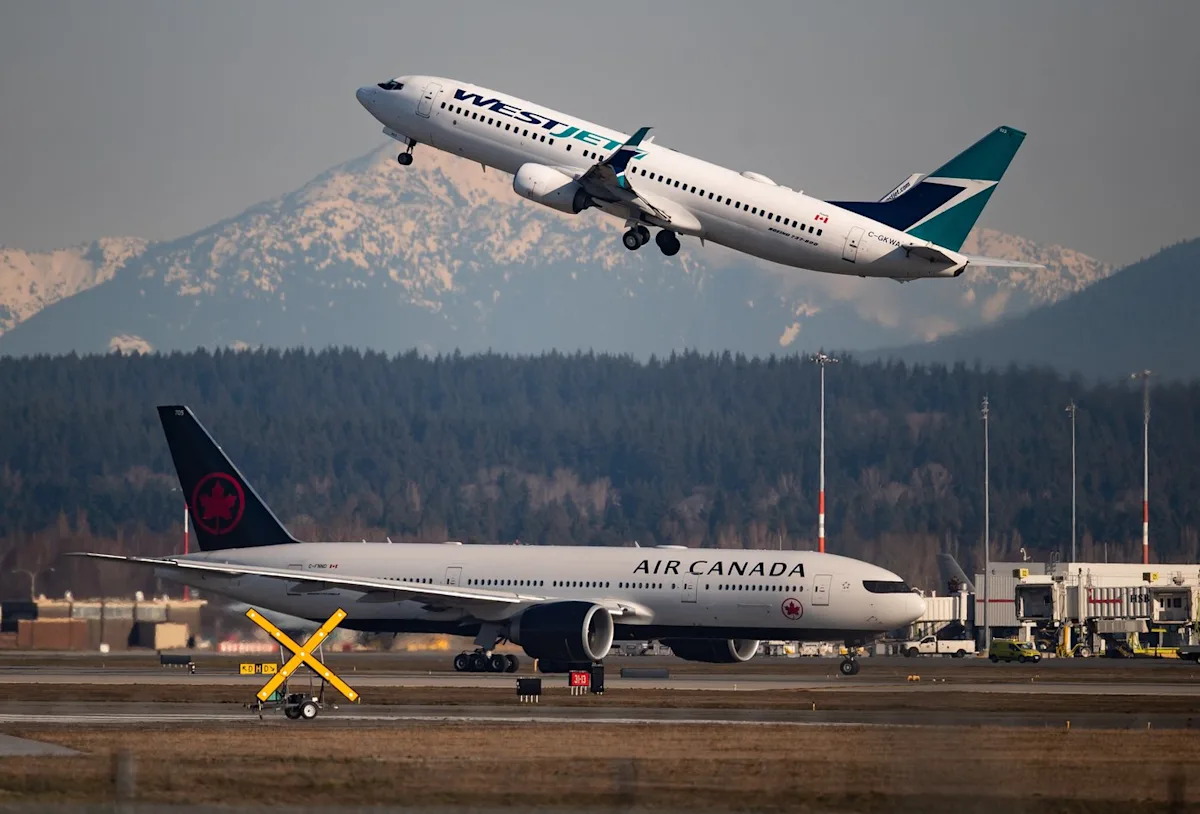
An Air Canada flight departing for Toronto, bottom, taxis to a runway as a WestJet flight bound for Palm Springs takes off at Vancouver International Airport, in Richmond, B.C., on Friday, March 20, 2020. THE CANADIAN PRESS/Darryl Dyck - The Canadian Press
An Air Canada flight departing for Toronto, bottom, taxis to a runway as a WestJet flight bound for Palm Springs takes off at Vancouver International Airport, in Richmond, B.C., on Friday, March 20, 2020. THE CANADIAN PRESS/Darryl Dyck – The Canadian Press · The Canadian Press

MONTREAL — The federal government on Monday offered loans to airlines struggling to cope with the soaring price of jet fuel, as fallout from the Iran war prompts them to slash flight schedules and cut profit forecasts.

The new program will let carriers borrow up to $150 million each, said Finance Minister François-Philippe Champagne.

Ballooning fuel costs have put severe pressure on airlines’ balance sheets, he said, framing the relief effort as a way to ensure “reliable and affordable” travel for passengers.

“By building on existing relief measures with targeted and temporary support for Canada’s airline sector, we are helping maintain connectivity, protect Canadian jobs and reduce pressures on travellers during this period of elevated fuel costs,” Champagne said in a news release.

Airlines that sign up must commit to “buy Canadian,” restrict dividends and executive compensation and maintain existing jobs in the country, the government said. The release did not spell out what buy Canadian refers to in the context of the loans.

The closure of the Strait of Hormuz caused by the Middle East war — now in its fourth month — has choked off nearly a fifth of global oil supply and sent jet fuel prices skyward.

As a result, profits among major North American carriers this year will shrink by US$3 billion or nearly a quarter, the International Air Transport Association forecast on Sunday.

While travel demand remains sturdy, Canadian airlines have cut less profitable flights from their schedules, raised gross fares and tacked on fuel surcharges to keep profit margins from shrinking too far.

Air Canada has cut at least a half-dozen routes as well as its adjusted earnings forecast by roughly $200 million for the year. WestJet has announced flight capacity cuts that will hit nearly six per cent — roughly 1,000 trips — this month.

Meanwhile, round-trip economy fares between Canadian cities rose 17 per cent at the end of May from a year earlier, according to travel search site Kayak.

Large airlines, which draw on more price-elastic corporate travellers and the allure of loyalty points, have multiple shock absorbers in their business models.

“Significantly higher fuel costs are a major headwind for airlines, but Air Canada still expects to offset 50 to 60 per cent of higher fuel costs in Q2 with some benefits from hedging and higher fares,” said National Bank analyst Cameron Doerksen in a note to investors, referring to the second quarter. Hedging policies help mitigate the risk of fluctuating fuel prices by creating fixed or capped costs on a chunk of purchases.


Low-cost carriers such as Flair Airlines often find themselves more vulnerable to those swings than their bigger competitors.

Fuel represents a bigger proportion of their costs, and they have fewer buffers in the form of higher-margin business passengers, myriad route options and a clientele less sensitive to rising fares.

“Fuel is exposing the difference between airlines with real pricing power and airlines with only demand,” said Chris Read, former director of corporate development at Air Canada.

The federal loan program marks the second time since COVID-19 that Ottawa has reached out with aid packages for airlines, after Air Canada, Porter Airlines and Air Transat accepted support during the pandemic.

Air Canada secured a $5.9-billion deal with Ottawa in April 2021 for a relief package that made loans available to the carrier — it ultimately borrowed $1.2 billion — but also required pledges to cap executive compensation at $1 million and restore service to regional airports.

Earlier this year, the government announced it would remove the federal fuel excise tax between April 20 to Sept. 7, reducing costs by four cents per litre on aviation fuel. The measure will save Air Canada alone tens of millions of dollars, based on fuel consumption figures from 2025.

This report by The Canadian Press was first published June 8, 2026.

Companies in this story: (TSX:AC)

Christopher Reynolds, The Canadian Press


Source link

  • Related Posts

    Nvidia CEO Jensen Huang declines Warren request to testify at AI hearing

    Nvidia CEO Jensen Huang has declined an invitation from Sen. Elizabeth Warren, D-Mass., to testify at a Senate committee hearing later this week about American AI development, NBC News has…

    NZ Commits to First LNG Import Plant Despite Gas Price Surge

    “Kiwis need a backup source of power when the wind isn’t blowing, the sun isn’t shining, and the lakes are low,” Brown said in a statement on Tuesday in Wellington.…

    Leave a Reply

    Your email address will not be published. Required fields are marked *

    You Missed

    Nvidia CEO Jensen Huang declines Warren request to testify at AI hearing

    Nvidia CEO Jensen Huang declines Warren request to testify at AI hearing

    Nova Scotia bucks the rental trend as supply-and-demand pressure keeps prices high

    Nova Scotia bucks the rental trend as supply-and-demand pressure keeps prices high

    Cheers to the Winners of EFF’s 18th Annual Cyberlaw Trivia Night! 

    Cheers to the Winners of EFF’s 18th Annual Cyberlaw Trivia Night! 

    Fifa vice-president Victor Montagliani: ‘MLS can become the second-biggest league in the world. Maybe the biggest’ | Fifa

    Fifa vice-president Victor Montagliani: ‘MLS can become the second-biggest league in the world. Maybe the biggest’ | Fifa

    House of Commons passes bill criminalizing forced sterilization

    House of Commons passes bill criminalizing forced sterilization

    NZ Commits to First LNG Import Plant Despite Gas Price Surge