dailynewsnblog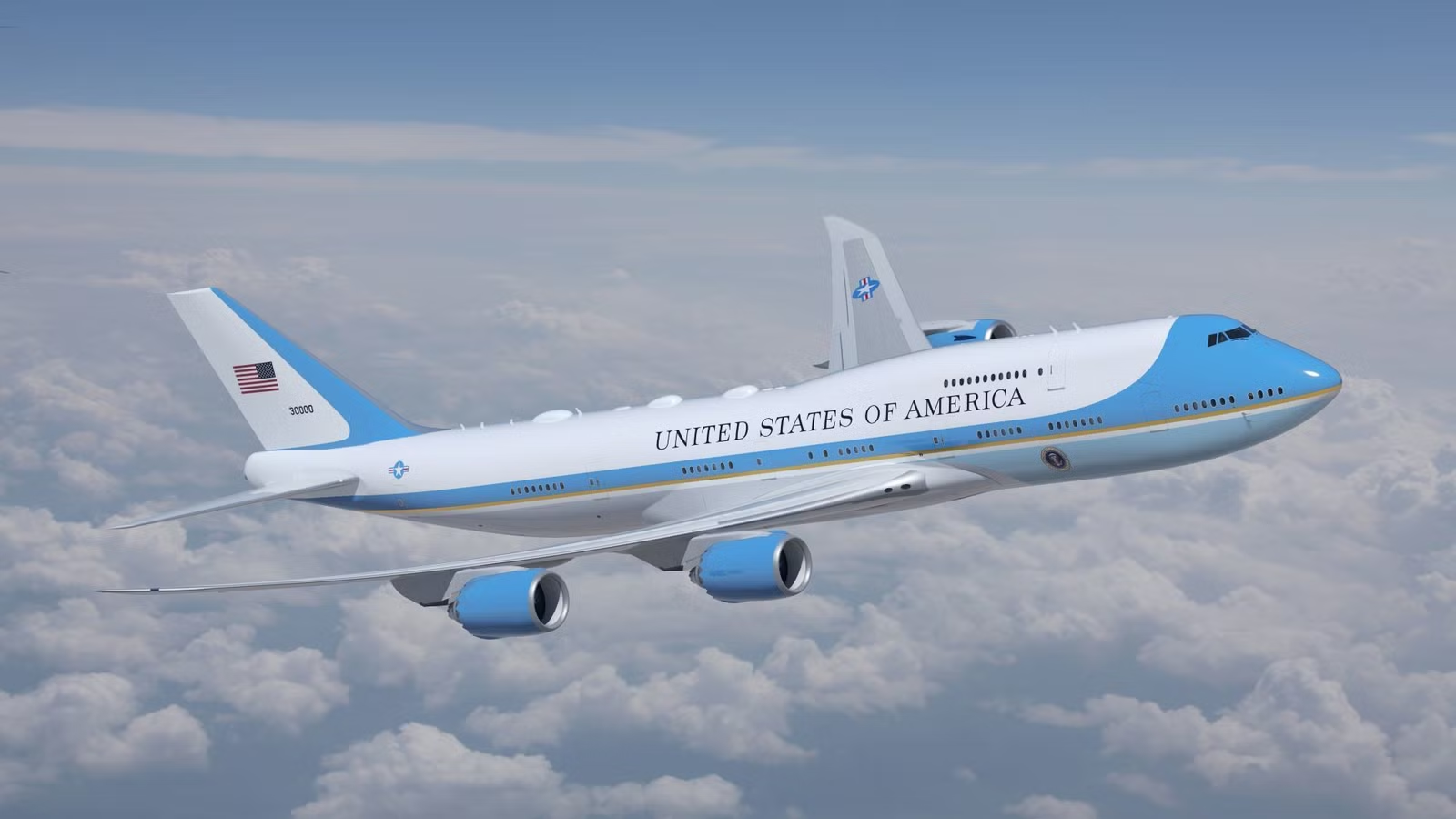
NATO is an alliance of 32 nations. While the United States dominates the alliance, it also includes some of the world’s other leading military and aerospace nations. In this article, we will examine VIP transport aircraft from the United States, Germany, the United Kingdom, France, Canada, and Turkey. For simplicity, we will use ‘presidential transport’ as shorthand for the aircraft used by a country’s senior political leadership, whether that is a president, monarch, prime minister, or chancellor.
Some countries, like the United States, use their VIP transport aircraft to project an image of military might and readiness. Others, like Gulf monarchies and Brunei, operate the massive Boeing 747 as luxury flying palaces for their Sultans/Emirs/Kings, emphasizing prestige and royal authority.
Still, others project an image of egalitarianism, government restraint, and fiscal responsibility, like Nordic states (especially Norway). These often require their ministers to fly commercially when feasible, although there are military backups when this is not possible. The leading European countries can be considered somewhere between the militarized US and the egalitarian Nordics in terms of their operational strategies for presidential aircraft deployment.
6
The Royal Canadian Air Force’s CC-150 & CC-330
One A310 VIP transport (soon one A330 MRTT)

Canada is a major NATO member, and its VIP aircraft are operated by the 412 and 437 Transport Squadrons. It operates four Bombardier medium-range business jets, one A310 (CC-150) permanently configured for VIP use. Canada is procuring one A330 MRTT (CC-330) tanker configured specifically for VIP use, and unlike the UK, it will not be used as a military tanker. It is expected to replace the aging A310.
Taking a brief look at other NATO members, the Italian Air Force operates a fleet of Airbus A319s, Dassault Falcon 900s, Gulfstream G650s, and Italian-built P-180 Avantis for VIP transportation. These are managed by the 31° Stormo ‘Carmelo Raiti’ at Ciampino Air Base near Rome. This makes Italy notable within Europe for being one of the largest countries and not operating any widebody VIP transportation aircraft.
Like other leading NATO air force VIP fleets, the Italian fleet is militarized with secure communications, some defensive systems, enhanced navigation, and military datalinks. Other NATO air forces worth mentioning include Poland, which operates modified Boeing 737-800 jets that were purchased after a crash of a Soviet-era VIP jet killed the Polish President. It also operates G550 business jets and Mi-8 helicopters. The Netherlands operates a Boeing 737-700 business jet and a Gulfstream G650ER.
5
The French Air Force’s A330
One A330-200 VIP transport

France is notable for relying almost exclusively on domestically designed aircraft (Dassault Falcon and Airbus types) for its government VIP transportation needs. This is a level of industrial sovereignty shared by very few countries, most prominently the United States and Russia. The primary high-end VIP transport is a modified A330-200 (registered F-RARF), as well as Dassault business jets, SOCATA TBM business jets, and Eurocopter Super Pumas.
As with other leading European VIP transports, the A330 has secure comms and strong military integration. With that being said, there is more emphasis on luxury and diplomacy than on heavy defensive armament. Speaking of the Dassault Falcon business jets, Dassault says that “all have encrypted SATCOM equipment for secure communications.”
It also adds that “Dassault Falcon Service with Sabena Technics supports the Falcons with a team of 15, which has members on duty 24/7. Missions can happen on short notice at any hour: dispatch must be within two to three hours. By the terms of our contract, dispatch availability must be above 90%.”
The G7 Nations’ Presidential Aircraft Ranked
Airbus is extremely prominent in this list.
4
The United Kingdom’s Royal Air Force Voyager
One Airbus A330 MRTT (Voyager) VIP transport

The United Kingdom operates a VIP fleet for high government officials and for the Royal Family. The most iconic RAF VIP transport is an Airbus Voyager (Airbus A330 MRTT) tanker called Vespina. This aircraft serves a dual role as the lead militarized VIP transport aircraft for the British Government, while also retaining full capabilities as an RAF tanker with cargo and troop transport capabilities.
In 2020, the aircraft was repainted from its military drab gray to white with gold lettering and the Union Flag on its tail. However, while this is perhaps the most capable British transport, the RAF appears to be more concerned with tasking it for military duties than VIP transportation. Indeed, the then-British foreign secretary, Boris Johnson, lamented in 2018 that Vespina “never seems to be available.” Between November 2023 and July 2025, the aircraft was not tasked for VIP transport.
Instead, the British have tended to rely on their Airbus A321. The RAF also operates a pair of AugustaWestland AW139 helicopters known as ‘The King’s Helicopter Flight,’ and a Dassault Falcon 900LX. The Vespina is not as hardened as a dedicated presidential command aircraft, but it does have a large number of military capabilities as a warfighting asset. It is common for the British Government to contract private aircraft for VIP duties, although it comes with risks like greater susceptibility to jamming.
3
The Turkish Air Force’s Boeing 747-8
One Boeing 747 VIP transport plus A340s and A330s

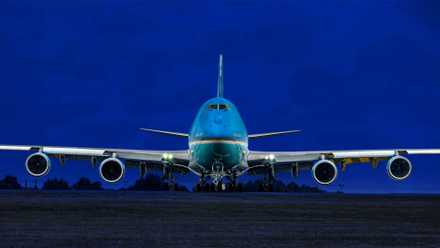
Turkey is one of the largest members of NATO and one that is relatively militarized compared with many of its European counterparts. The Turkish Air Force’s VIP fleet reflects this and operates a Boeing 747-8 Jumbo, one or two Airbus A340-500s, one or two A330-200s, a couple of A319 business jets, Gulfstream G550 business jets, and small Cessna Citations.
These Turkish aircraft are relatively militarized with secure, encrypted communications, defense systems, advanced navigation, military datalinks, and more. The fleet also reflects Turkey’s position at the crossroads of Europe and the Middle East, emphasizing prestige with luxurious yet functional interiors. Notably, the Turkish flagship presidential Boeing 747-8 (registered TC-TRK) is also an ex-Qatari that was gifted and transferred in 2018.
This is reminiscent of how Qatar gifted another 747-8 to Trump (US Air Force) in 2025 to serve as the VC-25 Bridge. The Qatari Amiri Flight has operated a total of six Boeing 747s over the years. This includes two highly customized Boeing 747-8s that were later gifted away: one to Turkey in 2018 and one to the United States in 2025. Of the remaining four aircraft, two were older Boeing 747SPs, and two were additional 747-8s.
One Boeing 747SP (registered A7-AHM) was transferred to the Yemeni Government in 2000, and another 747SP (Ex-Pan Am/ United Airlines) is stored at Pinal Airpark in the US. Qatar currently operates two VIP 747-8s, with one being among the most luxurious VIP 747-8s in the world and the other acting as a backup.

Why The E-4B Nightwatch & VC-25B Air Force One Are Critical To US National Security
Air Force One and the Doomsday aircraft are both designed as Presidential transports and command centers (for times of peace and emergencies).
2
The German Air Force’s A350s
Three A350-900 VIP transports

The current leader of Germany is the Chancellor Friedrich Merz, while the mostly ceremonial President of Germany is Frank-Walter Steinmeier. Germany is notable for having some of the largest and newest high-end VIP aircraft, centered on three Airbus A350-900s that were delivered since 2020. The German Air Force also operates a fleet of A319s, A321s, Bombardier Global business jets, and Eurocopter AS532 helicopters for VIP transportation.
The German A350s are relatively highly militarized and are being upgraded with J-MUSIC Directed Infrared Countermeasures self-defense systems. These are some of the first widebody aircraft to receive these systems. The contract was awarded to Israel’s Elbit in 2024 by Lufthansa Technik, with the work to be carried out over five years. The systems will protect against threats like surface-to-air missiles.
While Germany’s A350s are not militarized to the extent of the US’s VC-25 fleet, they are relatively militarized. The DIRCM upgrade was widely reported. However, it will likely have various other classified militarization work, like secure NATO networking, some degree of electromagnetic pulse (EMP) hardening, cyber defense, encrypted satellite communications, and protected communications suites.
1
The United States Air Force’s VC-25s (Air Force One)
Two to three Boeing 747 VIP transports

When it comes to militarization, the US Air Force’s VC-25 fleet is generally considered to be in a league of its own. With that being said, there is nuance as it includes multiple generations of aircraft (as the fleet is in transition), and many of the capabilities are classified. The existing two aging VC-25As are based on the legacy  Boeing 747-200 aircraft and were designed to be the Oval Office in the skies. The USAF also operates numerous other VIP based fixed wing and rotary-wing aircraft.
The VC-25s have self-defense systems, EMP hardening, a range of secure comms, in-air refueling, and a range of other known and unknown modifications. However, the VC-25A fleet is aging and becoming unreliable. In early 2026, a VC-25A suffered a technical issue, forcing Trump to return to base and transfer to a backup, modified shadowy Boeing 757. The Air Force is poised to retire these old 747-200s and transition to the VC-25B Bridge.
The VC-25B Bridge is the donated ex-Qatari VIP Boeing 747-8 that is rapidly being modified into an interim VC-25 Air Force One VIP transport and is expected to enter service in the second half of 2026. It is unclear what modifications the jet is receiving, but it is likely to be significantly less militarized and lack key capabilities like in-air refueling. In 2028 and 2029, Boeing is expected to deliver the next-generation VC-25Bs based on Boeing 747-8s, costing around $3 billion each.
Catch what other trackers miss
Emergency squawks, holds, NOTAMs — live signals, no signup.
Open tracker
Catch what other trackers miss
Emergency squawks, holds, NOTAMs — live signals, no signup.
Open tracker