dailynewsnblog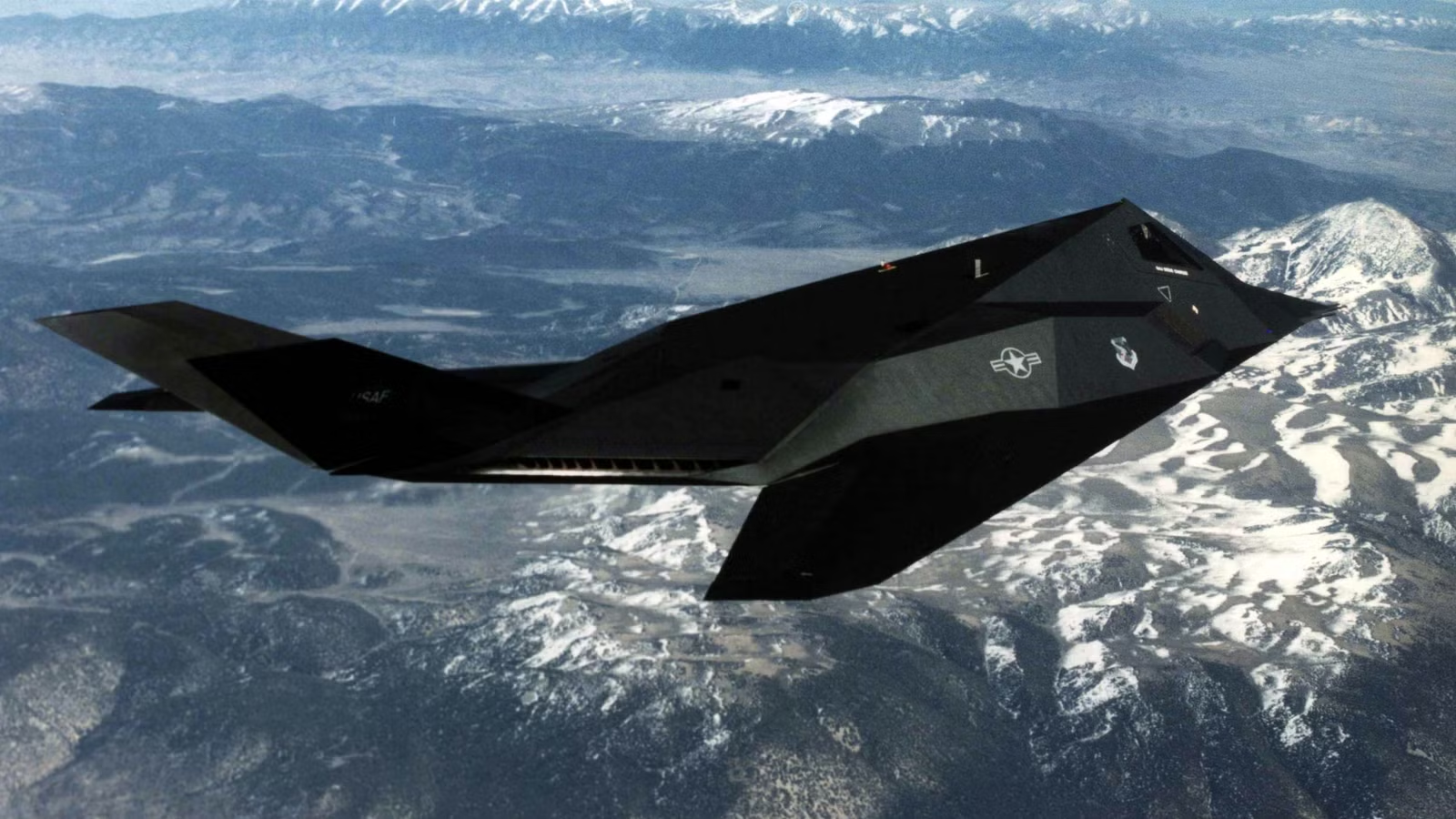
The Lockheed F-117 Night Hawk is a later Cold War icon and is famous for being one of the most closely guarded black box projects. It was the first operational stealth, or more accurately, low-observable, combat aircraft. The F-117 was a harbinger of things to come.
In Serbia, the Nighthawk remains a major source of nationalist pride for the nation that was forced to withdraw its forces from Kosovo in a nationally traumatic period of history. However, the implications of the successful Serbian intercept of one (maybe two) F-117s are often overstated. Hundreds of missions were flown in combat with minimal intercepts (400 against Serbia alone).
Stealth is not an invisibility cloak: it dramatically lowers the chances of intercepts, but it does not eliminate them. However, the lasting impact of the F-117 was the pivot of the United States Air Force into stealthy/low-observable combat aircraft. Even after it became obsolete and was supplanted, it remained valuable as an aggressor aircraft. The F-117 was officially retired in 2008, but it never fully went away, and won’t properly disappear until 2034.
First Generation Proto-Stealth Combat Aircraft

The Lockheed F-117 Nighthawk is sometimes considered the first stealth combat aircraft to enter service. While the aircraft has a low radar cross-section, true stealth is about much more than just reducing radar returns. Stealth is also about reducing infrared signature, electronic emissions, conducting electronic warfare, deploying virtual decoys, jamming, noise reduction, networking, and more.
However, the Nighthawk was only able to do some of these things to varying degrees, making it better understood as a low-observable aircraft. The F-117 program started in the 1970s as the US looked for a way to counter the Soviet Union’s increasingly capable surface-to-air missiles, and the B-52’s massed World War II-style brute-force attritional style was no longer feasible. As such, the Air Force had abandoned the B-58 and XB-70’s doctrine of flying higher and faster than air defense.
Meanwhile, look-down radars compromised the map-of-the-earth flying B-1 Lancers. US bombers could not fly higher, lower, or faster than air defense. Instead, the US switched to flying stealthily in plain sight, with the F-117 Nighthawk being the first of the stealthy lineage that would lead to the much more capable B-2, F-22, F-35, and B-21. The F-117 was originally intended to be a platform able to deliver tactical nuclear weapons against heavily defended, high-value targets.
The 1999 Serbian F-117 Incident

The loss of an F-117 in 1999 to an old S-125 (SA-3 Goa) Serbian air defense system did not demonstrate the failure of stealth/low observable. The details of the incident are remarkable, and there were many contributing factors to the successful Serbian intercept. One major contributing factor was that the Air Force was flying a predictable route without a fighter jet escort. Stealth is not just the aircraft itself, but also how a strike package is put together and executed.
Much of the intercept came down to luck and happenstance. The aircraft flew just the right route for the Serbian air defense unit, the unit was switched on at just the right time, the flight profile exposed the bomb bay doors, and the less radar cross-section optimized aspects of the aircraft. The incident is a reminder that many stealth aircraft are radar cross-section optimized in certain aspects, particularly the front. With that being said, the intercept was not a ‘one-in-a-million’ shot either.
Indeed, Serbian air defense is known to have hit other F-117s during the campaign (around April 30, 1999). It managed to return to its base but reportedly never returned to service. Two major effects of the loss of the F-117 were a massive propaganda win for Serbia and a technological compromise for the US.
The US returned to the site to bomb and destroy the wreckage. However, by that time, Serbian civilians were guarding it with their bodies, and the US aborted the strikes. It is widely believed that parts of the wreckage were examined by Chinese and Russian engineers, effectively compromising the aircraft.
5 Fighter Jets That Will Define Air Combat In The 2030s
The next era of air power is on the horizon.
Already An Old Design

By the time of the 1999 loss, the F-117 was already an aging aircraft that had roots in the 1970s. The B-2 Spirit offered a generational leap over the F-117 and had entered service in 1997. The US retired its F-117 fleet from combat service in 2008, just nine years later. However, the USAF did not scrap the fleet: rather, it kept some examples flying for testing and training. There are unconfirmed reports that the US used them for strikes in 2017.
In 2024, Sandboxx News ran an article discussing reports that they carried out strike missions in Syria in 2017. The rationale is that the threat environment was relatively low-threat, meaning even the old F-117 would be survivable, while the mission importance was low. The Air Force may not have wanted to risk losing a B-2. Like all aircraft, there is always a risk that the B-2 could malfunction and crash, falling into enemy hands.
Lockheed F-117 Nighthawk specs (per USAF Museum) | |
|---|---|
First flew | 1981 |
Entered service | 1983 |
First combat | 1989 |
Officially retired | 2008 |
Status | In limited service |
Planned full retirement | 2034 |
There is always a risk, however small, that a military’s aircraft technology will be compromised with every mission. Whether it happened or not, the F-117 strike mission was never acknowledged by the US. With that being said, it is known that examples continue to fly today and that they were never fully retired. The aircraft is a valuable training platform, including Red Air training, where they simulate stealth threats.
The US Kept Most Of The Fleet Flying

A total of 64 F-117s were built, including five prototypes and 59 serial production aircraft. The Air Force is estimated to have kept 40-45 examples flying after their 1998 retirement. In 2024, The War Zone said that the Air Force was considering keeping them flying through to at least 2034. It also wrote that “a portion of the remaining F-117A fleet, flown by Air Force test pilots, has been very actively used for research and development, test and evaluation, and training purposes in recent years.”
Catch what other flight trackers miss
Emergency squawks, holds, NOTAMs — live signals, no signup.
Open tracker
Catch what other flight trackers miss
Emergency squawks, holds, NOTAMs — live signals, no signup.
Open tracker
TWZ said that in 2022, the Air Force Test Center put out a request for information regarding a possible future contract for Nighthawk maintenance and logistics support service. That request stipulated that the period would last ten years, starting from January 2024. In 2017, Congress authorized the Air Force to start disposing of up to four Nighthawks annually. The 2022 Request for Information says the max divestment rate is between two and three jets a year.
In 2019, the Air Force said it had 51 F-117s, 12 of which would eventually go to museums. It is unclear how many F-117s, flyable or in storage, they have as of mid-2026, although 19FortyFive confirmed in January 2026 that they would fly until 2034. They are not only used as Red Flag aggressors but also as surrogates for stealthy cruise missiles during large-scale exercises. All remaining F-117 airframes are located at Tonopah Test Range Airport inside the Nevada Test and Training Range near Nellis Air Force Base.
Boeing F-47: Everything We Know So Far
There’s been a lot of mystique around the F-47.
First Aerial Refueling In 2025

Compared with other air forces such as Russia and China, it sometimes seems that the USAF has a love affair with aerial refueling. The US Air Force operates by an overwhelming margin the world’s largest tanker fleet. This is largely because most air forces are primarily designed for the defense of the homeland, while the USAF is designed as an expeditionary force able to project power around the world.
Sometimes, the USAF upgrades legacy aircraft with air-to-air refueling capability in their twilight years. In 2026, the venerable A-10 Warthog was seen in-air refueling for the first time. Most A-10s have been retired, and the remaining roughly 103 airframes are expected to finally retire in four years, by 2030. The Warthog is not alone. In 2025, the ‘retired’ F-117 Nighthawk was photographed by plane spotters conducting air-to-air refueling for the first time with a KC-46A, as shared on social media.
Almost two decades after their ‘retirement,’ it seems Nighthawks continue to receive upgrades. It seems the refueling capability is more linked to their role as aggressor and test aircraft than any planned future combat deployment. While the Nighthawks mostly keep out of sight, they are regularly photographed by plane spotters.
Not Returning To Combat Missions

While it is possible the F-117s returned to combat for a one-off Syrian mission, that was low-scale and context-dependent, with limited munitions. The F-117’s first combat mission took place in 1989 as part of the US invasion of Panama. After that, they took a major role in the Gulf War, operations in the former Yugoslavia, the 2001 Invasion of Afghanistan, and the 2003 invasion of Iraq. Today, the USAF has much more capable assets in service to carry out strike missions.
These include the MQ-9B Reaper, which the USAF praised in May 2026 as the ‘most valuable player’ in Operational Epic Fury, carrying out so many strikes that no other platform even “comes close to.” Additionally, the B-2 Spirit is now aging and will be complemented by and eventually replaced by the next-generation B-21 Raider, which is expected to enter service in 2027. Meanwhile, the justifiable combat use case for the F-117 is now very niche or nonexistent.
The US can use a range of precision stand-off munitions, various uncrewed platforms, or much more survivable crewed platforms. The F-117 is not likely to be survivable in highly contested airspace. It is also worth noting that the F-117’s payload capacity is small, only around 5,000 lbs (2,250 kg) compared with the F-15EX’s 29,500 lbs (13,400 kg) or the B-21’s unclassified 30,000 lbs (13,600 kg). However, as a training aircraft, it seems the F-117 never went away and will remain in service until 2034.