dailynewsnblog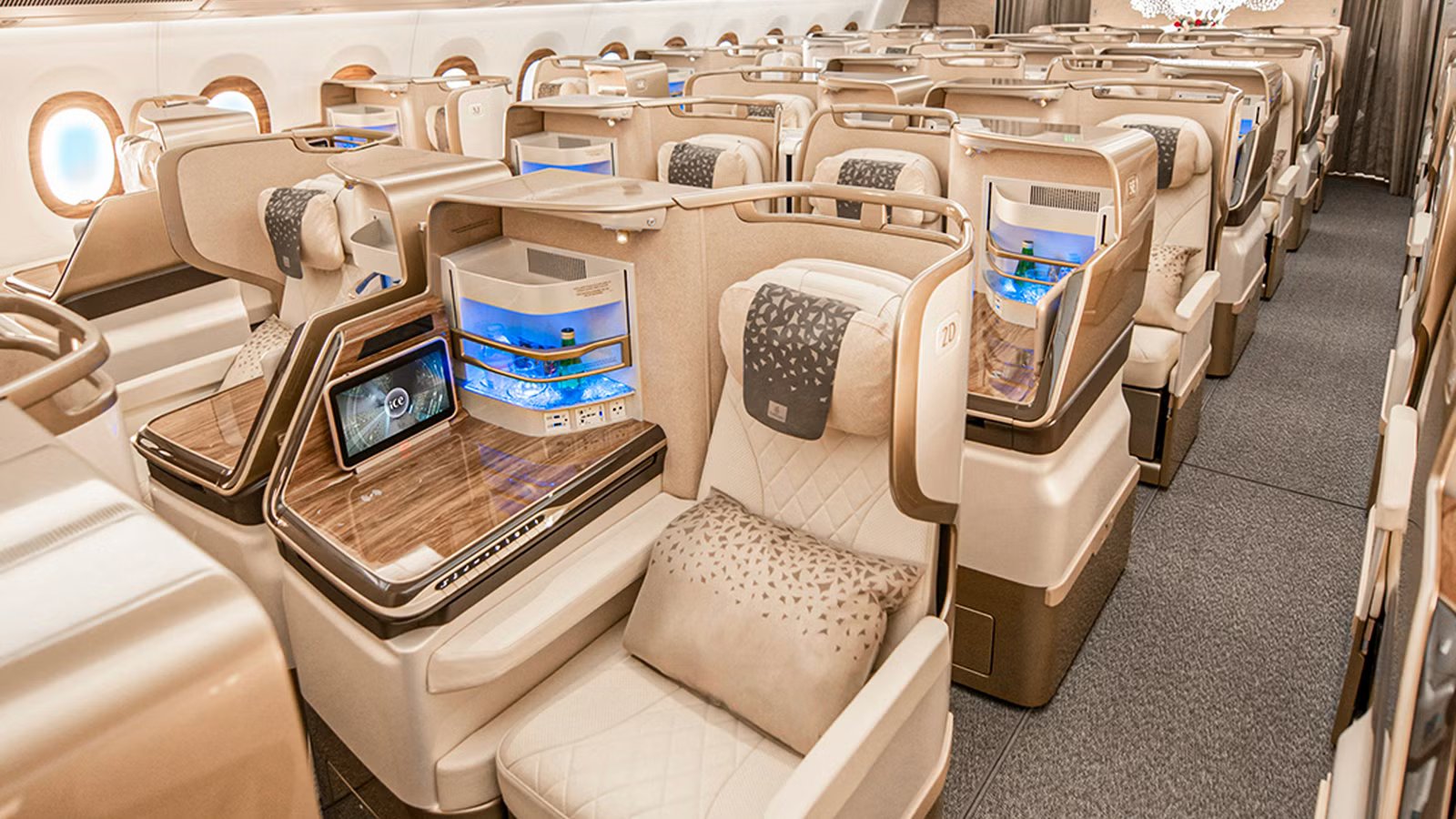
 Emirates has operated its Boeing 777 fleet for decades, and for most of that time the aircraft’s business class cabin has remained largely unchanged. The 2-3-2 layout that the majority of passengers experience on the 777 was competitive when it was introduced but has fallen behind what rival carriers now offer, particularly in terms of privacy, direct aisle access, and cabin technology.
The airline’s new Airbus A350-900 fleet carries a completely different business class product. The S-Lounge, as Emirates brands it, moves to a 1-2-1 configuration with fully flat seats, current-generation entertainment, and a design partnership with Mercedes-Benz. It is the most significant business class upgrade Emirates has introduced in years.
What Emirates Put Inside The A350 Business Class Cabin

Emirates’ A350-900 business class cabin carries 32 seats branded as the S-Lounge, arranged in a 1-2-1 configuration that gives every passenger direct aisle access. The design language draws explicitly from the Mercedes-Benz S-Class, a partnership Emirates has promoted heavily, with soft cream leather surfaces, wooden finishes, and silver metal trims running throughout the cabin. The seats are 21 inches (53 cm) wide with 44 inches (111 cm) of pitch and convert to a fully flat bed.
Each seat has a 20-inch (50 cm) 4K HD entertainment screen with Bluetooth audio pairing, allowing passengers to connect their own headphones wirelessly rather than using the airline-supplied pair. Wireless charging pads are built into the cocktail table at each seat, and both USB-C and USB-A ports are available for wired charging. The overall technology package is a generation ahead of what Emirates offers on its existing widebody fleet, where the entertainment hardware on most 777s predates current screen resolution and connectivity standards.
The cabin is finished to a standard consistent with Emirates’ broader brand positioning, but the seat itself is an open suite rather than an enclosed one. There is no sliding privacy door. The seat shell provides separation from neighboring passengers and the aisle, but the level of enclosure is lower than that of several competing carriers in their most recent business class products. Emirates has not indicated that a door-equipped version is planned for future A350 deliveries, suggesting the S-Lounge as delivered represents the intended final product rather than a first phase awaiting further development.
What Emirates’ 777 Business Class Has Looked Like For Years

The business class product most Emirates passengers have actually experienced is the one fitted to the majority of its Boeing 777 fleet, and it is a significantly different cabin from the A350 S-Lounge. Most Emirates 777s feature business class in a 2-3-2 layout, meaning passengers in center and window positions do not have direct aisle access and must climb over or disturb a neighbor to reach the aisle. The seats are angled lie-flat rather than fully flat on many configurations, and the cabin hardware, while maintained to Emirates’ standard, reflects a design generation that predates the current expectations of long-haul business class travelers.
Emirates introduced its Game Changer first class suites on the 777-300ER in 2017, but the business class cabin on those same aircraft was not redesigned to the same degree. The result is a fleet where a small number of 777s carry a cutting-edge first class product alongside a business class cabin that has not kept pace with what competitors have introduced in the years since. Qatar Airways launched QSuites with closing doors in 2017. Singapore Airlines introduced its latest regional business class on the 787-10. Cathay Pacific rolled out Aria suites on the A350. Emirates’ 777 business class has remained largely unchanged through that entire period.
The 2-3-2 layout is the single biggest point of difference between the 777 and A350 cabins. On a daytime flight it is a manageable inconvenience. On an overnight long-haul sector, being seated in the middle of a three-seat center block without aisle access is a fundamentally different experience from the 1-2-1 layout the A350 provides, and it is the primary reason the S-Lounge represents a genuine step forward rather than an incremental refresh.
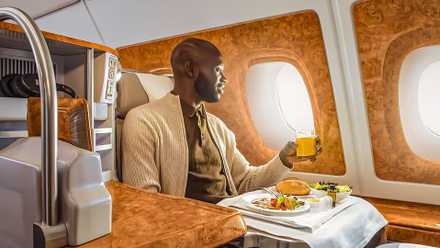
Why The Same Emirates Airbus A380 Business Class Seat Can Cost $2,500 Or $10,000 Depending On When You Book
The answer largely comes down to the pricing strategy the airline uses.
Where The A350 Is A Genuine Upgrade Over The 777

The most significant upgrade is the shift from 2-3-2 to 1-2-1. Every passenger in the A350 S-Lounge has direct aisle access without having to climb over another seat. On the 777, only passengers in the two window positions on each side have unobstructed access, and the three center seats require at least one passenger to move for the others to get out. That change alone places the A350 business class in a different competitive category from the 777, regardless of what the seat itself looks like or how it is finished.
The technology gap is the second most noticeable difference. The A350’s 20-inch (50 cm) 4K screens with Bluetooth pairing and wireless charging reflect current expectations for a premium cabin. The 777 fleet uses older entertainment hardware with smaller screens, wired-only audio on most aircraft, and no wireless charging capability. For passengers who travel frequently and have come to expect connectivity and device integration as standard, the A350 cabin feels current in a way that the 777 does not.
The seat dimensions are a more modest improvement. The A350’s width and pitch are competitive for a 1-2-1 business class layout, but not dramatically larger than those of the 777 in raw measurements. The difference in usable personal space is driven more by the layout change than by the seat dimensions themselves. A seat with direct aisle access and a defined suite shell around it feels substantially more private and spacious than a similarly sized seat in a 2-3-2 block where your neighbor’s shoulder is immediately adjacent.
The Missing Feature That Critics Keep Pointing Out

The most consistent criticism of the S-Lounge since its launch has been the absence of a sliding privacy door. The seat shell provides partial enclosure and separation from the aisle, but it does not close off the suite in the way that Qatar Airways QSuites, Delta One suites, or the newer products from Cathay Pacific and Japan Airlines now do. For a product launching in 2025 on a brand-new aircraft type, the lack of a door puts the S-Lounge behind where several competitors were years ago.
Emirates has not publicly explained the decision in detail. The airline may have concluded that on the routes the A350 is intended to serve, flight times are not long enough for a privacy door to be a decisive factor in the booking decision. A door matters more on overnight long-haul sectors where passengers want to sleep undisturbed. On a five-hour daytime flight from Dubai to Mumbai or a six-hour sector to Bahrain, the utility of a closing door is lower than on a 14-hour red-eye. If Emirates were to view the A350 as a regional aircraft rather than a long-haul flagship, the absence of a door may reflect a deliberate product positioning choice rather than an oversight.
Whether that reasoning holds depends on where the A350 eventually ends up flying. If the aircraft remains on short and medium-haul routes, the open suite design is defensible. If Emirates deploys it on longer sectors as the fleet grows, the absence of a door will become harder to justify against what every major competitor now offers at the same price point.
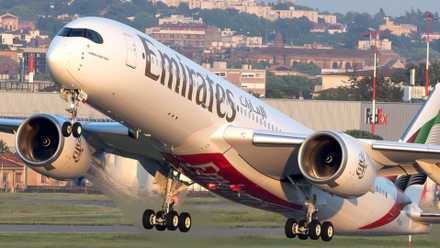
Why The Airbus A350 Has Such An Ultimate Passenger Experience
Discover why the Airbus A350 offers the ultimate passenger experience — quieter cabins, roomier seats, and comfort praised by flyers worldwide.
Why Emirates Ordered 65 A350s For Routes The A380 Cannot Serve

Emirates has built its network around the Airbus A380 and Boeing 777, two of the largest widebody aircraft in commercial aviation. That strategy works on trunk routes between major hubs where demand is deep enough to fill 350 to 500 seats per departure. It does not work on thinner routes where the passenger volumes cannot support that level of capacity, which has historically left Emirates unable to serve certain markets profitably or forced the airline to deploy aircraft that are too large for the demand.
The A350-900 solves that problem. With 32 business class seats, 21 premium economy seats, and 259 economy seats for a total of 312, the aircraft is significantly smaller than the 777-300ER and roughly half the size of an A380. That makes it viable on routes like Edinburgh, Bahrain, Kuwait, Mumbai, and Ahmedabad, markets where premium demand exists but not at the scale required to fill a widebody with 400 seats. The 65 aircraft on order give Emirates enough A350 capacity to build a meaningful secondary network of routes that the airline could not previously serve with a consistent premium product.
Before the A350, passengers on Emirates’ thinner routes often experienced a product that was inconsistent with what the airline offered on its flagship A380 services. The A350 standardizes the experience across a wider network, giving passengers on a Dubai to Edinburgh flight the same generation of business class seats and technology that the airline now promotes as its current standard. For Emirates, the A350 is less about replacing existing aircraft and more about opening routes that were previously uneconomical, while ensuring the product on those routes does not fall below the level the brand is built around.