dailynewsnblog
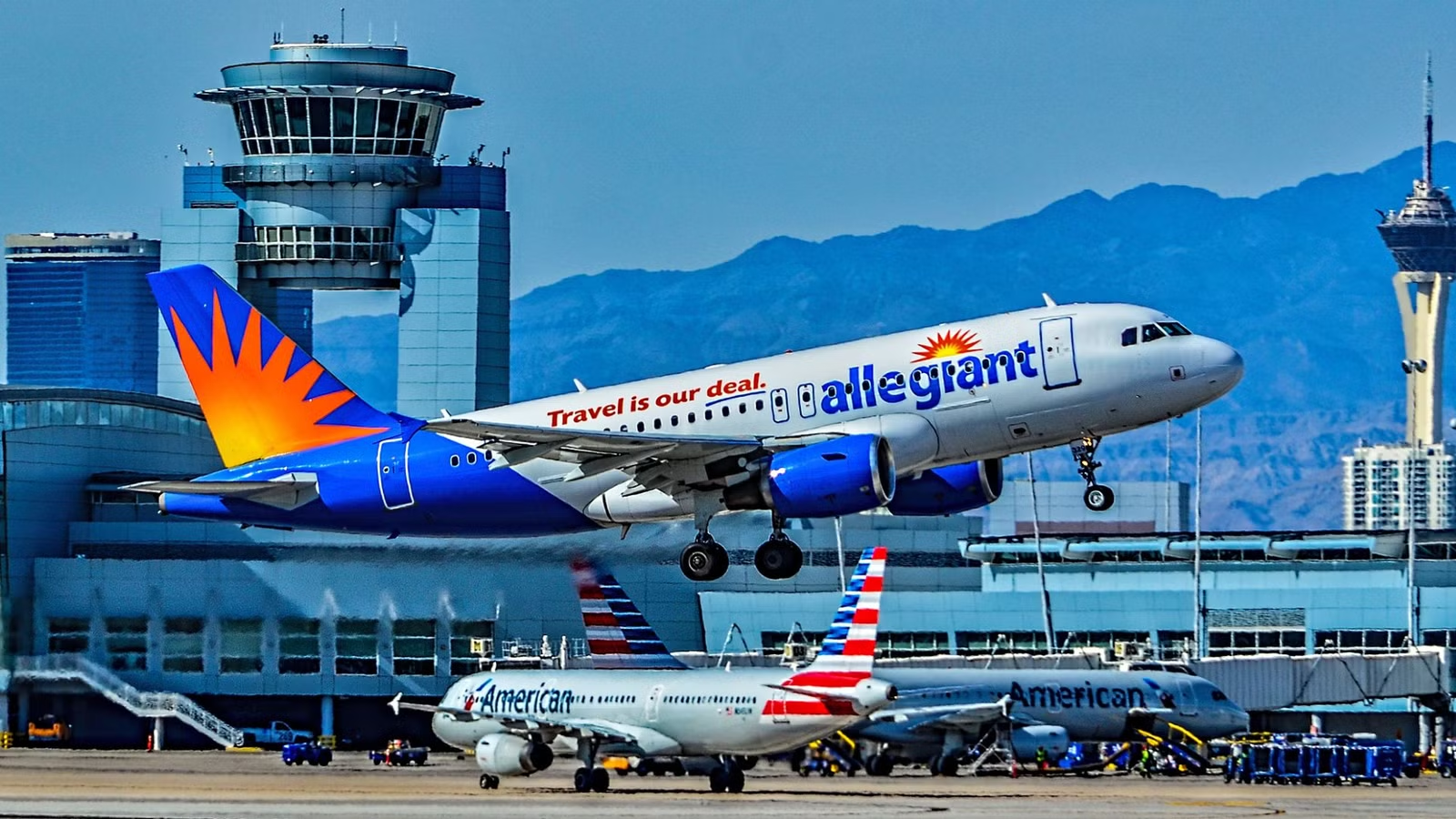
If you’ve ever watched or been on an aircraft sitting on the runway, you might notice the engines begin to hum and spin just before the plane moves. This process is called spooling up, and it’s a moment often overlooked by passengers but is a key part of the takeoff routine. It’s the quiet buildup before the engines roar to life, the subtle pause that signals the aircraft is preparing to accelerate down the runway.
There’s a purposeful rhythm to it, a controlled, deliberate increase in activity that sets the stage for the takeoff. From the outside, it may look like a simple engine warm-up, but it’s one of those moments that shows how precise and coordinated every part of flight really is. Spooling up is the calm before the power, the first step in a carefully orchestrated process that makes every takeoff feel smooth and controlled.
How Does A Jet Engine Work?

Before exploring what exactly ‘spooling up’ is, and why pilots do it, it is firstly important to understand the basic principles of a jet engine, specifically a turbojet. The key reason behind a turbine engine’s operation is based on Newton’s Third Law: air is forced rearward, causing the aircraft to move forward. The basic principle of a jet engine is in four stages: pulling air in, compression, ignition/combustion, and pushing air out through the exhaust.
First, air enters the front intake of the jet engine, where it is slowed and straightened so it flows smoothly. This air then passes through the compressor, which uses rows of spinning and stationary blades to squeeze the air to a much higher pressure and temperature. Fuel is sprayed into the compressed air in the combustion chamber and ignited. The combustion is continuous, not explosive, and it adds a large amount of energy to the airflow, causing it to expand rapidly.
Next, the hot, expanding gases flow through the turbine, whose blades extract energy to keep the compressor spinning. After the turbine, the gases still have very high speed and pressure, so they are forced through a narrowing exhaust nozzle, which further accelerates them even more. When this high-speed jet of gas shoots out the back of the engine, it pushes the aircraft forward, producing thrust.
Turbojet Vs Turbofan

Most modern commercial aircraft utilize turbofan engines, which vary slightly from the turbojet engine we just explored. So, what is the difference? The easiest way to think of a turbofan engine is a turbojet engine (which essentially becomes the turbofan engine core) with a large fan attached to the front. A turbojet engine sends all incoming air through the engine and creates thrust mainly from very fast exhaust.
Meanwhile, a turbofan adds a large fan at the front and produces most of its thrust by moving a much larger mass of air at a lower speed, which makes it quieter, more fuel-efficient, and better for subsonic flight. Air enters the inlet and immediately meets the large fan. The fan splits the airflow into two streams: most of the air bypasses the engine core and flows around it, while a smaller portion enters the core.
The bypass air is accelerated rearward by the fan and already produces a significant amount of thrust without being heated or burned. Turbofan efficiency is measured using ‘bypass ratio’ (mass of air bypassing the core: to the mass of air passing through the core). From this point, the turbofan works on a similar principle as a turbojet, whereby the core airflow is compressed, mixed with fuel, and burned.
The hot gases spin the turbines, which power both the compressor and the large front fan via a shaft. After passing through the turbine, the remaining exhaust exits the nozzle, adding more thrust. In a turbofan, most thrust comes from the fan (bypass air), not the hot exhaust, which is why modern airliners use turbofans instead of turbojets.
What Is The Key Difference Between Turbojets & Turbofans?
Turbojets excel in high-speed flight, while turbofans offer better efficiency. Learn about history, differences and impact on the world of aviation!
What Is ‘Spooling Up’?

In essence, spooling up refers to the process of increasing an engine’s rotational speed, specifically the fan, compressor, and turbine, in preparation for higher thrust. Jet engines don’t produce full power instantly, as the massive rotating components need time to accelerate, and the airflow, fuel flow, and temperatures must stabilize. When a pilot moves the throttle forward, the engine gradually ‘spools up’ to the desired speed rather than jumping to maximum power immediately.
You can think of it a little bit like pedaling a bicycle: it is impossible to pedal as fast as you can straight away. Pilots often spool engines in stages, especially before takeoff. They may first advance the throttles to a moderate power setting and hold briefly, allowing both engines to reach the same rotational speed. Spooling up also gives pilots a final opportunity to monitor engine performance before committing to full thrust.
Pilots can check parameters like temperature, pressure, and vibration to ensure everything is operating normally. Once the engines are stable, the throttles are advanced for takeoff or climb power, and the aircraft accelerates. In short, spooling up is the engine warming up and synchronizing to provide smooth, safe, and efficient thrust.
Reduced Risk Of Thrust Asymmetry

Thrust asymmetry occurs when the engines on a multi-engine aircraft produce different amounts of thrust, which can cause the aircraft to yaw toward the lower-thrust side. During the initial phase of the takeoff roll, the aircraft is moving at low speed, so the aerodynamic control surfaces, particularly the rudder, have limited effectiveness. If one engine accelerates faster than the other, even briefly, it can create a yawing moment that is difficult to counteract and may push the aircraft off the runway centerline.
Gradually spooling up both engines allows them to reach similar rotational speeds before full thrust is applied, reducing the risk of asymmetric thrust. The mechanical and thermodynamic properties of jet engines make perfect instant synchronization impossible. Differences in compressor inertia, airflow dynamics, ambient temperature, and fuel system response can cause engines to spool at slightly different rates.
By advancing the throttles to an intermediate power setting and holding briefly, pilots allow engines’ N1 (fan/low-pressure) and N2 (core/high-pressure) spools to stabilize at matched speeds. This ensures that when takeoff thrust is applied, both engines generate nearly identical thrust, maintaining directional control and minimizing lateral forces on the aircraft.
Spooling up also prevents sudden thrust differences that can occur if one engine overshoots its target rotational speed while the other lags. Such thrust spikes are especially hazardous during the first seconds of the takeoff roll, when the aircraft has minimal lateral stability. By carefully controlling spool-up and monitoring engine parameters like EGT, fuel flow, vibration, and RPM, pilots ensure both engines develop thrust uniformly.
The True Differences Between Pratt & Whitney & CFM Engines
Both companies make engines that power narrow-bodies, but have different design philosophies.
Avoiding Compressor Stalls Or Surges

Have you ever seen flames shooting out the back of an aircraft’s engine on takeoff, or maybe heard ‘popping’ noises? Although alarming and discomforting, especially for non-regular or nervous flyers, chances are this isn’t an engine fire or failure, but a compressor stall or surge. A compressor stall occurs when the airflow through a jet engine’s compressor blades becomes disrupted, reducing the compressor’s ability to pressurize air.
In axial compressors, air must flow smoothly at a precise angle over each stage of rotating blades. If the airflow separates from the blades due to sudden throttle changes, distorted intake air, or excessive blade angle, the compressor cannot maintain pressure, causing a brief loss of thrust, vibration, and sometimes a loud rumble. Minor stalls may correct themselves, but severe stalls can damage the compressor or fan.
A compressor surge is a more extreme event in which airflow actually reverses direction through the compressor, often because the downstream pressure exceeds what the blades can push forward. Surges produce violent pressure fluctuations, loud bangs, and sometimes flames or smoke from the intake.
They are dangerous because they can stress turbine blades, damage bearings, or cause engine flame-out. Gradually spooling up engines before takeoff maintains smooth airflow, stabilizes combustion, and prevents abrupt pressure imbalances, thereby reducing the risk of both stalls and surges while ensuring predictable thrust.
Do Turboprop Aircraft Spool Up?

A turboprop engine is a type of aircraft engine powered by a gas turbine engine that drives a propeller, rather than producing most of its thrust from jet exhaust. In a turboprop, the turbine extracts energy from the hot gases produced by burning fuel in the combustion chamber and transfers it through a reduction gearbox to spin the propeller at an efficient speed. Unlike turbojets or turbofans, where high-speed exhaust provides the majority of thrust, in a turboprop, the propeller produces most of the thrust.
This is especially important at lower speeds and altitudes, making it very efficient for regional flights, cargo planes, and smaller commuter aircraft. In short, turboprops do indeed spool up, in the sense that the turbine and connected components accelerate to the correct rotational speeds before full power is applied. When the pilot advances the power lever, fuel flow increases, and the turbine begins to spin faster.
The reduction gearbox ensures that the propeller turns at a practical speed for aerodynamic efficiency. This staged increase in engine and propeller RPM allows the aircraft to generate smooth, predictable thrust while preventing mechanical stress, overspeed, or uneven torque between engines. Spooling up in a turboprop is important for safety and performance. For twin-engine aircraft, it ensures symmetric power output, reducing yawing moments during the takeoff roll.
It also allows pilots to monitor critical parameters such as turbine temperature, torque, propeller RPM, and fuel flow before applying full power. By gradually increasing engine speed, the airflow, combustion, and propeller thrust stabilize, reducing the risk of engine damage or sudden control issues. In short, spooling up in a turboprop is the process of bringing both the turbine and propeller to operating speeds safely and efficiently before demanding maximum thrust.