dailynewsnblog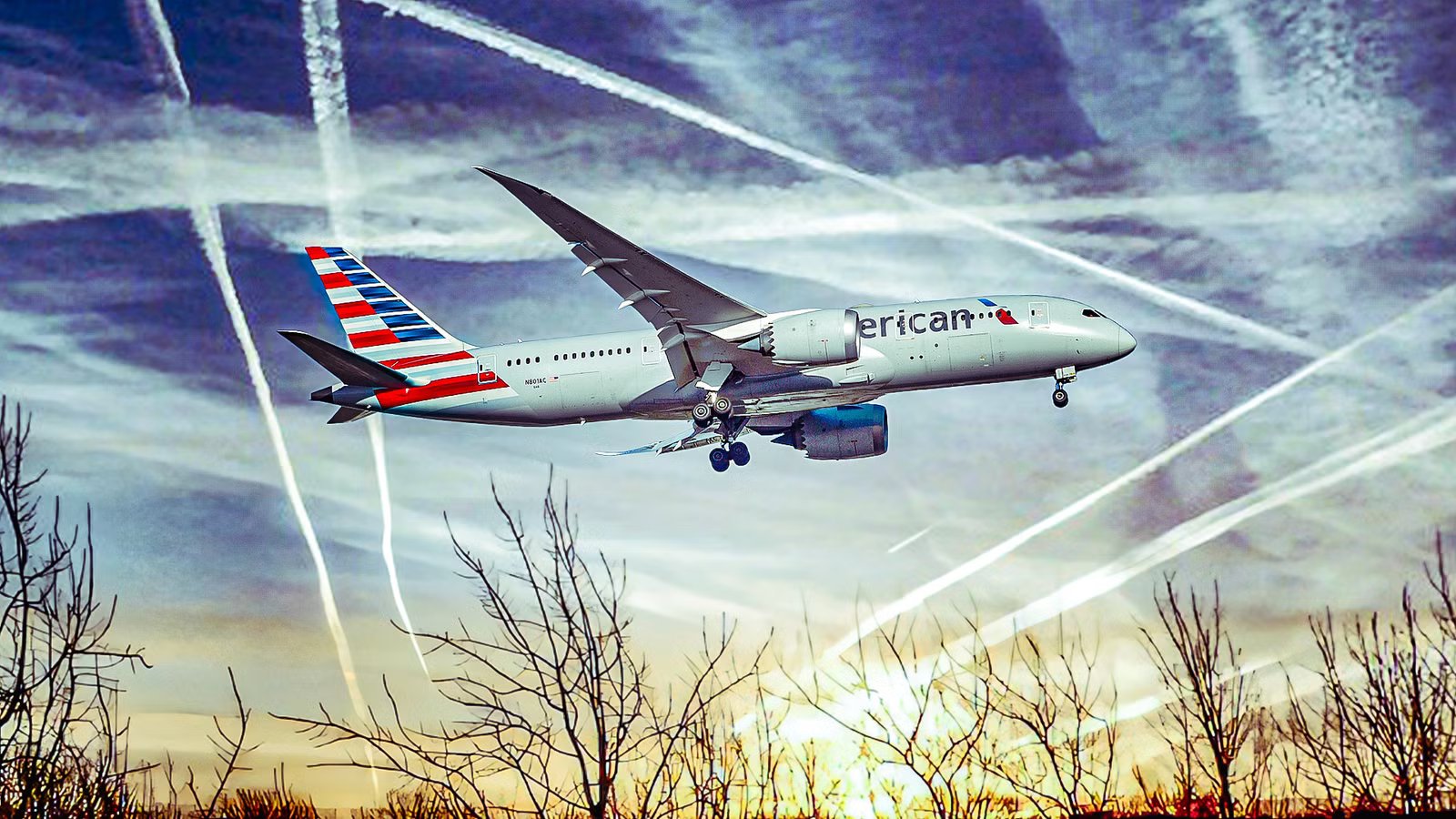
Look up at the clear sky on any given afternoon, and the visual asymmetry of modern air travel becomes immediately obvious. One commercial airliner leaves a thick, bright white plume slicing through the upper troposphere, while another jet flying not too far above leaves absolutely nothing but empty blue air. This phenomenon raises a persistent question for observers on the ground: why do condensation trails, or contrails, form behind some aircraft but not others?
At its core, a contrail is not smoke or unburnt fuel, but actually a cloud of ice crystals manufactured by the intersection of engine physics and local atmospheric conditions. Every commercial jet burning conventional fuel expels water vapor and tiny soot particles, but the atmosphere itself decides whether those emissions lock into visible structures or instantly disappear. This article will explore the exact micro-climatic thresholds that trigger these artificial clouds, examine how modern ultra-high-bypass engines have unintentionally altered the contrail production window, and break down how global carriers are suddenly using predictive artificial intelligence to actively rewrite flight paths and clean up the skies.
All Depends On Air Condition

The immediate reason some aircraft produce brilliant white lines while others leave an unblemished sky comes down entirely to the microclimate of the air mass the jet is situated in. Contrails mostly form when the surrounding air is both intensely cold and highly humid, forcing water vapor from the engine exhaust to instantly freeze into ice crystals. If the atmosphere is dry or slightly too warm, these combustion byproducts remain invisible and dissolve into the surrounding air within a few milliseconds. It is much more focused around localized atmospheric physics rather than a reflection of mechanical variance or specific airline operations.
Catch what other flight trackers miss
Emergency squawks, holds, NOTAMs — live signals, no signup.
Open tracker
Catch what other flight trackers miss
Emergency squawks, holds, NOTAMs — live signals, no signup.
Open tracker
How the formation depends on the surrounding air conditions explains why two commercial airliners can appear to travel along the exact same path from a ground perspective, yet display entirely different visual footprints. Standard air traffic control separation guidelines dictate that aircraft traveling in the same direction must maintain a minimum vertical buffer of 2,000 feet (610 meters), while opposing traffic is separated by 1,000 feet (305 meters). A vertical shift of just a few hundred feet can move an airframe out of a completely dry pocket of air and directly into a highly volatile, ice-supersaturated region. Consequently, one flight crew might be cruising through an invisible atmospheric blanket that triggers a thick, persistent trail, while a trailing aircraft flies through a dry layer with zero visual trace.
To understand this threshold mathematically, atmospheric scientists rely on a methodology established in the mid-twentieth century. Developed by military meteorologist Herbert Appleman in 1953, the Appleman chart maps the precise intersections of ambient temperature, pressure, and relative humidity required to initiate condensation. The historical framework proves that even a microscopic variation in flight level can completely alter the visual profile of a flight, cementing the fact that contrails are a product of geography and altitude rather than the aircraft type itself.
When Stars Align

The process of developing a contrail requires a precise alignment of atmospheric parameters, the efficiency level of the propulsion system, and even the aerodynamic contours of the aircraft structure. When these elements interact at high altitudes, they dictate both the initial creation of the ice crystals and their long-term survival in the upper atmosphere.
The primary atmospheric catalyst is temperature, which must generally sit below -40°F (-40°C) to cause instantaneous freezing. However, the true deciding factor for persistence is relative humidity with respect to ice. When an aircraft enters an ice-supersaturated region, the ambient moisture locks onto the tiny soot particles exhausted by the engines, which are perfect cloud condensation nuclei. Furthermore, a secondary phenomenon known as an aerodynamic contrail can form entirely independent of engine combustion; as air flows rapidly over a curved wing or propeller blade, the localized drop in pressure causes a sharp drop in temperature, immediately condensing the background moisture into a fleeting vapor trail.
Flight Level Altitude | Ambient Temperature Standard | Humidity Level Threshold | Contrail Formation Likelihood |
28,000 feet (8,534 meters) | -41°F (-40.5°C) | Low (Under 40%) | Minimal / Instant Dissipation |
34,000 feet (10,363 meters) | -62°F (-52.2°C) | Moderate (50% to 60%) | Brief Exhaust Trails |
39,000 feet (11,887 meters) | -70°F (-56.6°C) | High (Supersaturated >100%) | Highly Persistent Cirrus Clouds |
These variables do not remain static, creating dynamic boundaries in the sky that shift by the hour. For example, it is entirely possible and often common to pierce a narrow, invisible moisture ribbon measuring just 800 feet (244 meters) thick. While inside this specific layer, the aircraft will paint a vivid, expanding white line across the horizon; yet the moment the pilot levels off just 1,000 feet (305 meters) higher in a drier atmospheric band, the trail stops abruptly, leaving a clean separation that confuses observers looking up from below.

Cruising Altitude: How Low Is Too Low?
Elevating or descending? Cruising altitude is a direct result of safety, fuel use, and comfort in a myriad of ways.
Can Contrails Be Contained?

The commercial aviation sector has often treated contrail mitigation as a secondary environmental objective, prioritizing the reduction of raw carbon dioxide emissions above all else. However, after a collaborative study conducted by Google Research and  American Airlines revealed that addressing non-carbon emissions yields an immediate, outsized climate benefit, everything began to change. Industry experts now view these upper-atmosphere ice clouds not as an inevitable cost of doing business, but as an operational variable that can be actively managed with the right algorithmic foresight.
The real-world proof of this concept emerged from a massive logistical trial involving 2,400 transatlantic flights. Integrating predictive artificial intelligence directly into standard flight planning software, dispatchers were able to map out ice-supersaturated regions with unprecedented accuracy. For the flights that actively adjusted their flight levels to avoid these humid pockets, researchers documented a 62% reduction in total contrail formation. This targeted routing delta ultimately yielded a 69% reduction in total climatological warming for those specific operations. Putting that into perspective, minor altitude corrections can practically neutralize a flight’s immediate thermal footprint.
Despite these impressive atmospheric victories, translating laboratory success into daily airline operations is not a simple task. Out of roughly 1,200 flights offered alternative, contrail-free routes during wide-scale testing, only 112 flights were actually able to execute them. This really shows just how intense real-world constraints of international air traffic control coordination, pilot workload, and airspace saturation actually are. Due to just two or three percent of global flights being responsible for up to 80% of total contrail energy forcing, experts emphasize that airlines do not need to overhaul the entire global airspace and focus more on the margins.
The Topic Of Chemtrails

When seeking to explain why certain aircraft paint the sky while others fly clean, public discussions often drift toward alternative, unscientific theories. The most prominent of these misconceptions is the persistent internet myth of chemtrails, which posits that these white plumes are deliberate chemical agents sprayed by governments or commercial entities. Official guidance from the United Kingdom government systematically debunks this claim, reinforcing the baseline reality that contrails are purely a byproduct of hydrocarbon combustion mixing with extreme atmospheric conditions, completely devoid of secret additives.
Many will never believe in government guidance, so what is the actual science behind this? A more grounded comparative angle involves separating true exhaust contrails from aerodynamic contrails, as the two look superficially similar but rely on entirely separate physical triggers. While exhaust contrails depend heavily on engine soot acting as cloud condensation nuclei, aerodynamic contrails form completely independent of fuel combustion. As a jet accelerates through a highly humid air mass, the physical curvature of the wings or the rapid spin of propeller blades induces a sudden localized pressure drop. This rapid expansion of air causes a sharp drop in temperature, immediately condensing background moisture into a fleeting, glassy vapor trail that vanishes almost as fast as it appears.
Contrasting these physical mechanisms exposes a fascinating paradox built into modern engine architecture. One might assume that newer, more efficient aircraft would produce fewer contrails due to their advanced engineering. In reality, modern ultra-high-bypass turbofans extract far more heat from the core to generate bypass thrust, meaning their exhaust gases are significantly cooler when ejected into the open air; newer powerplants can reach the necessary condensation thresholds at much lower, warmer cruise altitudes than older, less efficient units, explaining why a brand-new airliner might leave a persistent plume while an older aircraft flying nearby leaves nothing.
Are More Fuel-Efficient Aircraft Increasing Global Warming?
Contrails exist when water vapour from aircraft engines condenses and freezes at high altitudes.
There Is Always A Caveat

Avoiding contrails via tactical rerouting seems like a straightforward environmental victory. However, the strategy introduces a delicate operational compromise. Forcing an aircraft to deviate from its optimal, fuel-efficient flight profile to bypass a humid air mass requires burning additional jet fuel, so if a flight plan requires a jet to burn significantly more fuel just to stay in clean air, then the immediate reduction in contrail formation is completely erased by the long-term penalty of extra carbon dioxide trapped in the atmosphere. Finding the exact break-even point is something that needs to be analyzed carefully in order to achieve.
The climate math becomes even more nuanced when factoring in the time of day a flight occurs. Contrails generated during daylight hours can actually have a net cooling effect by reflecting incoming solar radiation back into space, functioning briefly like a protective shield. Conversely, trails produced at night act exclusively as a thermal blanket, trapping the outgoing longwave heat trying to escape the surface of the Earth. Consequently, a flight plan that tolerates a contrail at noon might be completely unacceptable at midnight, meaning tactical rerouting software must prioritize night operations where the environmental penalty is highest.
Routing Decision Type | Flight Path Altitude Change | Fuel Burn Deviation | Net Climate Forcing Impact |
Daytime Contrail Tolerance | Maintained optimal cruise | 0% baseline | Neutral to slight cooling effect |
Nighttime AI Reroute | Adjusted by 1,000 feet (305 meters) | 1% to 2% increase | Significant reduction in thermal trapping |
Excessive Lateral Deviation | Diverted around supersaturated zone | Exceeds 4% increase | Negative, as carbon dioxide penalty outweighs benefit |
The exact metrics airlines use to claim sustainability victories should not necessarily be taken at face value. It is easy to celebrate a reduction in visible plumes, but if those changes trigger a systemic climb in raw fuel burn across a fleet, the net result could exacerbate long-term warming. Tracking the real-world trade-offs between immediate atmospheric cooling and multi-decade carbon accumulation is what moving forward should be looked into with far more scrutiny.
An Era With No Trails?

The presence or absence of a white line behind a high-altitude jet is not just some random occurrence. Contrails form because specific pockets of the upper troposphere possess the exact freezing temperatures and high humidity required to turn engine exhaust into ice crystals. Two identical airliners can generate completely different visual footprints simply because they are separated by less than 1,000 feet (305 meters) of vertical altitude, placing one airframe in a dry zone and the other in a highly volatile moisture ribbon.
International aviation continues to navigate its decarbonization goals, and now this phenomenon is transitioning from a visual curiosity into an actively managed operational variable. Seeing a clear sky behind an airliner will increasingly signify advanced algorithmic planning rather than mere luck. Carriers across the world are progressively demonstrating that minor, tactical altitude adjustments can eliminate a vast majority of these climate-warming clouds without disrupting standard scheduling or requiring cost-prohibitive operational overhauls.
The gradual adoption of sustainable aviation fuel already cuts down on soot particles by up to 70%, drastically reducing the structural density of resulting ice crystals. Farther down the line, the introduction of experimental hydrogen-powered commercial aircraft could shift the baseline entirely, as hydrogen combustion yields significantly higher volumes of water vapor than conventional hydrocarbons. Managing the skies will remain a dynamic challenge, but the transition from passive observation to active, AI-driven avoidance marks a profound step forward for global aviation sustainability.