dailynewsnblog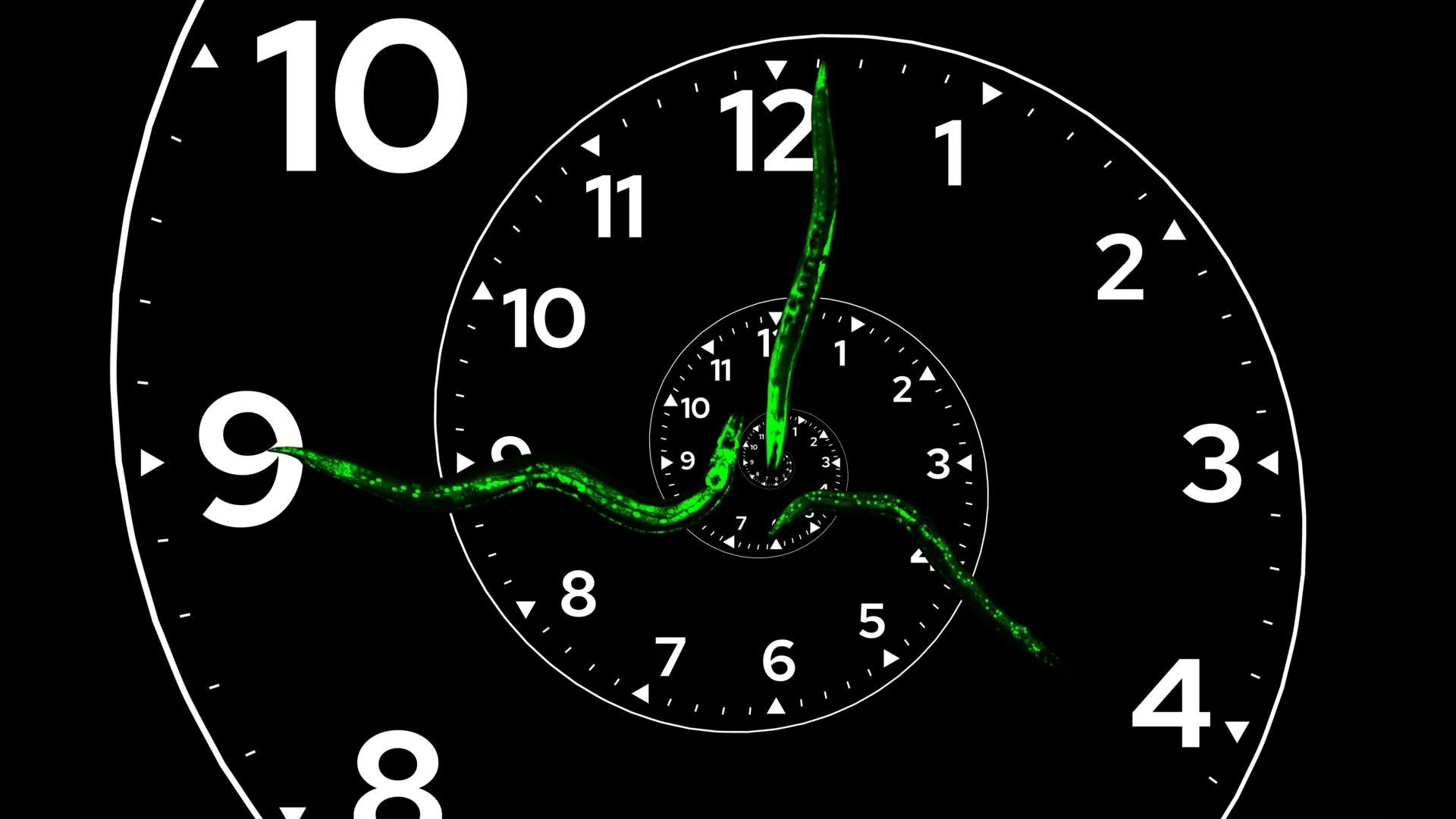
Imagine a train sitting at a station. Passengers have boarded, conductors have checked tickets, and everything appears ready to go. But if the engineer’s watch has stopped working, the train never departs. The doors stay open, the whistle never blows, and the journey never begins.
A similar problem can occur inside living cells. If the timing system that controls development fails, an organism may never progress through the stages needed to reach adulthood.
Researchers at Cold Spring Harbor Laboratory (CSHL) have now identified what appears to be a master developmental clock in the tiny worm C. elegans. The discovery reveals how cells keep growth and development on schedule by coordinating a series of carefully timed bursts of gene activity.
Scientists Identify a Master Developmental Clock
Several years ago, CSHL Professor Christopher Hammell and his colleagues discovered that development in C. elegans is driven by pulses of gene expression. These bursts of genetic activity occur in sequence and help guide the organism through each stage of growth.
What remained unclear was how those pulses were timed so precisely.
The team has now found that two proteins, MYRF-1 and LIN-42, form a feedback circuit that serves as the worm genome’s central developmental clock. Together, they determine when each pulse of gene expression begins and how long it lasts. According to the researchers, this is the first example of a non-repeating biological clock of its kind.
“This is the central clock for all cells in the worm,” Hammell explains. “It’s responsible for coordinating a finite series of sequential pulses of gene expression that must occur only once, and in order, for proper developmental progression. It’s like a ratchet. It turns genes on and off multiple times during development, but ultimately, it’s only going in one direction.”
How MYRF-1 and LIN-42 Control Growth
To uncover the clock’s mechanism, the researchers combined traditional molecular biology experiments with DNA sequencing, protein sequencing, and the artificial intelligence tool AlphaFold.
Their findings revealed that MYRF-1 plays several critical roles during development. The protein acts as the trigger that starts each developmental stage and is also required for the checkpoint that marks its completion.
Once a burst of gene activity begins, MYRF-1 activates LIN-42. LIN-42 then helps regulate the intensity and duration of the genetic pulse. Together, the two proteins ensure that development proceeds in the correct order and at the proper pace.
When researchers blocked MYRF-1, the entire developmental program broke down.
“We’ve never seen anything like this before,” Hammell says. “MYRF-1 is part of this master regulatory clock for all cells, but it’s also acting as a key maker and the master key for each stage of growth. Without the right key for each stage, development hits a wall and can’t progress.”
Exploring How Cellular Clocks Stay in Sync
The research team also includes CSHL Director of Research Leemor Joshua-Tor. Their next goal is to better understand how MYRF-1 and LIN-42 physically interact and how these developmental clocks function across different cells.
One of the most intriguing questions is whether individual cellular clocks communicate with one another during development.
“The MYRF-1/LIN-42 circuit runs in all cells,” Hammell says. “And every one of these independent cellular clocks appears to be in sync when you watch normal development. But are they communicating with each other? We’ve never thought deeply about that question before.”
Potential Implications for Developmental Disorders
Understanding how developmental clocks operate and remain synchronized could provide important insights into cellular growth, differentiation, and the progression of tissues and organs.
In the future, this research may also help scientists better understand developmental disorders and certain genetic diseases. By revealing how the body’s internal timing systems keep growth moving forward, the findings could ultimately point toward new ways to address conditions in which normal development is disrupted.
Like a train that finally receives the signal to leave the station, the newly discovered MYRF-1/LIN-42 clock appears to help ensure that development moves steadily forward, one stage at a time.