dailynewsnblog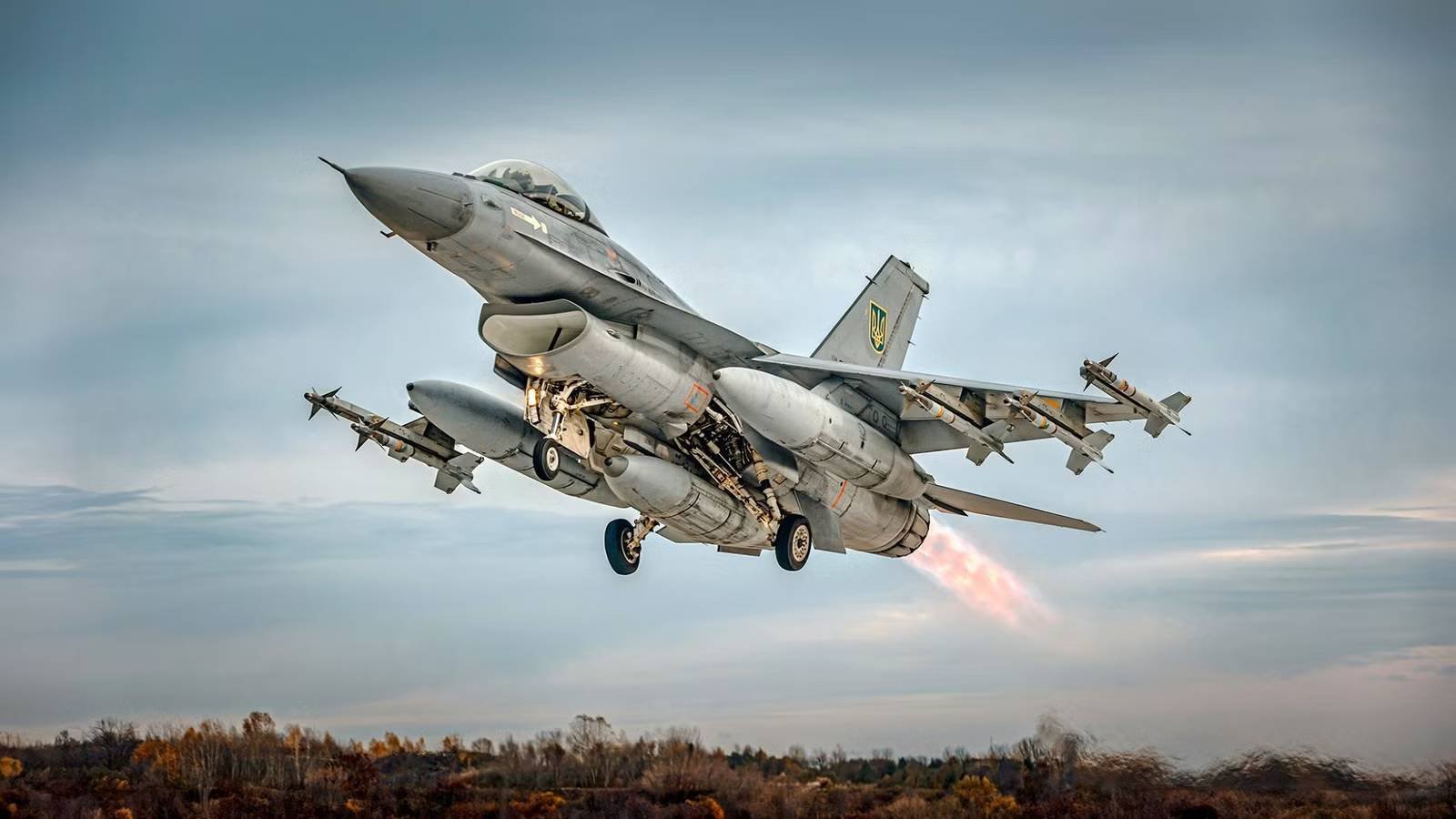
If you were wondering what kind of gas mileage a Lockheed Martin F-16 Fighting Falcon gets compared to your daily driver, you might be shocked to learn how low it can be. A rough average puts the fuel efficiency of the ‘Viper,’ as the F-16 is known, under one mile per gallon. When the pilot engages full afterburners at military power to perform combat maneuvers, the fuel consumption drops to less than 0.01 miles per gallon.
When performing at its full potential, the F-16 can burn roughly 3 gallons of jet fuel every second. Meanwhile, flying as efficiently as possible, the single-seat fighter jet gets about 0.7 miles per gallon while cruising at 30,000 feet (9,144 m) at subsonic speed, without afterburners. Flying at low altitude cuts that in half as the thicker air makes the engine work harder and burn more gas.
Despite these abysmal numbers, the F-16 is actually one of the least thirsty fighter jets currently in service around the world. Heavier multirole fighters with twin engines and stealth designs consume as much as twice the amount of jet fuel under the same conditions. One example is the US Air Force Lockheed Martin F-22 Raptor, with half the fuel efficiency. The Viper also beats out its successor, the newer F-35 Lightning II, which is not much better than the Raptor.
What Does It All Mean?

A fighter jet is a much different machine than any kind of automobile in existence, not only because of its mission but because it moves through the air instead of over the ground. It’s simple to measure miles per gallon in a car because it can only move at a linear distance, but it is not so simple for an aircraft. Pilots use pounds per hour as the standard for monitoring fuel levels and flight range.
A fighter jet moves in three dimensions through a fluid environment that constantly changes. On top of that, the extremely large volume of fuel and its volatility under different conditions make volumetric measurement useless. In a fighter jet carrying thousands of gallons of fuel, temperature changes can alter its volume by hundreds of gallons, but its weight remains exactly the same.
Another major difference between how cars and planes use fuel is the disparity in proportional capacity. One gallon of jet fuel weighs roughly 6.7 pounds, and when an F-16 is completely filled up, the 19,000-pound airframe puts on an additional 7,000 pounds of fuel. This also results in very low fuel efficiency when it first takes off and steadily improves as the thrust-to-weight ratio becomes more favorable.
Flying a fuel-efficient cruise profile, the F-16 burns around 3,000 pounds per hour. In contrast, lighting the afterburners and pushing the throttle to full military power increases the fuel consumption rate to 60,000 pounds per hour, as you can read in this Quora post. Notably, this is better than many of the other modern fighter jets it is compared to, but it has a much smaller fuel capacity, giving it a shorter range and combat radius. Although it is far less expensive to fly.
America’s Affordable Air Power Answer

The F-16 is not the highest-performance fighter jet in the world, nor has it ever been. It was developed at the same time as the McDonnell Douglas F-15 Eagle, which outclasses it in virtually every category. The reason this aircraft was championed by a group of US Air Force officers in the post-Vietnam era and continues to be one of the most popular warplanes in the world is its exceptionally well-balanced design. Simply put, the F-16 delivers a lot of capability at a low price tag.
Since its debut, many fighter jets have come along and continue to introduce superior technology and higher performance, like the F-22, the US Air Force’s current apex predator that succeeded the F-15. Similarly, the F-35 is gradually replacing the F-16 across all mission roles, but it costs exponentially more to procure and operate while delivering only limited new combat capabilities due to poor readiness levels.
The Fighting Falcon has evolved over the years to accommodate new technology and make the daytime light fighter a jack of all trades, multirole platform. It continues to be an invaluable asset to both the US Air Force and many operators around the world, but it still has its limitations. There is one contestant, albeit not a stealth fighter, that combines a more advanced technology and performance package in an airframe that delivers better efficiency. And it’s not made in America.

Before The F-35 Vs. After: How Air Combat Changed
Examining a paradigm shift in air warfare.
The Exception To The Viper’s Rule

The Eurocanard Dassault Rafale is one of the few that achieves better cruise efficiency than the F-16 despite having two engines. Its highly advanced delta-wing aerodynamics allow it to glide through the air with minimal drag during level cruise. Technologically, the F-16 is considered a fourth-generation, while the Rafale outclasses it with sophisticated systems that bump it up to 4.5 gen. The Rafale has evolved into a premier fighter jet that can match 5th gens in virtually every category except stealth. Meanwhile, the F-16 has stuck to its roots as a dogfighter.
The Rafale did not enter service until 22 years after the F-16 debuted on the flight line. The single airframe replaced seven legacy platforms across both the French Air Force and French Navy. It was intended to be an ‘omnirole’ fighter capable of performing virtually any mission, including nuclear deterrence. To make the Rafale capable of doing so much, it has superior performance and firepower compared to the Viper. The two aircraft are very closely matched in thrust-to-weight ratio, but the Rafale has a slight advantage.
While the Rafale has a high TWR, an air-to-air-loaded F-16 has better acceleration due to its lower gross weight. That allows a Viper pilot to quickly convert speed into altitude, resetting a fight or diving back into an engagement with an energy advantage if the Rafale has bled off speed during low-speed maneuvers. And in this scenario, the latest upgrades to off-boresight tech in the F-16 help close the gap in weapons capability with the larger and better-equipped French jet.
How The Dassault Rafale Stacks Up Against The F-16, Gripen, & Typhoon In 2026
Comparing France’s exquisite omnirole jet to the leading fighters.
Paradigm Shift In Fighter Tactics

Since the late 1970s, General Dynamics’, later Lockheed Martin’s, F-16 Fighting Falcon has been a workhorse light fighter for the United States and many allies. Its fundamental design and systems are from a time when all-digital cockpits, networked data links, and stealth technology were all things of science fiction. By the end of the 1990s, engineers had crammed nearly every upgrade possible into the airframe.
At least 30 countries now operate the F-16, which has been manufactured in more than 4,700 units. The F-16 airframe has been inching closer to its upgrade capacity limits since the late 1990s, including radar size, armament volume, fuel capacity, and stealth enhancements. The Joint Strike Fighter program was initiated by the United States and its allies to field a single family of aircraft to replace the F-16 and the even more obsolete Fairchild Republic A-10 Thunderbolt II, or Warthog.
Across the US Air Force, squadrons are steadily transitioning to the conventional takeoff and landing F-35As as F-16s are retired. The same pattern is unfolding in Europe, the Pacific, and the Middle East, where allies like the United Kingdom, Italy, Norway, Australia, Japan, and Israel are already flying the Lightning. Still others, like Poland, Switzerland, and Greece, have orders pending. The overall trend is clear as the stealth fighter is gradually taking over.
5 Fighter Jets That Will Define Air Combat In The 2030s
The next era of air power is on the horizon.
The Sunset Of The Viper

The F-16 is currently the most mass-produced fighter jet in service, with new airframes still rolling off the line. More than 4,600 have been made; the JSF is catching up quickly. Over 1,230 F-35s have been delivered to date, while the F-16 fleet has dropped from its peak of about 800 to a projected 400 by 2030. Older F-16 blocks retire first, and new USAF fighter squadrons fill their place with F-35As. To replace their own F-16s, allied operators such as Italy, Norway, the Netherlands, Poland, and Israel have ordered or are already operating F-35s.
That same program aimed to design a successor to the Navy’s F/A-18 Super Hornet and the Marine Corps’ AV-8B Harrier. The Lockheed Martin F-35 Lightning II emerged victorious in 2001. Lockheed Martin created three versions: the F-35A for conventional takeoff, the F-35B for short takeoff and vertical landing, as well as the F-35C, which is carrier-capable and catapult-launched. The direct replacement for the F-16 is the F-35A.
Maintenance & life cycle cost trajectory are major motivators. Many F-16 airframes are approaching 8,000 flight hours. Service life extension programs (SLEP) can push them to 12,000 hours, but cost roughly $20 million per jet and still can’t add internal weapons bays or signature reduction. Commonality across services greatly simplifies procurement, sustainment, and upgrades. A single JSF family simplifies training, logistics, and software upgrades for the Air Force, Navy, Marine Corps, and partner air forces.