dailynewsnblog
 Southwest Airlines has spent much of the last two years trying to convince investors that it can evolve beyond the low-cost formula that made it successful for decades. Assigned seating, extra-legroom rows, and discussions about lounges and premium products all suggest an airline searching for higher-margin revenue streams at a moment when the broader US airline industry is becoming increasingly dependent on premium travelers.
The challenge for Southwest Airlines is that the economics driving the premium boom at the likes of  Delta Air Lines and
  United Airlines are rooted in long-haul international flying, widebody aircraft, and premium cabins that generate extraordinary yields. Southwest Airlines, however, has none of those things. Its all-Boeing 737 fleet was designed around simplicity, fast utilization, and dense economy seating, and those realities make profitable premium cabins far more difficult than they initially appear.
The Revenue Gap That Southwest Airlines Cannot Access

Across the US airline industry, premium revenue has become one of the most important financial drivers in the post-pandemic era. Analysts increasingly estimate that premium cabins now generate roughly 30% to 40% of total revenue for the major full-service carriers, especially on international routes where travelers are willing to spend thousands of dollars more for lie-flat seats, lounges, upgraded meals, and privacy.
Delta Air Lines and United Airlines have benefited enormously from this shift, and both carriers discovered that premium leisure travelers are now willing to pay fares once associated almost exclusively with corporate travel, particularly on transatlantic routes. As such, flights from New York John F. Kennedy International Airport (JFK) to London Heathrow Airport (LHR) or  Los Angeles International Airport (LAX) to Tokyo Haneda Airport (HND) can generate extremely high margins.
This is because business class cabins command such large fare premiums over economy class, but Southwest Airlines fundamentally cannot participate in that market. The airline operates an all-Boeing 737 fleet without widebodies, and its route network remains overwhelmingly domestic and short-haul. Even if the carrier introduced a domestic first class product tomorrow, it still would not be competing in the same revenue category that has transformed the financial performance of the legacy carriers.
Domestic first class simply does not produce the same economics as international business class. A passenger flying from Dallas/Fort Worth International Airport (DFW) to  Miami International Airport (MIA) may pay a few hundred dollars more for a recliner seat and complimentary drinks, but that revenue uplift is dramatically smaller than the premium generated by international lie-flat cabins. The ceiling on domestic premium revenue is therefore much lower before Southwest begins dealing with the 737’s limitations.
The Boeing 737’s Cabin Was Never Designed For Premium Service

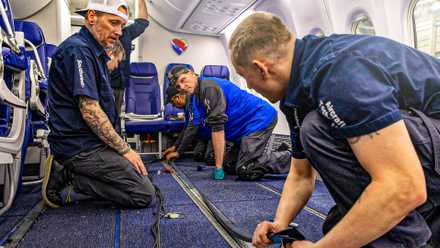
One of the biggest practical obstacles facing Southwest Airlines is that its aircraft interiors were built around efficiency rather than premium service. While  American Airlines, Delta Air Lines, and United Airlines all operate Boeing 737s with domestic first class cabins, those aircraft were configured from the beginning to support differentiated cabin products, including larger forward galleys and onboard catering infrastructure.
Southwest Airlines configured its fleet differently. The carrier historically prioritized quick turns, low maintenance complexity, and maximum seating density, and as a result, its Boeing 737-700 fleet features only small rear galleys, while the larger 737-800s and 737 MAX 8s use full-size rear galleys but still lack substantial forward galley space. That matters because premium cabins are not just about larger seats.
Southwest Airlines’ Fleet (Per ch-aviation) | ||
|---|---|---|
Aircraft | Number In Fleet | Number On Order |
Boeing 737-700 | 294 | – |
Boeing 737-800 | 196 | – |
Boeing 737 MAX 7 | – | 269 |
Boeing 737 MAX 8 | 310 | 186 |
Indeed, passengers paying higher fares increasingly expect a full-service experience, including hot meals on longer domestic routes. Southwest Airlines currently serves beverages and light snacks because its aircraft are not equipped with the ovens and galley systems necessary to support more elaborate catering. Retrofitting those systems is much more complicated than simply installing new appliances, as a proper forward galley requires physical space.
Furthermore, on a Boeing 737, that space comes directly from revenue-generating seats. Once Southwest Airlines begins carving out room for ovens, storage, carts, and service areas, the available footprint for passengers shrinks quickly. Unlike airlines operating larger widebody aircraft, Southwest Airlines does not have excess cabin space to work with. Every inch removed from the economy cabin directly impacts the economics that have historically defined the airline’s business model.
The Seat Count Equation Quickly Turns Unfavorable

RECARO, Simple Flying
Southwest Airlines’ Boeing 737-800 and Boeing 737 MAX 8 fleet is currently configured with 175 seats in a dense single-class layout. That density is central to the carrier’s low-cost strategy because it spreads operating costs across a larger number of passengers, lowering cost per available seat mile. Introducing a domestic first class section changes that equation immediately, as a realistic premium configuration would likely include between 12 and 16 recliner seats.
IT would also feature cabin dividers, expanded storage, and additional galley space. Once those modifications are completed, the aircraft’s total capacity would likely fall into the range of roughly 155 to 162 seats. That reduction creates a major revenue problem, as Southwest Airlines would be removing more than a dozen economy seats from every flight across hundreds of aircraft operating thousands of daily departures.
Simple Flying Quiz
Easy (15s)Medium (10s)Hard (5s)
Those lost seats represent revenue opportunities that disappear permanently, regardless of whether the premium cabin sells out. The premium section must therefore generate enough additional yield to compensate for all of the displaced economy revenue. On long-haul international routes, airlines can often make that math work because premium passengers pay dramatically higher fares.
However, on short domestic flights, the pricing gap is far smaller. For example, a passenger might pay an additional $150 or $250 for domestic first class, but that increase often does not fully offset the lost revenue associated with removing multiple economy rows. The challenge becomes even harder during weaker demand periods.

Why One Of The World’s Biggest Airlines Bet Its Future On A Single Aircraft Family
Southwest Airlines operates only Boeing 737 family jets.
Premium Service Threatens Southwest Airlines’ Fast Turnaround Model

Operational efficiency has always been one of Southwest Airlines’ defining strengths. The airline built its reputation around fast aircraft utilization, with quick turnarounds allowing individual aircraft to operate multiple daily flight segments. That model depends on simplicity, and the single-class cabin simplified cleaning, and limited onboard catering reduced servicing requirements between flights. Indeed, the carrier’s famous 25-minute turnarounds became a cornerstone of its cost advantage for decades.
Premium cabins introduce complexity into every part of that process, as first class passengers generally board earlier and deplane more slowly because they carry additional baggage and expect a more personalized service experience. Recliner seats also require more cleaning time than standard economy seating because they include larger surfaces, tray tables, and armrest controls.
Meal service further complicates operations, as, once hot catering enters the equation, aircraft require additional provisioning and galley servicing between flights. Flight attendants must reset premium cabins, restock meals, and prepare service equipment before boarding begins again.
Even small delays matter enormously in Southwest Airlines’ network structure because the airline relies on tightly coordinated schedules built around rapid aircraft movement. Adding just a few minutes to each turnaround can create cascading operational disruptions throughout the day.
Southwest Airlines’ Route Network Limits Premium Revenue Potential

Network structure is another major obstacle to profitable premium cabins, and Southwest Airlines’ average sector length is approximately 90 minutes. This means that most flights are relatively short domestic segments where passengers spend limited time onboard. Premium economics improve significantly on longer flights because passengers place greater value on comfort, meals, workspace, and personal space during extended journeys.
This is why routes such as  Boston Logan International Airport (BOS) to Seattle-Tacoma International Airport (SEA) generate strong domestic premium demand for Delta Air Lines, United Airlines, and American Airlines. Southwest Airlines’ network is different, and the carrier operates a massive point-to-point system filled with shorter city pairs where the premium experience has less time to justify a substantial fare difference.
As such, a passenger flying for just over an hour may be less willing to pay several hundred dollars extra for a wider seat and complimentary snacks. JetBlue provides an important comparison point, as its Mint business class product performs very well on transcontinental routes lasting five or six hours. However, JetBlue has notably avoided expanding Mint across its shorter domestic network because the economics become much less attractive.
How Southwest Airlines Became The World’s Largest Low-Cost Carrier
The carrier has the largest revenue of any low-cost airline globally.
Southwest Airlines Would Be Entering A Crowded Market

Even if Southwest Airlines solved the operational and aircraft challenges associated with premium cabins, it would still face another major problem: arriving late to a market already dominated by powerful competitors. American Airlines, Delta Air Lines, and United Airlines have spent decades building premium ecosystems around their first class and business class products.
These carriers operate extensive lounge networks, maintain corporate travel relationships, and integrate premium cabins deeply into their loyalty programs. Southwest Airlines, on the other hand, would be starting from almost zero in that environment, and the carrier has historically marketed simplicity, low fares, and customer-friendly policies rather than premium experiences.
Building a credible premium brand, therefore, requires much more than simply installing larger seats at the front of the aircraft. Passengers paying higher fares increasingly expect a seamless ecosystem that includes priority services, lounges, premium food, and meaningful loyalty benefits. However, Southwest Airlines lacks much of that infrastructure today, and creating it would require substantial investment beyond aircraft interiors alone.