dailynewsnblog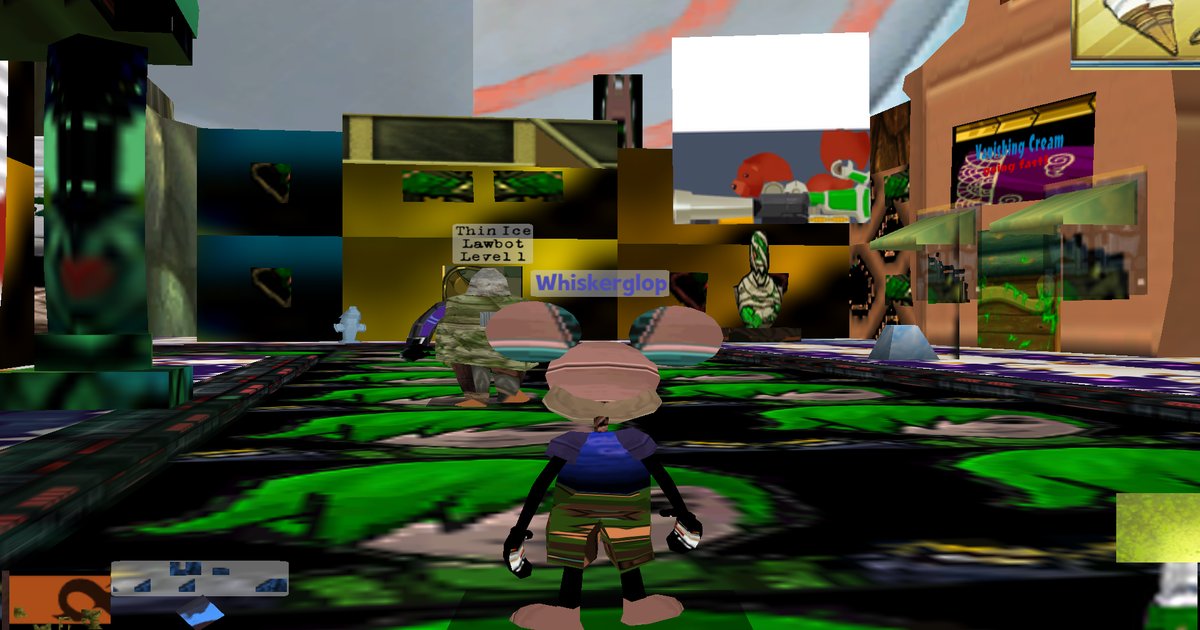
I’ve really been getting into videogame collages, lately – projects like Funi Racoon, a verminous cache of Windows 95 desktop materials and Easter Island sculpture, and Water Level/b.l.u.e. EXPLORATION, a “plunderludic” in which Dark Souls, Super Mario 64, and Kingdom Hearts swim through each other. To that short list add Texturetown, “an algorithmically remixed MMO created from assets of now-defunct mid-2000’s children’s MMOs”, devised by LA-based academic Aidan Strong. It’s an eerie, dysfunctional homage to an early noughties gold rush in online spaces for kids, a Backroom-style memorial to abandoned servers and the youthful experiences they once facilitated. God, I’m old.
As described on the Itch.io page, the game features “altered code” from Toontown (2003-2013), audio from Pirates of the Caribbean Online (2007-2013), text from Club Penguin (2005-2017), and textures from Fusionfall (2009-2013). “In the early 2000s, MMOs like Everquest and World of Warcraft demonstrated the massive financial potential multiplayer games could have,” Strong writes on his blog. “Hoping to capitalize on this trend, children’s entertainment companies like Cartoon Network and Disney began developing their own multiplayer games filled with characters from their IP.”
There was a “massive influx of children’s games being released in a short period of time”, he goes on. “Yet, due to poor financial performance, most of these games were shut down less than 10 years after their launch. Despite loving and engaged communities, their worlds were abandoned overnight. Texturetown creates a world from the shared memory of these once-lively spaces. It repurposes the source code of these games to invoke disjointed nostalgia. Sounds and memories are decontextualized to create a hypothetically playable, but functionally inert game.”
As with a lot of collagic videogames, Texturetown interests me partly because you can (mis)read it as a parody and a rebuttal of AI-generated art – AI generation being a fundamentally “retro” technology that makes educated ‘guesses’ based on patterns extracted from a huge library of assets, attempting to weld them into a complete and coherent commodity. By contrast, Texturetown is artfully rough and ‘slapped-together’, its source materials seemingly locked in a struggle for supremacy, echoing how the games in question once vied for the hearts and minds of young teenagers. It serves up a simulation in which history is at once travestied and reasserted, where the occlusion of one inspiration by another encourages you to think more precisely and inventively about the past.
You could also categorise it as an expression of what Natalie Lawhead has recently termed “meanderware”, or game design devoted to the poetics of the humble hyperlink and to dreams of an internet that isn’t centralised around monolithic search engines and social media platforms. “Younger people don’t really know that this internet is possible,” she writes. “It’s something we need to keep alive, and teach people to be empowered.”
Anyway! Thanks to Warpdoor for spotting this. Did you play any of Texturetown’s source games back in the day? I’ve been trying to work out what I’d put in my very own videogame collage. I wonder what you’d get if you added Vagrant Story, Crash Bandicoot, WipEout and Civilisation 2 together.