dailynewsnblog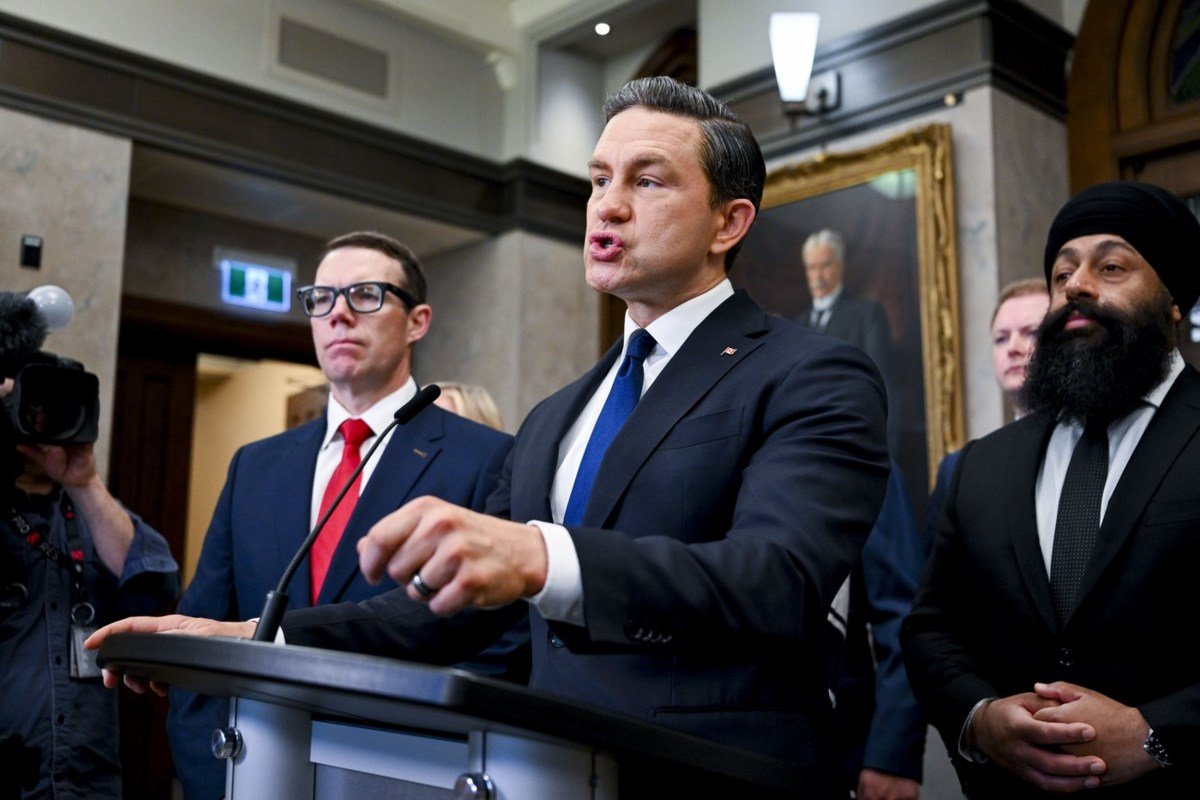

OTTAWA — Conservative Leader Pierre Poilievre accused Prime Minister Mark Carney on Monday of avoiding accountability after recent data showed the Canadian economy contracted again.
OTTAWA — Conservative Leader Pierre Poilievre accused Prime Minister Mark Carney on Monday of avoiding accountability after recent data showed the Canadian economy contracted again.
Statistics Canada said Friday that real gross domestic product declined 0.1 per cent on an annualized basis in the first quarter. That second consecutive quarterly contraction to start the year meets some definitions of a technical recession.
Many economists have dismissed the recession label, arguing the recent slump doesn’t have the depth or breadth to meet that bar.
But Poilievre told reporters on Parliament Hill on Monday that there’s nothing technical about this downturn. He cited statistics about rising insolvency rates and food bank usage to show that Canadians are worse off after a year of Carney’s government.
He said Canadians need answers about why Canada has the only shrinking economy in the G7.
Carney was scheduled to tour a construction site in Ottawa Monday and was not present for question period in the House of Commons.
“You would expect him to be there, to be accountable, to show his incredible economic brilliance, but he’s not showing up for question period,” Poilievre said.
The Conservatives are calling for an emergency parliamentary debate so the government and Official Opposition can present their competing visions for the economy.
The Canadian Press reached out to the Prime Minster’s Office on Monday for a response to Poilievre’s statements. The request was forwarded to John Fragos, press secretary to Finance Minister François-Philippe Champagne.
He pointed to high U.S. tariff levels and other geopolitical events to explain Canada’s economic uncertainty.
“Canadians do not need political theatre right now — they are looking for a plan. That’s exactly what we are delivering — to diversify our trading relationships, supercharge major projects, invest in workers and drive down costs,” Fragos said.
On Monday, Poilievre cited a list of other G7 nations also dealing with tariffs and the effects of the Iran war. He said none of those economies are in recession.
“Mark Carney has been gallivanting around giving speeches filled with dazzling buzzwords that achieve nothing but the worst economy in the G7,” he said.
Poilievre also dismissed assessments pushing back on the recession label as coming from “Liberal commentators and economists.”
Scotiabank chief economist Derek Holt came out swinging against recession talk in a note to clients Monday.
Looking past the small size of the decline, Holt noted that harsh winter weather and tariff-induced trade swings were spurring volatility in the recent economic data. Imports of gold were also sharply higher in the first quarter and dragged GDP lower.
“It would be irresponsible to make a recession call on the basis of surging gold imports that are idiosyncratic in nature versus reflective of underlying activity in the economy,” Holt said.
He also pointed to ongoing consumer strength and early signs of an economic rebound in the second quarter as proof points against a sharp contraction in the economy.
Fragos cited a recent forecast from the International Monetary Fund that projected Canada’s economy would grow at the second-fastest rate in the G7 this year and next. He also pointed out that the Liberals have rolled out new affordability measures in the past year to help struggling families pay the bills.
“We look forward to updating on additional actions to build a stronger, more competitive, and more affordable economy, which we expect the Leader of the Opposition and all opposition parties will support,” Fragos said.
This report by The Canadian Press was first published June 1, 2026.
Craig Lord, The Canadian Press