dailynewsnblog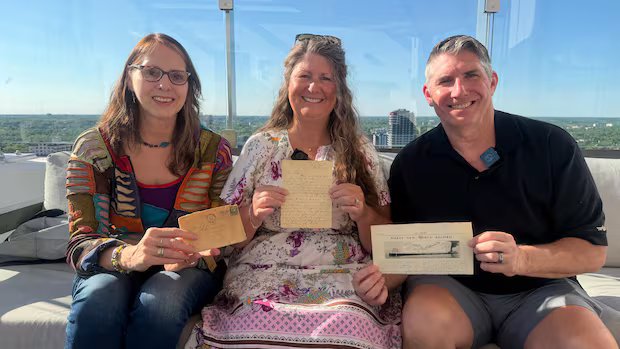
Christina Archer was cleaning out the bedroom of her former London, Ont., home in 2001 when an envelope fell out of from the wall behind her closet.
In it was a nearly century-old handwritten letter penned in cursive.
“We were like ‘Holy cow, it’s from 1929!’ It looked like somebody might have placed it there as a time capsule,” Archer told CBC News.
“I was just so drawn to the history of the whole thing, it’s a historic letter depicting the beginning of the early 30s and the cursive writing,” she said. “It was just amazing, beautiful writing.”
The letter, dated Aug. 13, 1929, was written by a Charles Slater who was serving on a Great Lakes freighter, S.S. Lemoyne out of Fort William, Ont., now Thunder Bay. He wrote to his father about the challenges Canada’s grain industry was facing at the onset of what would later become the Great Depression.
Slater’s letter, which can be read in full at the bottom of this story, also mentioned forest fires, and a book he recommended to his dad, titled All Quiet on the Western Front, by German novelist Erich Maria Remarque.
The envelope was addressed to Samuel Henry Slater at 818 Princess Avenue in London’s historic Woodfield neighbourhood, where Archer and her family later lived.

Archer said she tried finding Slater or his relatives through phone books and land registry documents with no luck — and eventually, she moved to another city, but kept the letter.
Twenty five years later in May of this year, she decided to try again. This time, she posted on a Facebook group for people who grew up in London. To her surprise, a local genealogist contacted her and offered to find information about Slater.
Within 48 hours, she was connected with Londoner Aaron Powers, the grandson of Slater’s half-sister Audrey. The couple immediately met with Archer to receive the letter.
“It’s strange because a week ago, I didn’t know I had this big a family,” said Powers. “All my life, I thought my family was very small.”
Who was Charles Slater?
Marisa Cooper is a genetic and forensic genealogist at Our Story Canada who responded to Archer’s Facebook post and connected her with the Powers family.
Through piecing together information from old census data, city directories and public records, she learned Charles Slater was born in London in 1914. She said his mother died in 1920 when he was six-years-old and his father Samuel Henry eventually remarried, after which they moved to his step-mother’s house on 818 Princess Ave.

When he wrote the letter in 1929, Slater was 15 years old and working on a freighter during The Great Canadian Grain Blockade that stalled wheat exports, which the Canadian economy heavily relied on at the time.
“When Charles wrote his letter in 1929, noting there was ‘no grain to bring back,’ he was witnessing the first domino to fall in the Great Depression,” said Cooper. “His letter reflects what was going on in a historical context at that time.”
According to the 1931 census, Slater moved back to London and worked odd jobs, including at the appliance company, Kelvinator. His first wife died in 1947 and he remarried in 1950. Slater died in 1984 at age 70.

After building his family tree, Cooper discovered that Slater’s only child from his first marriage died as an infant and he didn’t have any children with his second wife. That meant she had to pivot and find his siblings.
Cooper used public records build the timeline. She learned Charles had three full siblings, a half sibling and four step siblings,” said Cooper.
That half sibling was Powers’s grandmother Audrey, who settled in nearby Dorchester where she lived until her death in the early 2000s. Cooper said Slater’s father is also buried in Dorchester.
An unexpected family tree
Aaron admits he regrets not asking questions about extended family members sooner, but discovering the letter has sparked curiosity in Powers to learn more. He now has Audrey’s old family photo albums with images and mentions of Charles.
The couple said they’re amazed at the life Slater lived as a young teenager.
“It’s just amazing that at 15, somebody is working on a steamship. It’s the beginning of the war. It was really interesting and felt like it was a man talking in this letter, not a kid,” said Powers.
“He talked about layoffs, he talked about gas prices. I think this whole situation is just fascinating,” added Laurie.

“It’s an heirloom and it was very exciting to finally hand over the letter to the rightful owners of who should have had it all these years,” said Archer.
“I now call these people my friends, and I’m honoured to have done this in memory of Charles. I almost feel like I know him now too.”
Read Charles Slater’s letter from August 1929