dailynewsnblog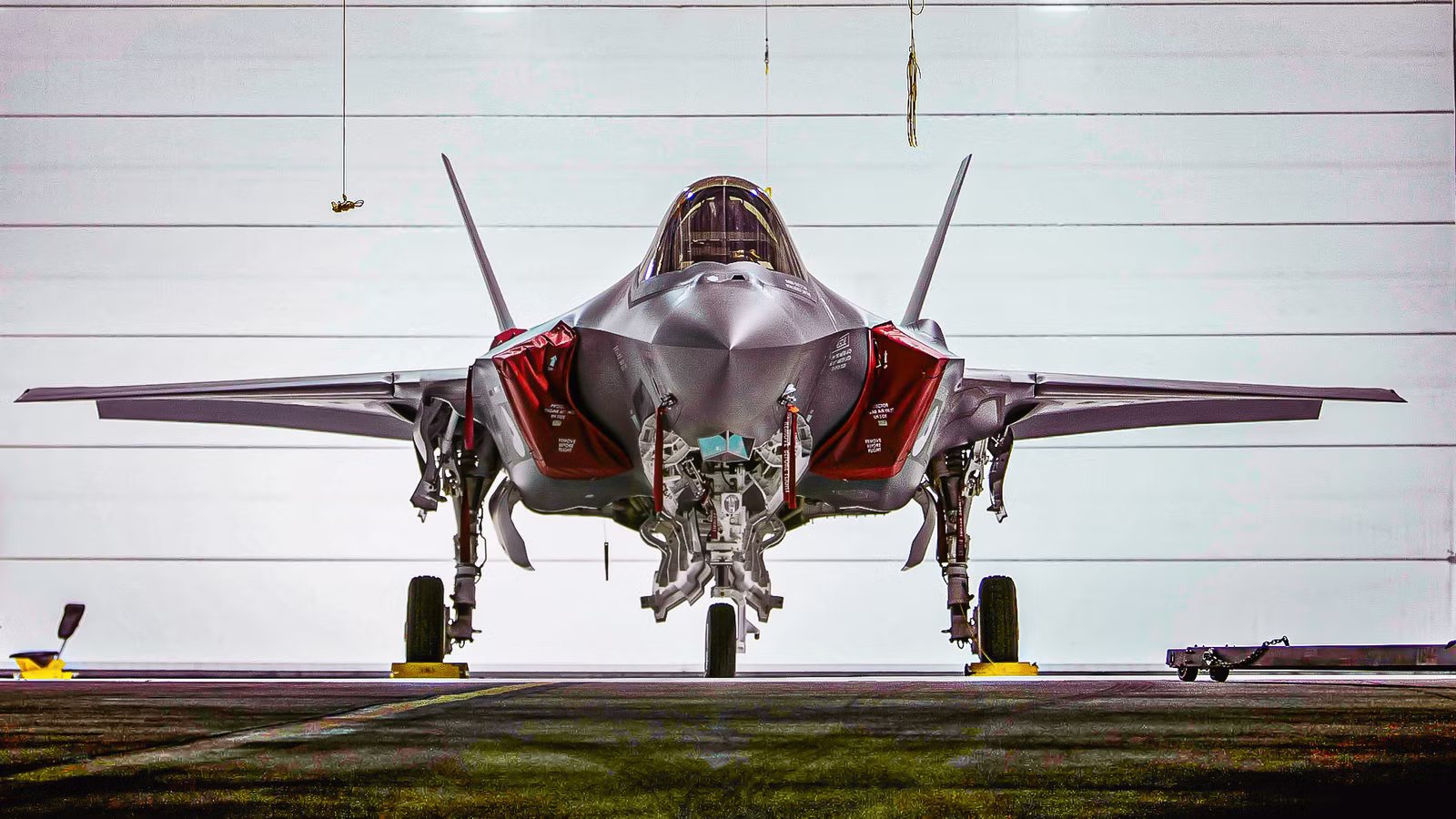
The Heat Issues With The Harrier

The Harrier family was notorious for its exhaust being so hot and concentrated that it could severely damage flight decks, runways, and the aircraft itself. This limited where and how long the aircraft could hover and made it more difficult to use in hot climates and when carrying heavier loads. This also contributed to increased maintenance burdens.
The Harrier vectored extremely hot engine exhaust downward through its rotating nozzles, generating a massive infrared signature, intense thermal stress, the ingestion of hot gases back into the engine, and more. The Harrier basically generated one downward giant hot jet blast from its Rolls-Royce Pegasus via four rotating nozzles. The F-35B produces a more balanced thrust spread out over the central LiftFan, the swiveling exhaust, and wing roll posts.
It is important to note that the F-35B did not completely solve the heat issues, as thermal management remains an issue for the jet. But it did dramatically improve them and make it possible to build a much larger STOVL aircraft with much greater weight and sophisticated electronics. The Harrier also had to balance on a single column of air, making it difficult and dangerous to land. The F-35B’s columns are much more stable.
The F-35B Replacement Of The Harrier

The British Aerospace Sea Harrier (the British variant of the McDonnell Douglas AV-8B Harrier II) became iconic in the 1982 Falklands War and performed well against Argentine forces. It was retired from the Royal Navy in 2010 (now replaced by the F-35B) and by the Indian Navy in 2016. The upgraded AV-8B II remains in service in the Italian Navy, Spanish Navy, and with the US Marine Corps.
That said, it is now in its twilight years as the Italian Navy is phasing them out and replacing them with the F-35B by 2028, and the Marines are expected to retire the last of their Harriers in 2026. The Marine Corps is completing its retrofit program of amphibious assault ships to carry F-35Bs. Going forward, the Marine’s fighter jet fleet will be composed of legacy F/A-18 Hornets and F-35Bs, with the Hornets being gradually phased out. The Spanish continue to operate the AV-8B and plan to sustain them into the 2030s with no clear replacement after ruling out purchasing the F-35B. The F-35B is a generational leap over the Harrier in many respects.
|
F-35B operators (per F-35.com) |
Entered service |
Remaining AV-8B Harrier operators |
Expected retirement |
|---|---|---|---|
|
US Marine Corps |
2015 |
US Marine Corps |
2026 |
|
Italian Navy |
2024 |
Italian Navy |
2028 |
|
Royal Navy |
2020 |
Spanish Navy |
2032 |
|
Japan Maritime Self-Defense Force |
2026 |
Not only is the fighter jet a stealth fighter and a super-sensing computer with a ‘god’s eye view’ of the battlespace, but it also has a massively larger payload capacity and a greatly extended combat range. Lockheed’s X-35 demonstrator completely outclassed the competing Boeing X-32 demonstrator when it came to STOVL demonstrations. Whereas the X-32’s system is described as an update of the older Harrier, the X-35 was revolutionary and relied on what test pilot Rowdy called the “17 Miracles.” These were made possible by the massive 48-inch diameter Rolls-Royce LiftFan.
Will Lockheed Martin Catch Up F-35 Delays In Time For The 2030 US Marine Hornet Replacement?
It seems that the Marines will be able to more or less transition to the F-35B and F-35C by 2030.
The F-35’s Improved Thermal Management

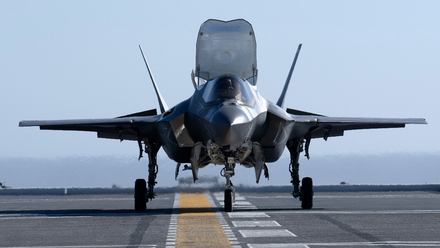
The F-35B mostly splits its lift generation between the rear swiveling exhaust nozzle and the large Rolls-Royce LiftFan behind the cockpit. With this method, the downward exhaust is cooler, the heat is spread out, hot gas recirculation is reduced, and the heat strain on the ship’s deck is reduced. This is not only beneficial for the ship, but is necessary for the F-35B itself.
It should be emphasized that the F-35B still has very hot exhausts that can sometimes be hotter at peak temperatures than the Harrier in some tests. It still causes deck heating issues, and amphibious assault ships have still required modifications, thermal coatings, and other measures to operate the F-35B.
Rolls-Royce is currently the only contractor that makes certain critical components for STOVL operations. Its LiftSystem is a descendant of the Pegasus engines and is comprised of the LiftFan, Driveshaft, 3 Bearing Swivel Module (3BSM), and Roll Posts. The F-35B’s F135-PW-600 engine and the Rolls-Royce LiftFan generate around 40,000 lbs of combined vertical thrust. The later AV-8B Harrier II variant’s F402-RR-408 engine generated around 23,500 lbs of thrust.
Thermal Management Is A Block 4 & 6th-Gen Challenge

The F-35B has vastly more electronics that could be damaged by heat than the old Harrier. This is true of all F-35 variants. Modern fighter jets like the F-35 are packed with powerful electronics (e.g., sensors, radars, electronic warfare systems, processors, computers). These create enormous amounts of heat that the aircraft needs to dispose of.
The ongoing F-35 Block 4 upgrade is providing a much more powerful electronic suite and is increasing the thermal issues. At the core of the F-35’s cooling system is Honeywell’s integrated Power and Thermal Management System (PTMS). Power generation and heat management are two of the key engineering challenges facing the current 6th-generation fighter jet programs. These are expected to dramatically increase the need for electricity, which will generate heat that, in turn, will need to be managed.
The contractor, Honeywell, says, “Our Power and Thermal Management System (PTMS) integrates a conventional auxiliary power unit, environmental control system and emergency power into a single system. On the F-35, the PTMS integrated power package delivers electrical power for the aircraft main engine start, auxiliary, and emergency power needs, while simultaneously providing thermal management of the aircraft heat loads.”

The Striking Differences Pilots Notice Between The F-35 Lightning II & F-22 Raptor
Explore how F-22 vs F-35 cockpit design, helmet tech & VTOL shape radically different pilot experiences in modern stealth fighters.
Lessons Learned From The F-22

Thermal management is an issue that affected the F-22 as well. The Raptor fleet was partially grounded in 2011 after hypoxia-like incidents where the pilots experienced dizziness, confusion, blackouts, and oxygen deprivation. The incidents were primarily due to issues in the Environmental Control System (ECS) and On-Board Oxygen Generation System (OBOGS). At the same time, the Raptor generates an enormous amount of heat from its avionics, radar, sensors, and computers. It took time to remedy the issue with modified pilot pressure garments, backup oxygen systems, and changes to the Raptor’s filters and airflow.
As the F-35 was designed after the F-22, it was able to benefit from lessons learned from the Raptor. This contributed to the development of the PTMS that better cools avionics and manages cockpit environmental conditioning. The F-35 was also designed with the knowledge that future upgrades would generate more heat that would need to be managed.
The F-22 may not be an F-35 predecessor in the sense that the F-35 replaced it (they perform complementary roles), but it is a predecessor in the sense that it was developed around a decade earlier. Heat management is far from the only lesson the F-35 was able to learn from the Raptor. Another major improvement aided by the F-22 has been to the F-35’s radar-absorbent materials (RAM) or “stealth paint.” These are far more durable and easier to maintain and upgrade.
Thermal Management & 6th-Gen

While many headlines focus on the stealth, speed, combat cloud, MUM-T, and sometimes tailless features of 6th-generation fighter jets, one of the biggest engineering challenges and bottlenecks is heat management. Upcoming aircraft like the Tempest/GCAP and the F-47 are required to handle more heat loads than today’s 5th-generation fighter jets while also preserving infrared spectrum stealth.
Many in the aerospace industry consider thermal management as important as thrust, stealth, and aerodynamics. In engineering, many of the core challenges are what many people may consider mundane issues, and issues they would never think of. The US Navy’s F/A-XX and the troubled Franco-German FCAS 6th-generation fighter jets (which is to have a French carrier variant) also need to solve the exhaust problems for its carrier-based operations. That said, they are not expected to be STOVL aircraft.
Already, the F-35 is pushing the limits of onboard cooling, but the 6th-gen jets are to dial it up. These aircraft will combine extra powerful radars, larger sensor suites, advanced EW systems, AI-assisted computing, lasers, more powerful engines, more electric generation, and more. If WWII fighters can be compared with flying tractors with machine guns, 6th-generation fighter jets will be flying overheating smartphones that need to hide their heat signature from thermal cameras. They are to be flying computer command centers that happen to carry missiles.