dailynewsnblog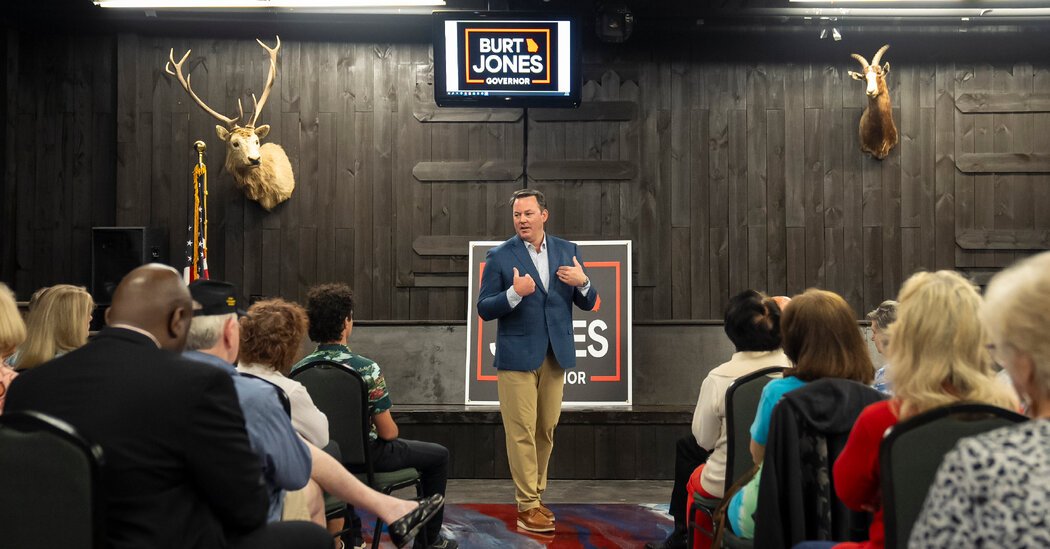
Burt Jones, the Republican front-runner in the Georgia governor’s race, presents his considerable efforts to overturn Donald J. Trump’s election loss in 2020 as a badge of honor.
On the stump, he even boasts about it.
“You’ve got to think back to who was standing up — who was in the ditch, in the foxhole — with everybody when we were fighting in 2020,” Mr. Jones told a crowd recently while campaigning inside a gun store in suburban Atlanta.
Last week, Mr. Jones, with the help of an endorsement from President Trump, was the top vote-getter in the first round of Georgia’s Republican primary for governor. He now faces a June 16 runoff against Rick Jackson, a brash, pro-Trump billionaire.
But Mr. Jones still carries the baggage — or as some would have it, bragging rights — from the presidential election of six years ago, when there were few state officials who played more important roles than Mr. Jones in the efforts to keep Mr. Trump in power.
The New York Times reviewed the lengths to which he went, drawing on thousands of files from state and federal investigations, including public documents as well as leaked discovery material produced in the failed Georgia criminal case against Mr. Trump and his allies.
Taken together, they show that in the weeks after the election, Mr. Jones, then a state senator, coordinated with the Trump campaign and was even in contact with Mr. Trump himself, who would proclaim during a 2020 rally that Mr. Jones was “in my pocket.”
Mr. Jones tried to organize a special state legislative session to overturn Mr. Trump’s electoral loss. He helped arrange public hearings in the State Senate, where Rudolph W. Giuliani demonized Atlanta election workers and advanced false claims that the election had been stolen. He joined a fake Electoral College contingent from Georgia that sent its false votes to Washington as part of a multistate effort to try to derail the certification of Joseph R. Biden Jr.’s victory. He backed Texas litigation challenging his own state’s election results.
And on the eve of the Jan. 6 Capitol riots, he traveled to Washington for an audience with Vice President Mike Pence.
Mr. Jones’s efforts were noticed at the highest levels of the Trump campaign. On Nov. 30, 2020, Josh Findlay, a Trump campaign lawyer, wrote an email to Bill Stepien, the head of the campaign, and other top officials.
“Senator Jones wanted the campaign to know that there is a group of legislators” who “will do whatever it can to make this productive for the President,” he said.
If elected governor, Mr. Jones would join several Republican governors who are 2020 election deniers just as the Trump administration is using the Justice Department to seize 2020 ballots and revive old conspiracies.
Mr. Jones’s campaign declined to answer a list of detailed questions for this article. In a brief phone interview, Mr. Jones chuckled and asked if the article would be “a little fluff piece about what a wonderful person I am.”
He added: “I don’t have anything to hide.”
Early Aboard the Trump Train
Mr. Jones was an early loyal supporter of Mr. Trump. He jumped on board in 2015, when many thought that a man known more for “The Apprentice” than for politics would flame out.
“I just said, ‘Nah, guys, I think you’re wrong on this one. This guy is getting traction,’” Mr. Jones said in a December 2015 interview.
After the 2020 election, Mr. Jones cemented his role as a Trump supporter who would not accept the president’s defeat.
In texts the day after the election, he wrote to David Shafer, the chairman of the state’s Republican Party at the time, excoriating Brad Raffensperger, who as secretary of state was overseeing the vote count. “What in the hell is SOS doing????” Mr. Jones wrote.
The situation grew more tense as Mr. Trump amped up his unsubstantiated claim of a stolen election. There was vigorous pushback from some state Republicans, including Gov. Brian Kemp, Lt. Gov. Geoff Duncan and Mr. Raffensperger.
But Mr. Jones attacked the state’s Republican leaders, including Mr. Duncan, for asserting — accurately — that there was no credible evidence of widespread voter fraud.
“Unleash the POTUS on him,” Mr. Jones texted to a Trump campaign official on Dec. 1, 2020. “His ass needs to be brought down a notch or 4 spots.”
Mr. Trump indeed attacked Mr. Duncan, calling him, among other things, “a RINO Never Trumper.” (Mr. Duncan, now a Democrat, was also a candidate for governor this year but lost in the May primary.)
Giving Giuliani a Hearing
Mr. Jones and some other state lawmakers began agitating for a special session, part of a Trump campaign contingency plan to have swing-state legislatures override the results. Mr. Jones was in communication with the Trump team, including Bill White, a Trump donor, about the strength of support among state senators, according to an email from Mr. White.
In a call on Dec. 7, 2020, Mr. Trump pressed David Ralston, then the speaker of the Georgia House, to hold the special session, telling him, “Burt Jones is very much on our side.”
That month, records show, Mr. Jones also worked closely with Trump allies in preparation for legislative hearings, during which Mr. Giuliani and other Trump allies aired false claims about the election. One fixation was video of ballot counting from inside State Farm Arena in Atlanta that Trump allies falsely claimed showed evidence of chicanery.
“As they used to say over at the University of Georgia, the eye in the sky doesn’t lie,” Mr. Jones said during a hearing.
The state’s Republican leadership debunked that conspiracy theory. And later, in a successful lawsuit brought against him by two Atlanta election workers, Mr. Giuliani acknowledged that claims he had made about them were false, but said in court documents that he had relied on information Mr. Jones had provided.
Mr. Jones and other state lawmakers even filed an amicus brief supporting Ken Paxton, the Texas attorney general, who had unsuccessfully asked the Supreme Court to prevent Georgia, Michigan, Pennsylvania and Wisconsin from casting their legitimate Electoral College votes for Mr. Biden. The brief asserted that at least 66,247 underage people in Georgia had illegally voted — a claim that dissolved under scrutiny.
A Fake Electors Plot
Simultaneously, Mr. Jones worked on assembling a slate of fake electors to potentially replace the real ones. On Dec. 11, he texted Mr. Shafer, the state party chair: “So if we send a slate of delegates up to DC….. they can object to one over the other?” he asked.
Mr. Shafer responded: “The Congress is the judge.”
Later, Mr. Jones asked a former Republican state representative, Susan Holmes, if she was attending a Dec. 14 meeting of fake electors, according to a 2024 deposition of Ms. Holmes that was taken as part of an election interference investigation.
She explained in the deposition that she did not attend “because Trump hadn’t won.”
Mr. Jones considered serving as a fake elector, text messages show.
At one point, he said to Mr. Shafer, “I am not there yet….. I need to weigh everything out.”
He asked Mr. Shafer to talk with his father, Bill Jones, a wealthy businessman. He noted that his father was a lawyer. “Talking to him now,” Mr. Shafer replied.
Mr. Shafer, in a text message to The Times, said that he did “not recall the conversation in any detail” but said he would have told the elder Mr. Jones that, on the advice of the party’s lawyers, they were seeking to preserve the president’s legal options.
Ultimately, Mr. Jones served as a fake elector.
On Jan. 5, a Washington Visit
Weeks later, on Jan. 3, at 11:07 p.m., White House phone logs show that Mr. Trump had a three-minute conversation with Mr. Jones. What they discussed is not known. On the morning of Jan. 5, Mr. Jones sent a text to a person whose identity is not clear from the records obtained by The Times. “I am in DC, where are you today?” Mr. Jones wrote.
The reply: the Willard Intercontinental Hotel, which had become the working headquarters for members of the election-denial movement, including the conspiracy theorists Alex Jones and Roger J. Stone Jr.
“Be there in 20,” Mr. Jones replied.
That night, he went to a dinner at Vice President Pence’s residence, where he had intended to present a letter asking Mr. Pence to delay the Electoral College vote count for 12 days to allow for a more thorough fraud investigation.
Mr. Jones told The Atlanta Journal-Constitution that he decided not to hand over the letter after he read Mr. Pence’s “body language.” He told a local radio reporter that he “saw the writing on the wall.”
During the Capitol riots the next afternoon, Mr. Jones, back in Georgia, declared in a text message, “Well everything has officially gone off the rail.”
Not Giving Up
Mr. Jones would remain a true believer, even as Republican leaders in the Georgia legislature stripped him of a committee chairmanship for his efforts to overturn the election.
“All they did was liberate me, and make me want to go at it harder,” he recounted later in an interview.
Indeed, in June 2021, he and other pro-Trump Georgia officials went to Maricopa County, Ariz., on what Mr. Jones called a “fact-finding mission” to observe a controversial audit of the vote directed by the Republican-controlled State Senate.
In 2022, Fani T. Willis, the district attorney in Fulton County, Ga., sent Mr. Jones a letter warning that he might be indicted as part of a sprawling investigation into election interference. A judge eventually blocked Ms. Willis, a Democrat, from bringing a case against him, arguing that she had a conflict of interest. (A state official who later reviewed the case decided against charging Mr. Jones.)
Though Mr. Jones’s ironclad pro-Trump résumé should help him in the Republican runoff next month, it could drag him down in a general election as voters are unhappy about soaring inflation and the unpopular war in Iran.
But a contingent of Mr. Jones’s supporters are true believers, too.
Barbara Shoaf, a retired Delta employee, was one of roughly 50 people to show up at his gun-shop campaign event. She believed that the videos of ballot counting showed something illegal. It felt like a caper to be solved.
“I like watching a lot of mysteries and things,” she said.
Andrew Chavez and Duy Nguyen contributed research.